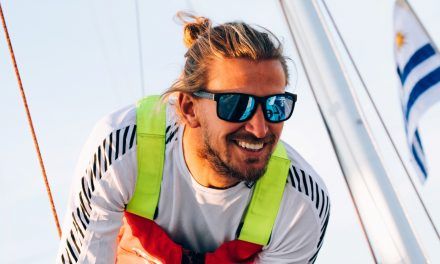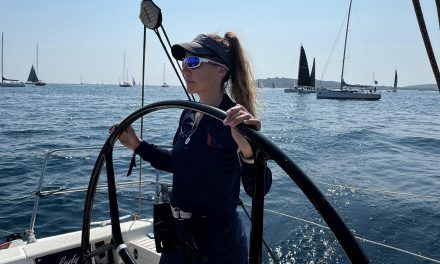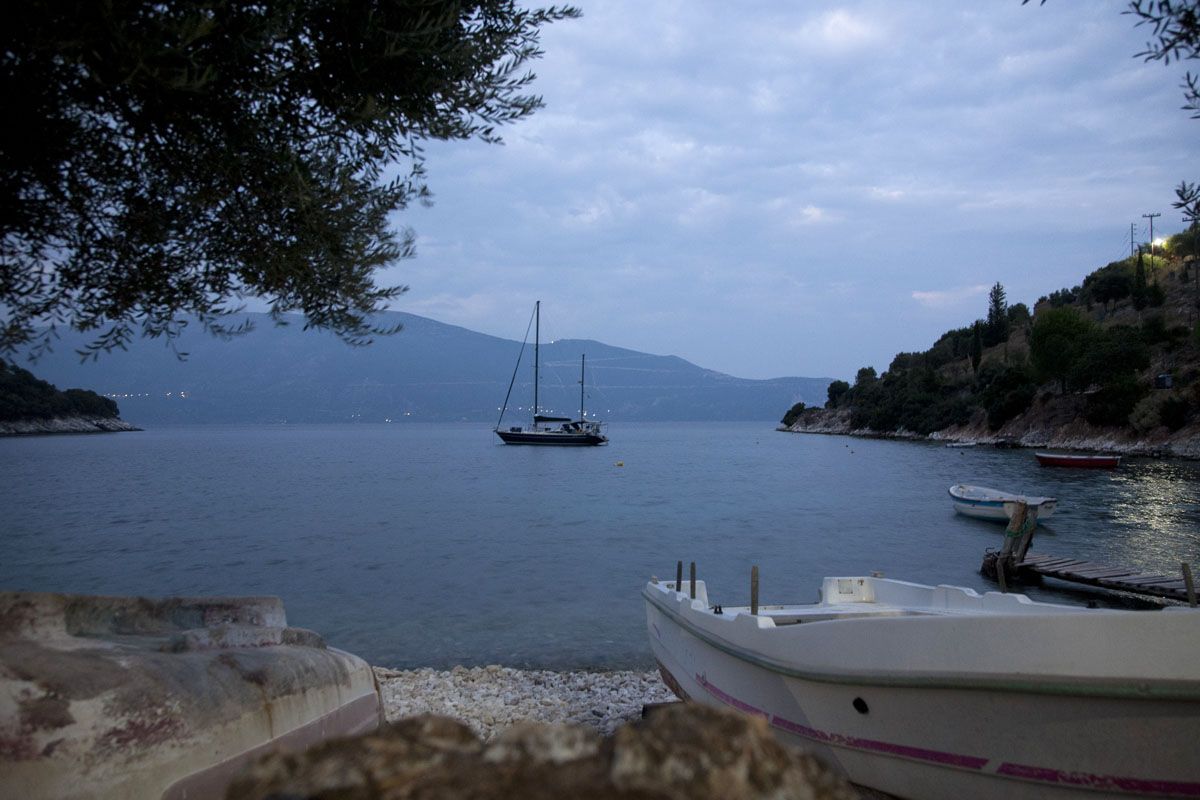
Image: “La Maga 3” at anchor
Ana Capsir, from Valencia, has been many things throughout her life. She began as a biologist, working for seven years at the CSIC (Spanish National Research Council), where she earned her doctorate in plant biochemistry. At the same time, living so close to the sea, she dedicated herself to observing it and watching ships sail. She enjoyed what she saw so much that she decided to put her biology career on hold to pursue a professional career in sailing. She is a certified skipper in the merchant marine.
She worked for a time on the schooner Tirant Primer, the Valencian Regional Government’s training ship, and also participated, with her own sailboat, in the TVE program “Corsica Salvaje” (Wild Corsica) from the series “Al filo de lo imposible” (On the Edge of the Impossible).
At a certain point in her life, she discovered Greece and was captivated by everything she found there: the culture, the food, the history, the people, and above all, sailing among its thousands of islands. She began spending extended periods of time there, and today she resides for much of the year in a small village on an Ionian island, where she sails her boat, “La Maga Azul” (The Blue Magician).
Throughout this time, she has also been developing her writing career, contributing articles to the Huffington Post, various nautical magazines, and the Greek newspaper Aχμí.
For the past fifteen years, she has also been writing on her blog, “Sailing Through Greece,” where she explores this fascinating country, writing about different topics such as mythology, travel, ships, culture, gastronomy, and more.
In addition, she is the author of three books: “Mil viajes a Ítaca” (2017), “Navegando por el cielo” (2020), and the recently published “Retratos de mujer mirando al mar” In this latest book, she gives voice to six courageous women who, like herself, decided to pursue their dream of a life sailing, each for different reasons: pleasure, adventure, ambition, survival, defense, or the pursuit of glory. They all succeeded, including Ana Capsir, because, as she says, anything is possible if you do it with passion and conviction.
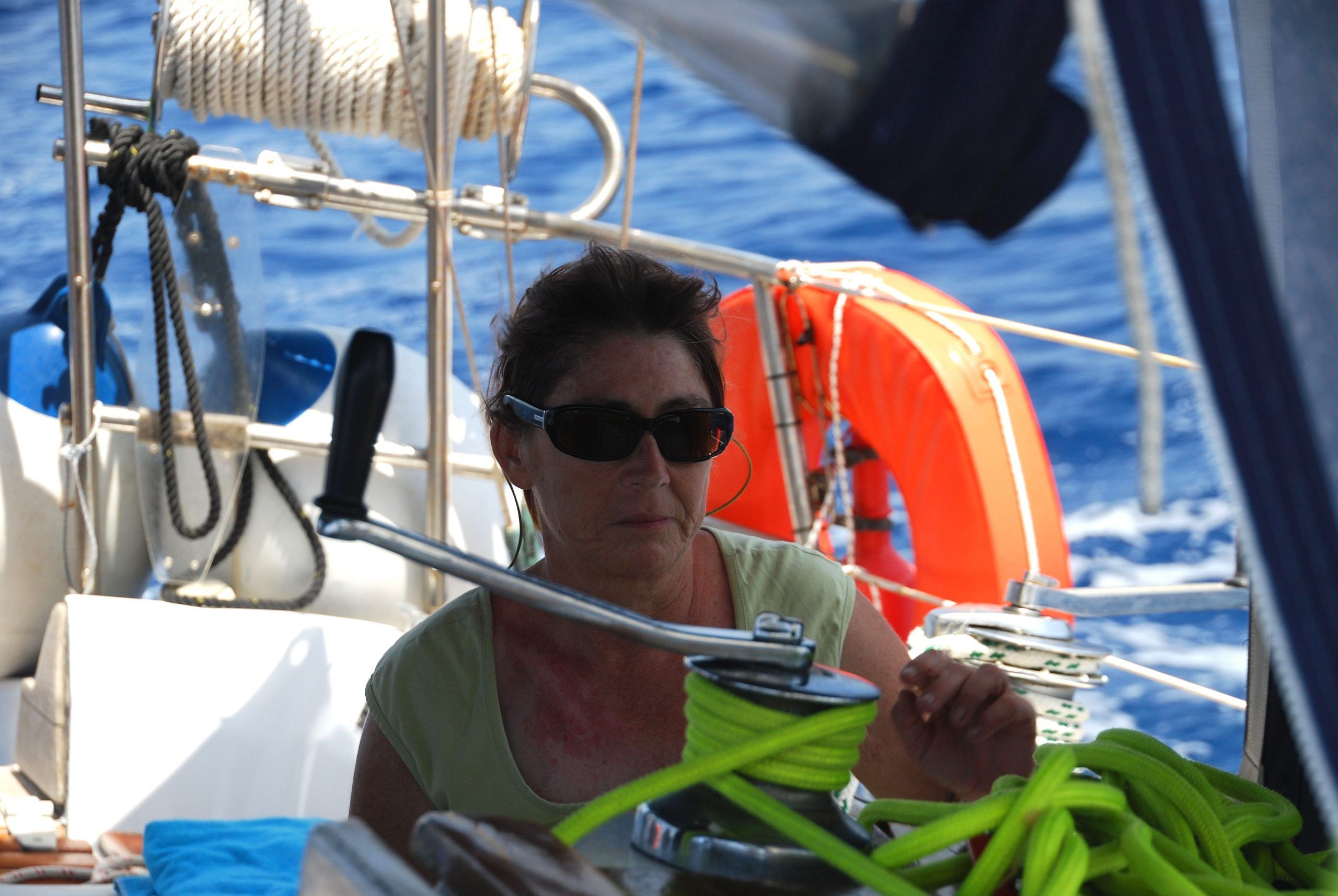
Image: Ana Capsir
Ana, what do you see in the sea and sailing that led you to decide to dedicate yourself to it professionally?
A seafarer’s career is one of the most interesting and comprehensive for a restless and curious person like myself. It demands mastery of so many fields that you end up seeing the world through thick and thin.
A captain must study physics and mathematics, meteorology and oceanography, astronomy, ship handling, law, first aid, languages… They have to know how to stow cargo, how a ship behaves at sea, and what constitutes a good design. They must be familiar with radio communication procedures and regulations. And, on smaller vessels, the skipper also has to be a bit of a plumber, electrician, carpenter, and repairman.
On the other hand, we sailors are obliged to be passionate about hydrodynamics and the lift of the hull profiles. To know that Eiffel didn’t just design a tower. To harness the winds with the correct trim of our sails and rigging, to achieve the best performance.
Is there a more diverse profession than that? If you also dedicate part of your work to teaching, as I do, you must delve a little deeper, because those who teach must first explain things to themselves. And the more you learn, the more you want to know.
What experience did you have as a navigator and what do you do to complete your training?.
As a child, I sailed dinghies, a fundamental way to experience sailing and the sea. Later, I moved into the world of cruising, traveling, chartering, transfers, maintenance, and teaching, especially aboard the Valencian Regional Government’s schooner.
First, I obtained the recreational yacht captain’s license, and then I earned my Master Mariner’s license. I had to study the same material several times, but I didn’t mind much.
How has your work as a professional navigator developed, and what has it consisted of?
As I mentioned before, my activity has focused on the world of sailing: chartering, nautical teaching, transfers, construction and maintenance of boats.
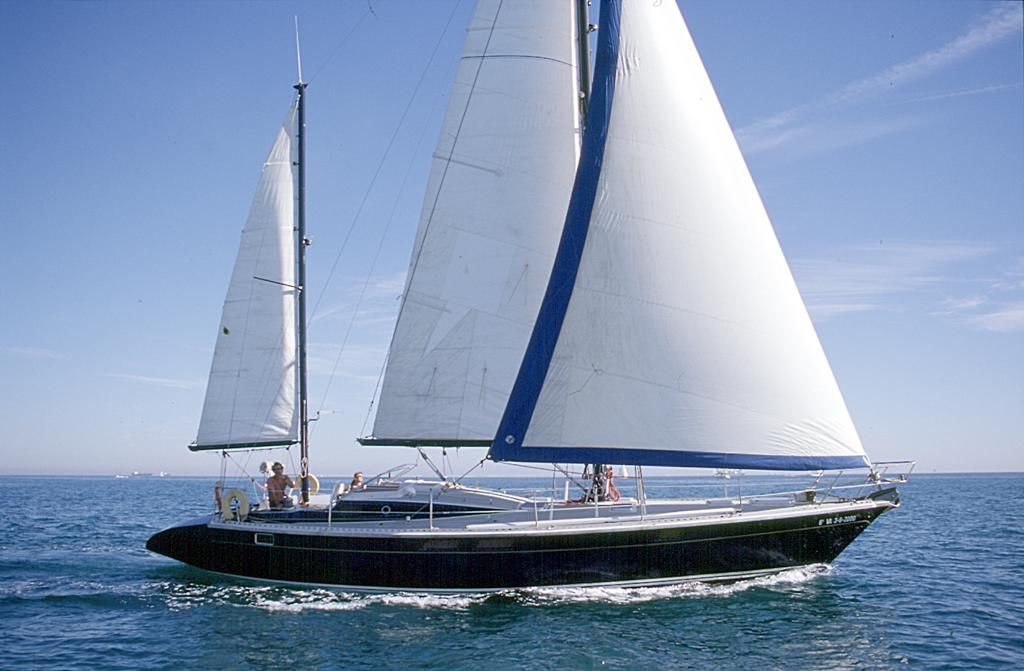
Image: “La Maga 3” sailing
When you decide to buy your own boat, what qualities do you think it should have?
I was sailing 470s at the time, and I decided to switch to cruising so I could travel and live on board. In fact, my husband and I lived on one of our boats for 10 years.
A good boat should be safe and comfortable at sea. I’m referring to the complete opposite of the boats being built now, which are focused solely on summer charters (flat hulls for racing, lots of cabins, and disproportionately large, open cockpits). Boats with V-shaped hulls handle waves better, even at the expense of performance, but you appreciate that on a long upwind leg.
I dislike the new production catamarans with their flybridges and booms several meters above the deck. I pity the skippers who have to sail them. In fact, you rarely see them sailing with the mainsail; I don’t even want to think about what it must be like to lower the sail so high up when something unexpected happens.
I prefer schooners and ketches, for aesthetic reasons and because of the convenience of having the flag spread out. La Maga Azul is a ketche.
What is it that you discover in Greece that captivates you to the point of living part of the year on an Ionian island?
Greece has always captivated us with its luminous past, its fundamentally maritime nature (it’s hard to lose sight of the sea; it will appear around every bend in the road, even if you try to avoid it), and its island character. It comprises nearly 6,000 islands and islets which, along with its gulfs, inland seas, and inlets, make sailing a true delight.
When we went there in the 1980s, we hadn’t intended to stay, but the country charmed us, and above all, we were captivated by the Greeks themselves. Their eccentric, self-governing, yet deeply supportive character reminded us of the Spain we had left behind with its progress and tourism. It was a truly unique country; there was no other like it.

Let’s talk about your latest book, “Retratos de mujer mirando al mar (Portraits of Women Looking at the Sea)”
What led you to write specifically about these six women and not others?
From my house in Lefkada, I can see Ítaca and Cape Dukaton, better known as Sappho’s Leap. There, a temple dedicated to Apollo once stood, where heartbroken, unrequited lovers would throw themselves into the sea to escape their torment.
The poet Sappho was a revolutionary woman for her time and an influential figure, even in the world of politics. For this reason, she was banished from her island of Lesbos and hated by many. It was Plutarch, in his “Parallel Lives,” who portrayed the Muse as a vulgar, superficial damsel, committing suicide at Cape Dukaton over unrequited love, quite far from Lesbos.

Image: Artemisia of Caría
Artemisia of Caría also met her end at the foot of the white cliffs of Dukaton. Supposedly, Artemisia, Queen of Halicarnassus, fell in love with a man named Dardanus. When he ignored her, she gouged out his eyes. Repentant, she had no choice but to commit suicide, and once again she chose Cape Lefkada. This time, it was a Byzantine writer and patriarch who spread the rumor.
When I went out onto the terrace in the morning, I would watch them leap, hand in hand, soaring over the valleys and silhouetted with clarity against the dazzling blue of the Ionian Sea. And I thought of Sappho’s words: “In the future, someone will remember us.” We remember Sappho through the fragments of her poems that have survived. But Artemisia inspired a more concrete vision in me, allowing me to interpret her as the woman dedicated to the sea that she was.

Image: Isabel Barreto
All the women who appear in the book are real and span a broad period of our history: from the Greco-Persian Wars (5th century BC) to the last century. This vast span of our civilization also runs parallel to the evolution of ship designs and navigation techniques. It’s a field that fascinates me, but one I haven’t explored in depth so as not to bore the reader.
I’ve also tried to touch on the various professions connected to the world of ships: warfare, exploration, trade, piracy, or simply the pleasure of sailing. Sometimes the boundaries aren’t very clear, because who wasn’t a pirate during wartime? Who wasn’t trading or exploring while simultaneously raiding or being raided?
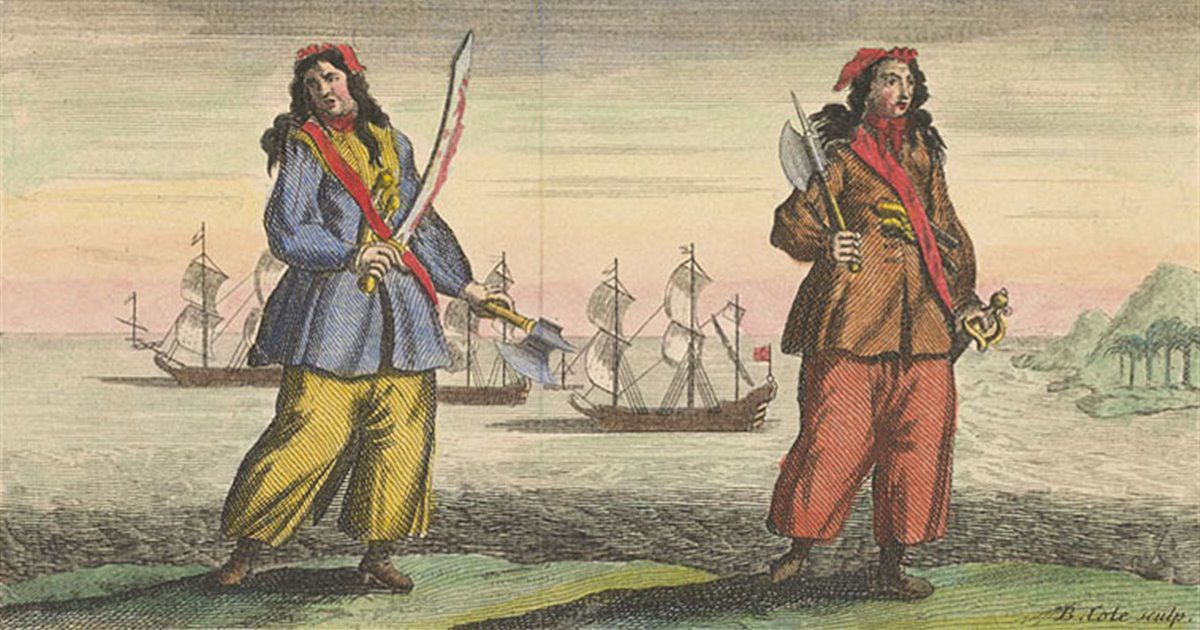
Image: Anne Bonny and Mary Read
The six women manage to live a life that was primarily intended for men and earn respect; how do they do it?
Not all of them succeeded. Some were shut down, or went down in history only as cruel, arrogant, or haughty women. It was their chroniclers who constructed the narrative. We will never know if it is true or biased, but what we do know is that a certain spirit is required to command a ship. Those same attributes, in the case of a male captain, are transformed into courage, discipline, and daring.
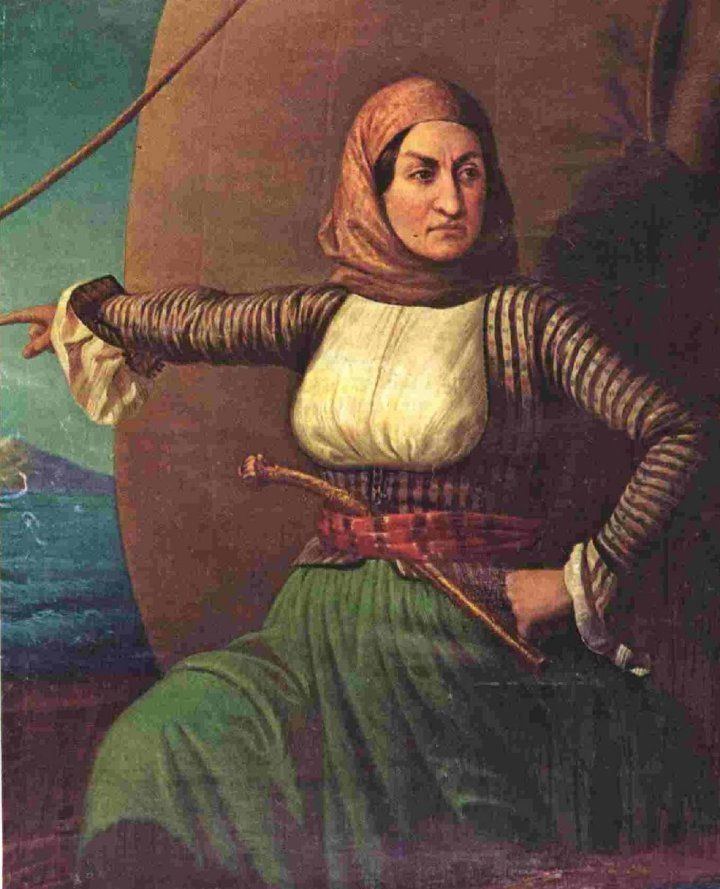
Image: Laskarina Bubulina
Almost all of them display a tough and often cruel personality.
Are they like this from the beginning, or do the extreme situations they experience during their voyages cause them to develop a survival instinct that makes them ruthless?
I believe that the sea and commanding a ship, or a fleet, in extreme conditions require a certain strength of character and personality, and that can be interpreted as cruelty or arrogance. What’s surprising, in cases like Isabel Barreto’s, isn’t that she made it, but that she made it alive.
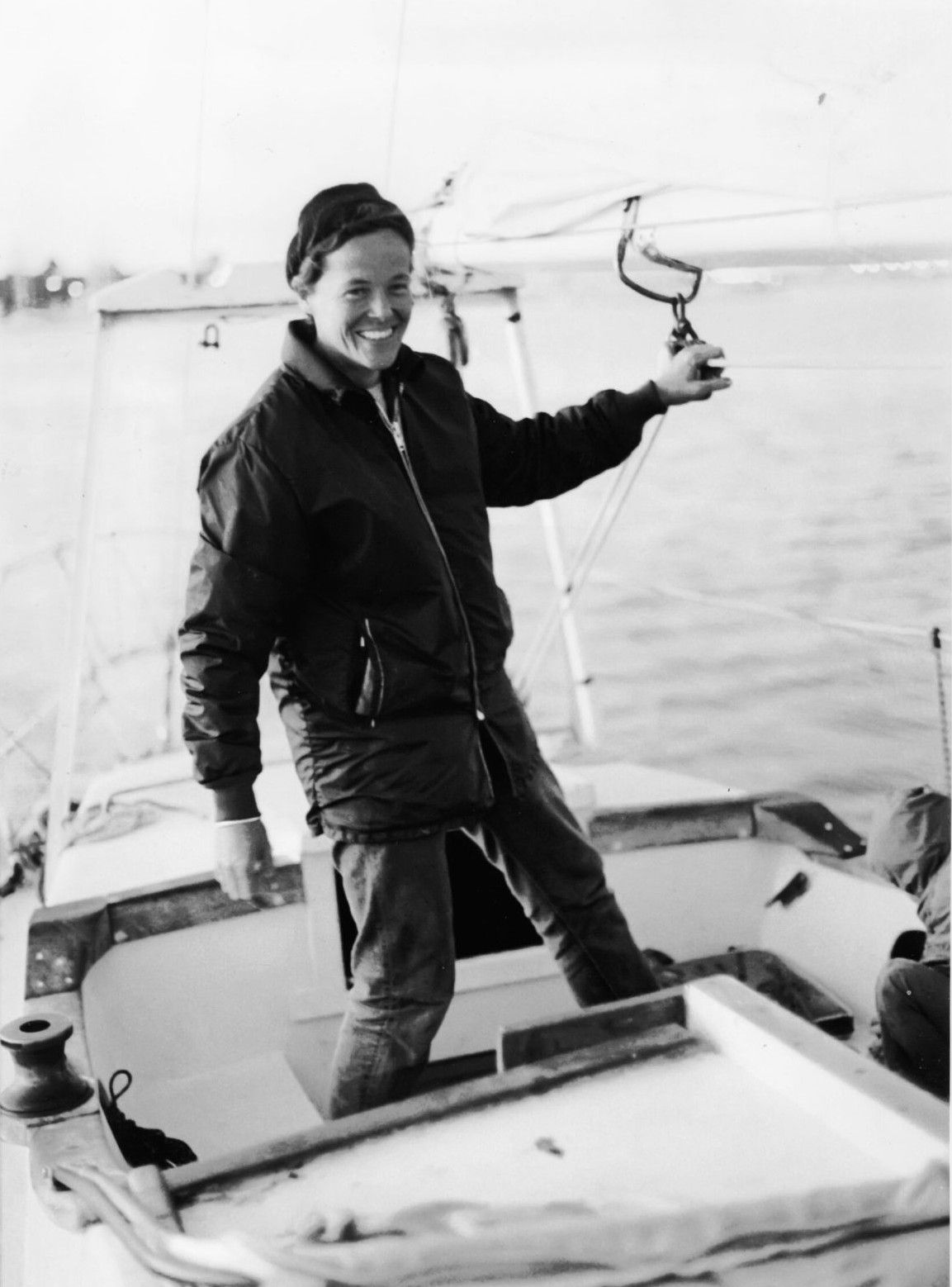
Image: Nancy Griffit
How has the involvement of women in the world of navigation evolved over the centuries?
Women have always been considered bad luck on board a ship. I believe this is now completely outdated, except in some narrow-minded people who aren’t worth paying attention to. So, it’s common to see women working at sea. This is also because women have discovered that life at sea is transcendent, despite the discomfort and danger, and that it’s worth dedicating their lives to it.
The fact that the sea has been a predominantly male world isn’t entirely the fault of men; we women have also played a significant role. There’s nothing worse than the prejudices or envy of other women who don’t understand your unconventional approach to life.
Today, many women sail and work professionally at sea; these are no longer unusual occurrences.
On large ships, with trained crews, the hierarchy and chain of command are fully understood. Insubordination towards the captain, whether male or female, is considered a very serious offense and is punishable by law. The problem arises on small boats used for pleasure cruising, where the captain’s role is less clearly defined. Any Tom, Dick, or Harry who’s obtained their recreational boating license, or read a couple of books, dares to question you, challenge you, and tell you how you should proceed, maneuver, or behave. A maritime career requires restraint and patience. I’m still trying, but I don’t always succeed.
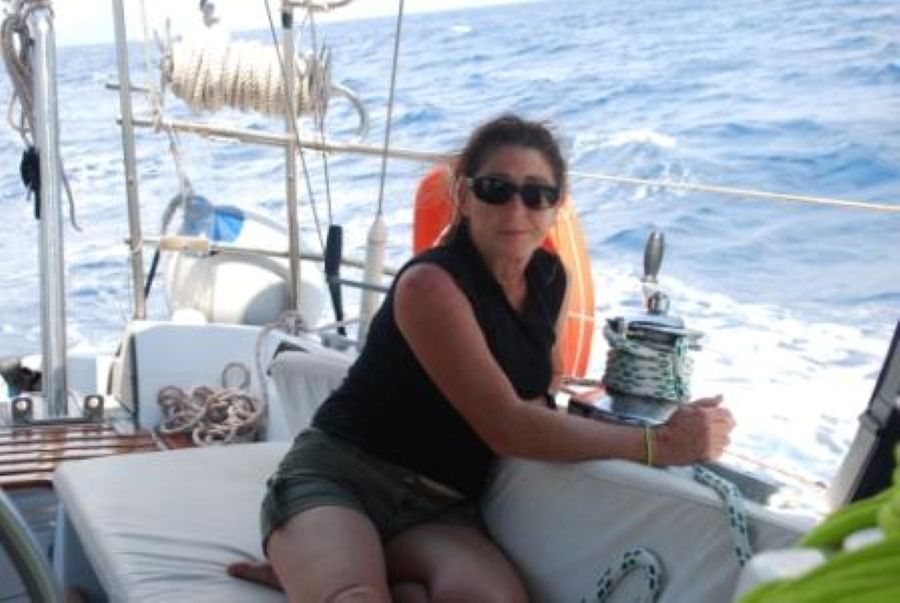
Image: Ana Capsir
Finally, Ana, how do you see your future? What are your plans?
Travel, sailing, a new book in mind…?
I just retired, and that word comes from jubilation. But that doesn’t mean I’m going to stop sailing, only that I’m going to stop earning a living that way. I’ll continue sailing the seas with La Maga and writing. Writing is a way to learn and remember. To remember literally means “to pass through the heart again.” So I’m retiring with jubilation, but with good memories, because I have a heart.
You can follow Ana Capsir’s interesting articles on her blog through the following link:
From “Navegantes Oceánicos” we thank Ana Capsir for sharing her experiences with our readers in this interview and for presenting her engaging book, “Portraits of Women Gazing at the Sea,” a publication we hope will be a great success.
We also wish Ana fair winds and much luck in her upcoming voyages and projects.