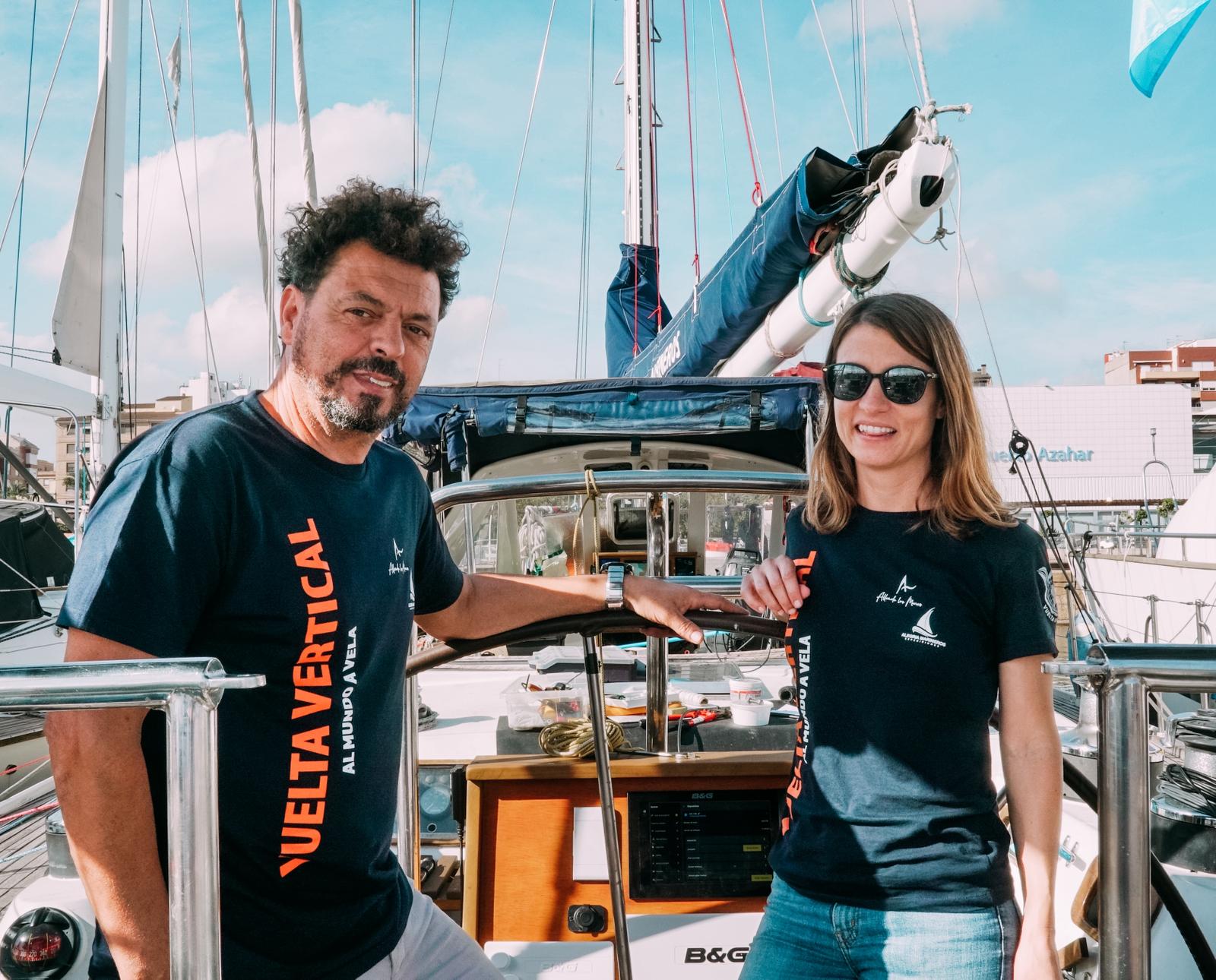
The Vuelta Vertical sailing trip is now underway
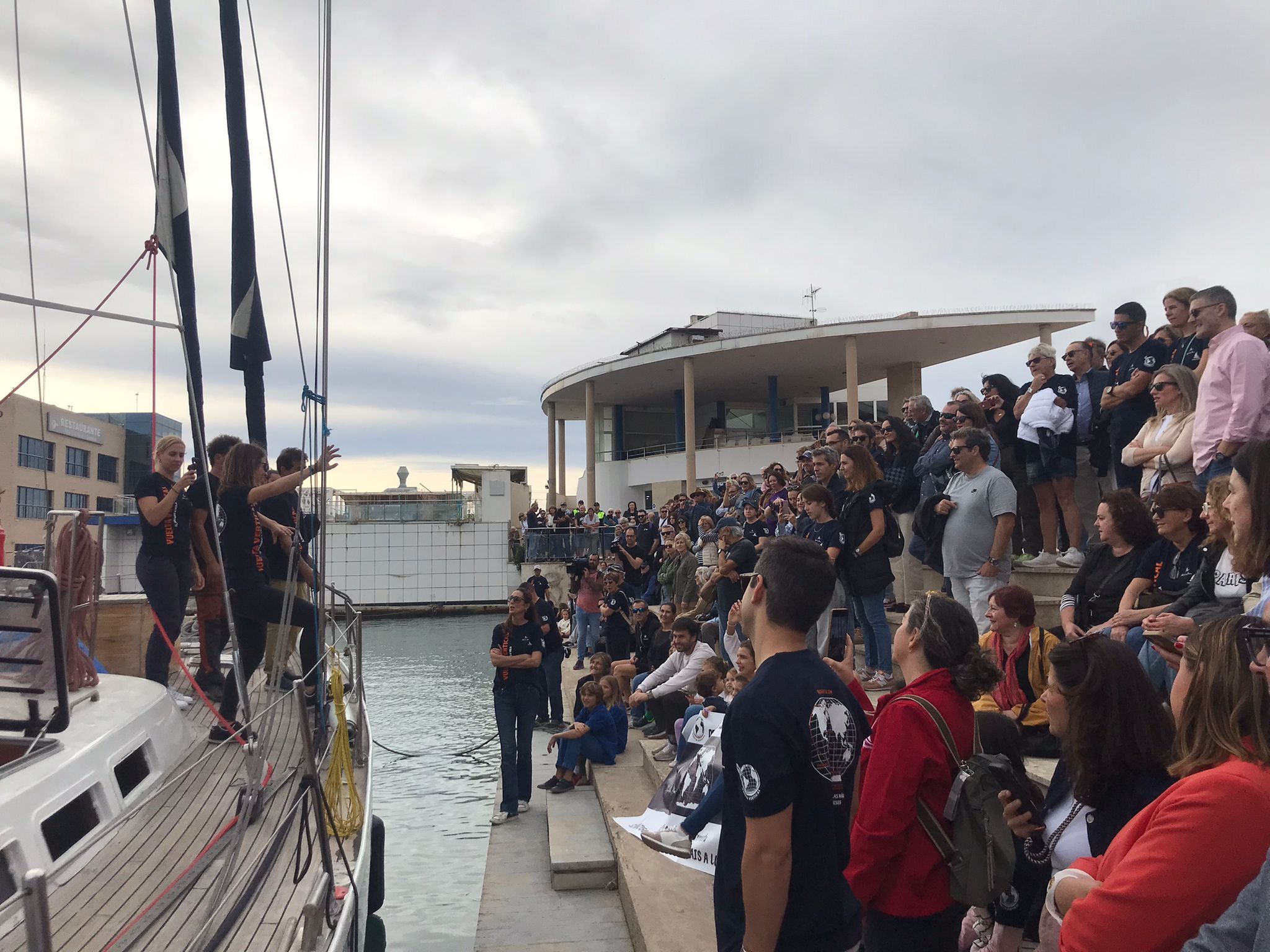
- Flanked by several vessels that escorted it to the open sea, the sailboat “Alegría Marineros” has set sail with Paula Gonzalvo and Pedro Jiménez as captains.
- Thus begins twelve months of unprecedented navigation to circumnavigate the globe, linking the two poles; the first leg will conclude at the end of December in South America.
CASTELLÓN | 15 NOVEMBER | COORDINATES 39°57′ N 0°1′ O
The Vuelta Vertical voyage, an absolutely historic sailing expedition along the route chosen to circumnavigate the globe, is now underway. This Saturday at noon, the sailboat Alegría Marineros, captained by Paula Gonzalvo and Pedro Jiménez, set sail from the port of Castellón. A tremendous challenge lies ahead: to cover more than 35,000 nautical miles in 12 months of sailing, first descending to the Antarctic Circle, then ascending to the Arctic, circumnavigating it, and finally returning to the Iberian Peninsula. This route, never before attempted, can also be followed online through the official website vueltavertical.com.
At 1 p.m., next to the Royal Staircase of the Port of Castellón, the sailboat began its departure maneuvers, under the watchful eyes of invited local authorities, who are collaborating on the expedition. In the first few miles, the Alegría Marineros was escorted by several vessels that responded to the invitation issued by the Royal Yacht Club of Castellón, on a day described as “historic” by the collaborating institutions.
On land, in addition to the captains’ families, friends, and expedition members, numerous people followed the maneuvers, drawn by curiosity and joining in the midday celebration. The Castellón Model Making Association also participated with an exhibition of model ships in the port area.
First leg across the Atlantic.
Thus began the first of the six stages planned for the Alegría Marineros, a voyage exceeding 65,000 kilometers, equivalent to nearly one and a half times around the Earth. This stage is expected to conclude on December 26 near Mar del Plata, Argentina. Until then, they will sail 6,000 nautical miles across the Atlantic Ocean in 45 days. They will cross the equator for the first of two times during the expedition.
After a 10-day rest stop at this first port of call, the second stage will begin on January 5 and continue until April 9, covering 12,000 nautical miles and 89 days of continuous sailing. This second stage, from Mar del Plata to Valdivia, Chile, will circumnavigate Antarctica, where, in addition to the dreaded icebergs, they could encounter storms and hurricane-force winds exceeding 60 knots.
That second stage will undoubtedly be extremely demanding and will test both the endurance and strength of Paula Gonzalvo and Pedro Jiménez, as well as the modifications made to the 21-meter-long, aluminum-hulled sailboat Alegría Marineros to reinforce it for sailing among ice.
Start of scientific prospecting work.
The Atlantic Ocean, which will be crossed during this first stage of the Vertical Loop, is the first of the five oceans (all of Earth’s oceans) that the expedition will traverse. It will also be the first in which Paula and Pedro carry out the scientific work that forms part of this Vertical Loop and makes it so incredibly special, beyond its adventurous and pioneering nature.
It’s worth remembering that, among other things, they will be recording underwater noise and measuring various physicochemical parameters in the oceans, as well as analyzing the presence of microplastics in polar waters and collecting samples of marine biodiversity using what is known as environmental DNA. A complex system of physicochemical probes and a powerful computer in a “science cabin” will allow for the proper processing of all the data obtained.
It is also anticipated that access to the data obtained will be as rapid as possible and shared with various academic institutions (such as, among others, the University of Alicante, the Ramón Margalef Multidisciplinary Institute, UCN, the UN Decade of Action for Oceans, and True World). Furthermore, the idea is that this data will be used for an educational project called Ocean Classroom, which aims to bring this scientific work to schoolchildren in participating schools or those that express interest in the initiative.
It is no wonder that César Bordehorde, a researcher at the University of Alicante and science communicator, recently described the Vertical Loop as “a true gift for science.” It is also a gift for all lovers of extreme sailing, who will be able to experience it live through the streaming broadcast. All of this undoubtedly justifies the anticipation with which the moment of its departure from the Port of Castellón was experienced this Saturday.
FOR INTERVIEWS OR MORE INFORMATION:
SARA, ground communications support
comunicacion@vueltavertical.com
Tfno.: +34 614 379 580
From “Navegantes Oceánicos” all our support to Paula and Pedro in this great challenge and unprecedented ocean project that is the Vuelta Vertical.
Fear winds anf following seas !.