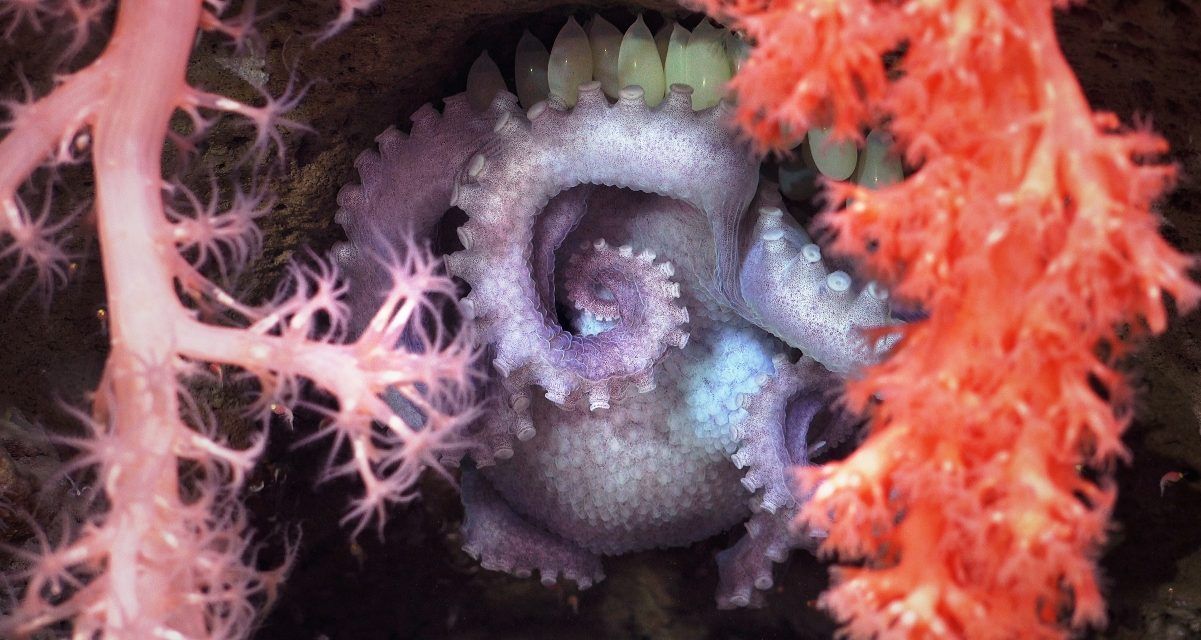
Hiding Octopus with Eggs. Image source: Schmidt Ocean Institute
Scientists from the Argentine Research Council (CONICET) dazzled the entire country with a live broadcast of an underwater expedition to the Mar del Plata Canyon oasis. This adventure, aboard the Schmidt Ocean Institute’s Falkor vessel with its robot SuBastian—a remotely operated vehicle capable of reaching depths of 4,500 meters—captivated a large part of the population with a series of master classes that brought together research and dissemination of marine science, with knowledge, depth, and, above all, a love for their work.
The expedition also led, perhaps like never before, to the discovery of some 40 previously unseen species and plants, which can now be studied on a new scale. These researchers say that everything collected will be useful, at least, for their next 10 years of research. The amazement at these discoveries, live and in person, also brought enormous joy to all the observers, but especially to the specialists who—on board the ship—spent three weeks, working different day and night shifts, to carry out the entire expedition.
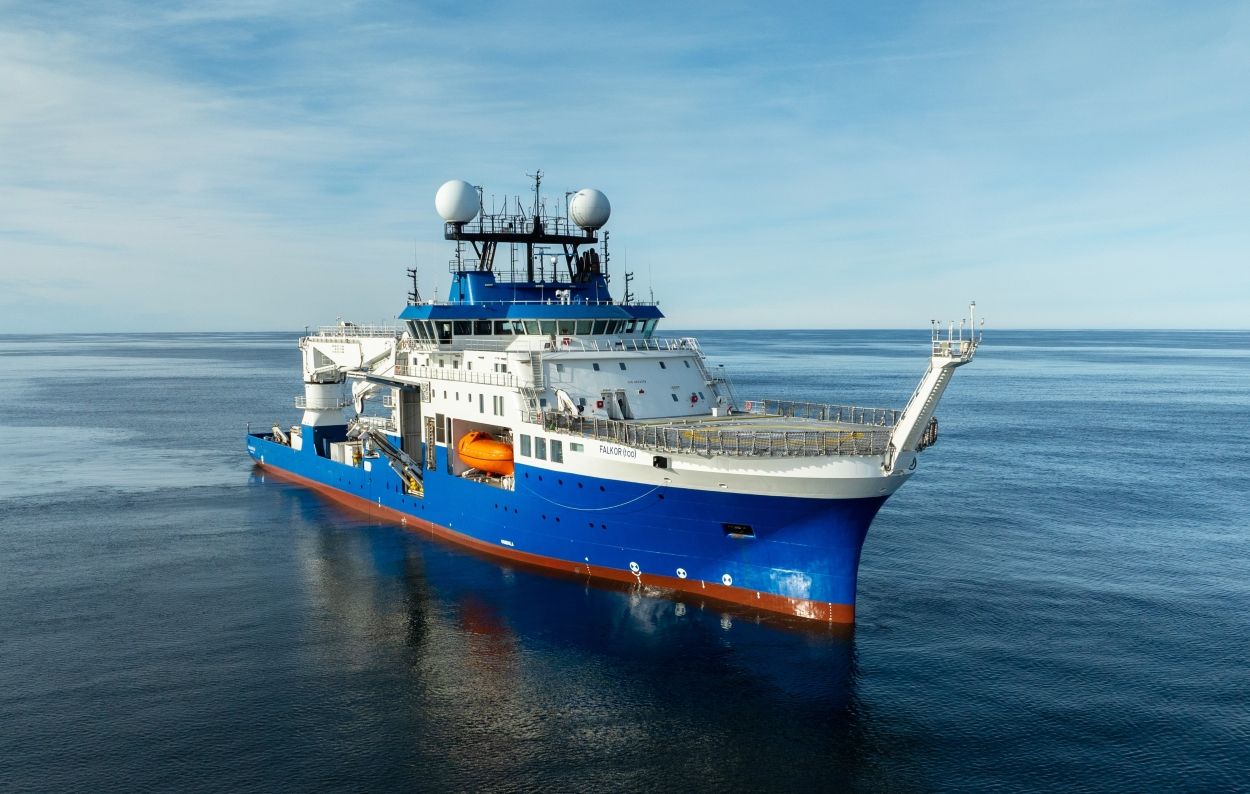
Falkor. Image source: Schmidt Ocean Institute
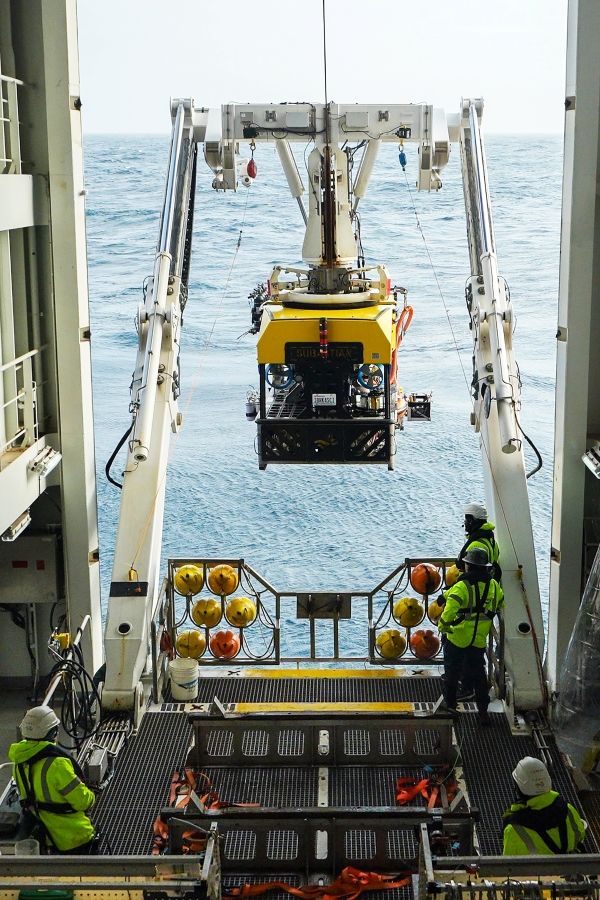
“Our underwater robotic research program includes a Remotely Operated Vehicle (ROV SuBastian) capable of depths of up to 4,500 meters and research for use on the R/V Falkor. The ROV is equipped with a suite of sensors and scientific equipment to facilitate scientific data and sample collection, as well as interactive research, experimentation, and technological development,” explained the Schmidt Ocean Institute.
In addition to all the interest it sparked in marine life, which led everyone from the New York Times to TV France to cover the topic, the expedition uncovered a serious problem: plastic pollution. It is estimated that between 19 and 23 million tons of waste are dumped into aquatic ecosystems annually.
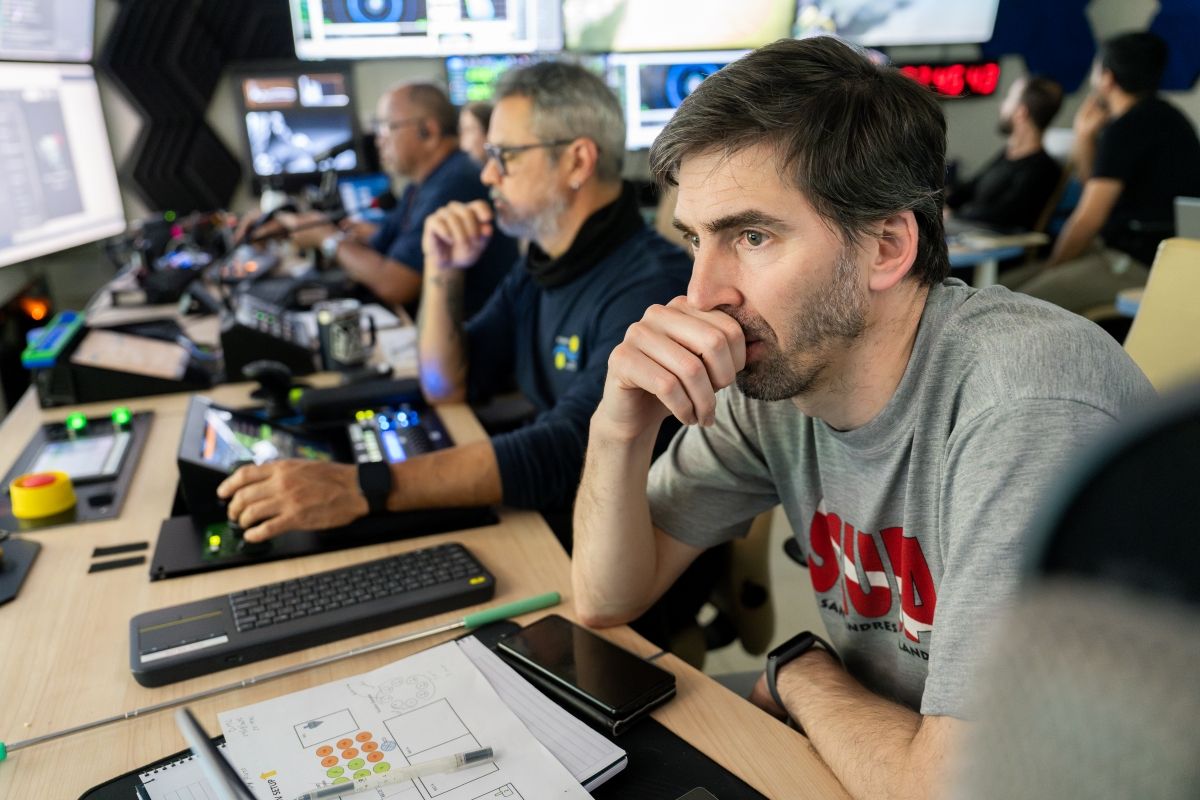
Chief Cientific Daniel Lauretta (CONICET) onboard Falkor. Source: Schmidt Ocean Institute
After the expedition in Argentina, the Schmidt Ocean Institute plans to begin a new voyage off the coast of Uruguay this Friday, August 22nd, to unravel the mysteries of the seafloor and its ecosystems: Uruguay SUB200.
The expedition, comprised of local scientists from various academic institutions in the country, as well as international specialists and researchers, will seek to generate knowledge about this marine biodiversity, documenting species and ecosystems that inhabit the depths, many of them still unknown.
Gustavo Villa, science journalist and broadcaster for TV Ciudad de Montevideo, the only media outlet that will be on board, spoke with Navegantes Oceánicos (Bluewater Sailors) about the expectations for this great adventure.
What is the expedition starting now in Uruguay about? Who is organizing it?
—The Uruguay Sub200 Expedition aims to directly investigate and observe, for the first time, the waters, the seabed, and the exclusive economic zone of Uruguay, between 200 and 3,500 meters deep, from south to north, from the maritime border with Argentina to the maritime border with Brazil. The voyage will include 37 scientists from six different countries, although the majority will be researchers from Uruguay.
What is the difference between this expedition and the one we observed in Argentina?
—This expedition, unlike the one carried out in Argentina, which focused solely on a geographical feature near the city of Mar del Plata, will explore seven canyons, some interesting subsurface sites, and archaeological sites such as a sunken Uruguayan warship. It will investigate what happened to the biodiversity that may have developed around that shipwreck.
It will also investigate the subsurface of the seabed, where emanations are produced, and the micro and macroscopic fauna of those depths. In addition to the fauna of the seabed, a group of experts on surface marine fauna will also be present. Finally, research will be done on water salinity and temperature, among other physicochemical parameters.
Is this the first time Uruguay has had an expedition of this nature, or has research already been done in this regard?
—No, it’s one of the first investigations being conducted. It will be a major interdisciplinary project that will generate enormous knowledge of the territory, which is virtually unknown except for small investigations conducted prior to this possibility, such as the Spanish ship that confirmed the presence of cold-water corals in Uruguay’s continental waters.
ROV SuBastian. Image source: Schmidt Ocean Institute
What are your expectations and what are the main searches? Especially considering the phenomenon the expedition sparked in Argentina, due to the number of views and the public’s following of the song through streaming.
—The expedition’s expectations, basically, are to record, visually and with all the instruments this ship has, in addition to SuBastian, the entire area to be explored. Today, we have maps, but not the details that will be achieved after this experience, such as the details of the seafloor relief. We also hope to see how the clash of the warm currents from Brazil and the cold currents from the Falkland Islands, which clash off Uruguayan territory, interact in the region’s diversity.
In addition, we hope to gain insight into biodiversity and, in some cases, gain valuable information on the impact of certain fishing practices. In other words, there are many assumptions, but few are known for sure, so there is so much to explore.
What will the expedition be composed of and how long will it last?
—The campaign will run from August 22 to September 19, 2025. The initial plan is to explore 50 points of interest within an area limited to the north by latitude 34°71′, to the south by latitude 37°28′, to the east by longitude 51°41′, and to the west by longitude 54°20′. The depth distribution of the stations covers a wide range of depths, from -3,073 meters to -143 meters. That is, it extends from the border with Argentina to the south and with Brazil to the north.
Who are the members and what will the crew be like?
—There are 37 experts in different fields of knowledge who will participate in the expedition, led by Leticia Burone, PhD in Marine Geology, and Alvar Carranza, PhD in Biodiversity and Conservation. The principal investigators are Fabrizio Scarabino, Claudia Piccini, Beatriz Yannicelli, Juan Pablo Lozoya, and Javier Sellanes. The boat has a capacity for 25 people, so there will be a changeover on September 5th, and a total of 37 scientists will participate.
The participation of Alejandro Balbis, a musician—not the usual one in these cases, although it has happened on other occasions—was also coordinated. He is very popular in Uruguay, with a presence in Candombe and the local carnival. Another interesting aspect of this expedition is that a science journalist, in this case me, will be participating in the mission. He is interested in research. That’s why we’re also going to broadcast from the ship for the program Sobreciencia, which is broadcast on TV Ciudad, the public channel of the Montevideo City Hall.
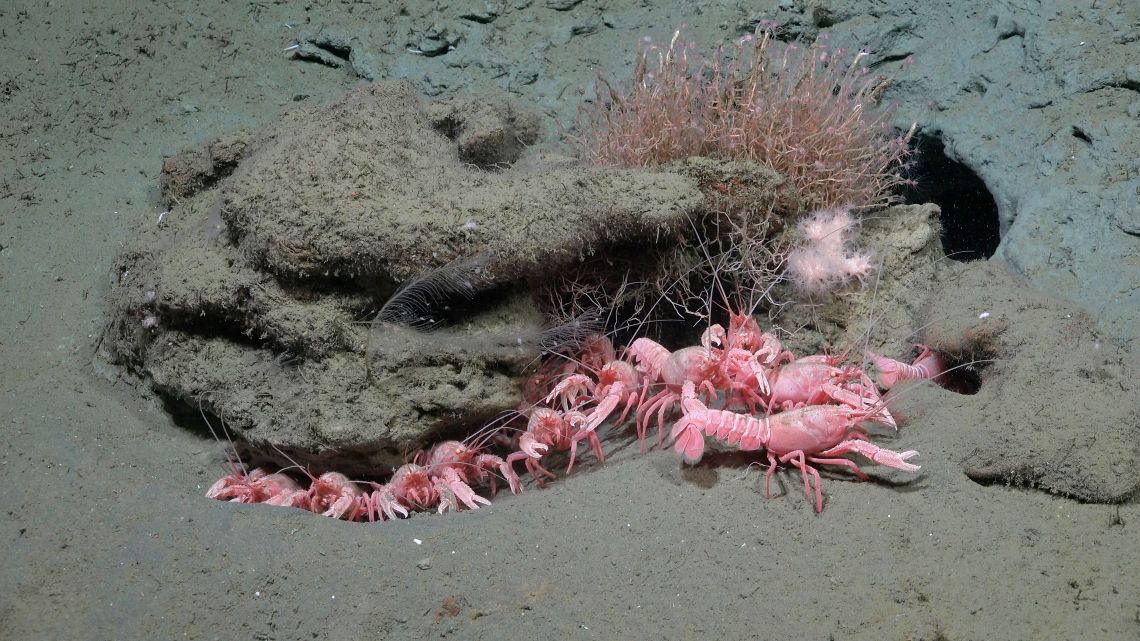
Family of Lobster. Image source: Schmidt Ocean Institute
Links of interest:
Expedition Mar del Plata https://schmidtocean.org/first-high-tech-exploration-of-argentinas-mar-del-plata-canyon-inspires-millions/
Mar del Plata. Galería de fotos: https://schmidtocean.org/collection/4500-m-rov/
Web Uruguay SUB200: https://uruguaysub200.udelar.edu.uy/
Web oficial SOI: https://schmidtocean.org/
YouTube (live streaming): www.youtube.com/@schmidtocean
Sobreciencia de TV Ciudad: https://www.youtube.com/watch?v=CyIJVzhb6kw
Celebrating the deep. Underwater Oases Mar del Plata Cannyon. Source: Schmidt Ocean Institute
From “Navegantes Oceánicos” we would like to thank journalist and scientist Gustavo Villa and the Schmidt Ocean Institute for their collaboration on this article.
We wish them the best of luck and success on this important new Uruguay Sub200 Expedition.