Introduction.
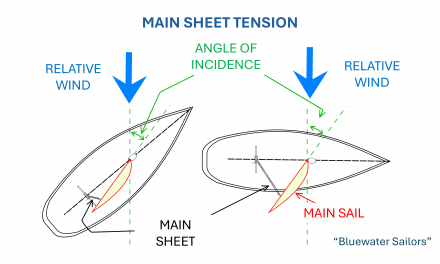
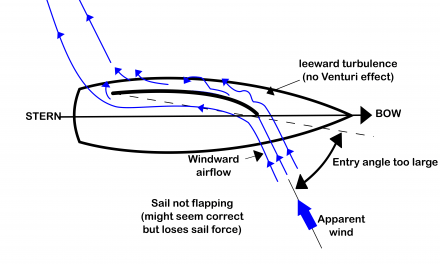
When, during a crossing, the best course to reach our destination is with the true wind astern (or very close astern), the genoa won’t work well on the same tack as the mainsail, as it will be significantly outwinded.
One option is to sail on a broad reach (120 to 150 degrees windward), with both sails working correctly (and tacked to the same side), and perform successive jibes, making progress towards our destination. This is a safe option, although the distance covered will be greater.
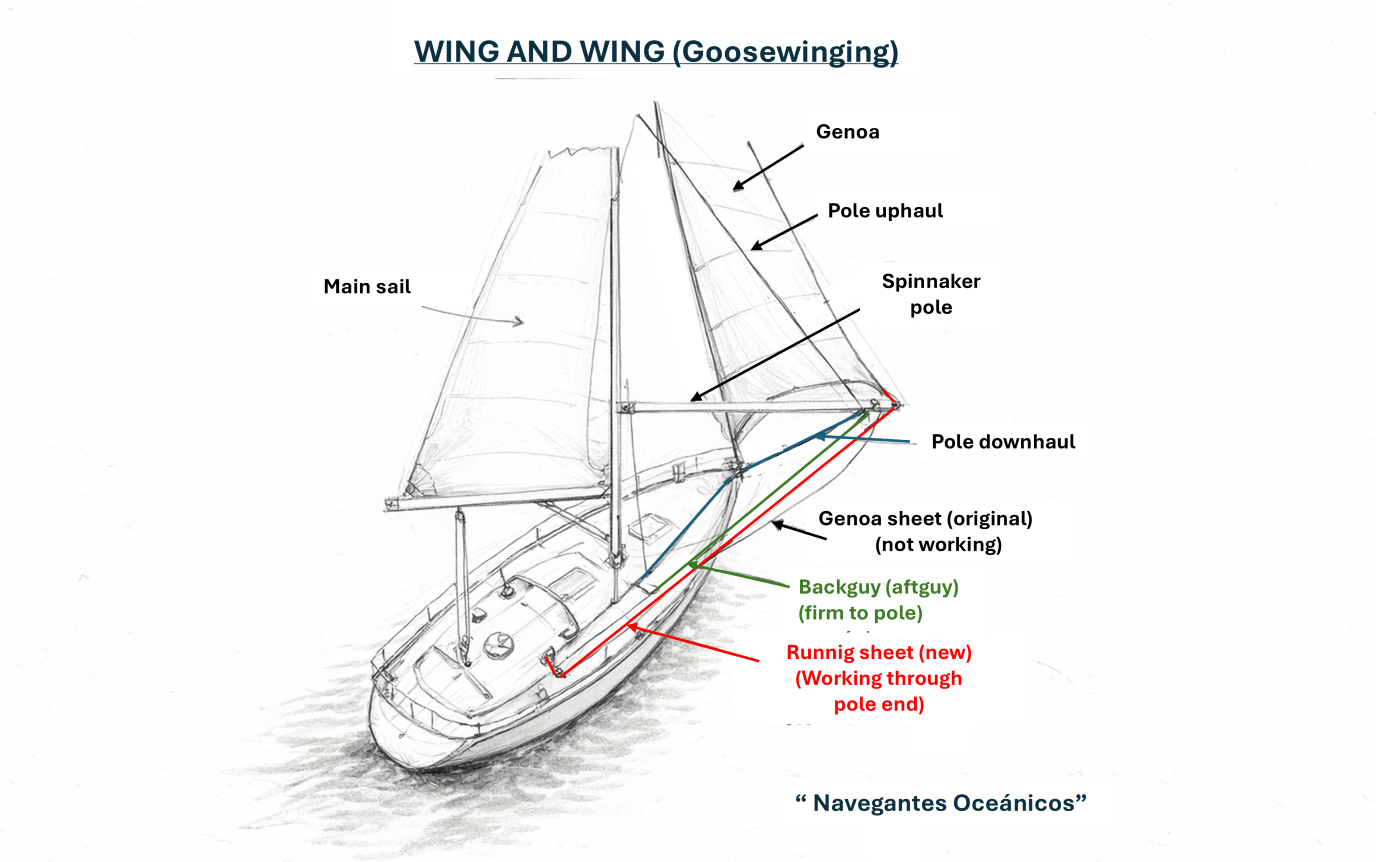
However, to sail a more direct course to our destination, one option is to set the sails in a “wing and wing” (goosewinging) configuration. This involves having the mainsail trimmed to one side (leeward) and the genoa trimmed to the opposite side (windward), assisted by the spinnaker pole. In this way, both sails receive the wind directly without being outwinded by each other, increasing their efficiency.
If we tried to sail with the spinnaker pole tacked off without using the pole, we would have to sail with the wind practically astern (which is very impractical). However, with the pole, we can sail in winds ranging from a close following to about 40 degrees astern.
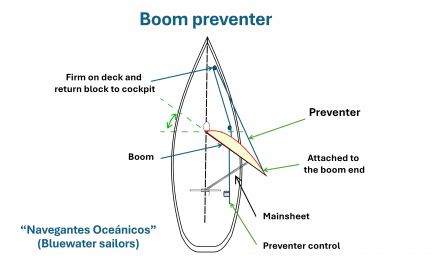
This maneuver allows us to cover less distance and sail efficiently (at a higher forward speed) with winds between the quarter and the stern. However, it requires taking certain precautions to help us handle the spinnaker pole safely and to be flexible and quick to react to a shift or increase in wind. Furthermore, we must avoid an unintentional gybe of the mainsail, which is a dangerous situation.
Below, we will look at some considerations regarding the use of the genoa with the spinnaker pole on a cruising sailboat that can help improve wing and wing sailing safety and flexibility in changing wind conditions.
Este contenido solo está disponible para subscriptores de navegantesoceanicos.com
Efecúe Log In para desbloquear.