From a very young age, Carlos Cuadrado trained in tennis, where he excelled, winning the prestigious Roland Garros Junior Trophy at just 18 years old. However, injuries forced him to retire prematurely from competitive tennis. Despite this, he continued in the world of tennis, in Australia, as a high-performance coach.
In 2017, he took a major turn in his life; he bought an ocean-going sailboat and embarked on the adventure of sailing around the world, completing it in four (4) years. His book, “An Unpredictable Rival,” was recently published, in which he recounts his adventures and how he has faced the challenges of ocean sailing.
We thank Carlos Cuadrado in advance for sharing his experiences with our readers in this interview.
Carlos, When did your relationship with sailing begin? How did you learn to sail?
It started in my childhood, during summers on the Costa Brava, on my father’s Zodiac. He and my uncle would go scuba diving, and I would tag along, fascinated by the sea. That’s when the dream of one day owning my own boat was born.
Years later, already in Melbourne and working for the Australian Tennis Federation, that dream took shape. I signed up for a couple of sailing courses, but I soon realized that the real learning experience was at sea. I went sailing because I needed to learn… and also because the emptiness left by a tennis career cut short too soon was pushing me to look for something more. I wanted to test myself, explore my limits, and rediscover that sense of purpose I’d only known through competition.
What prompted you to switch from tennis to sailing? How did the round-the-world trip come about?
At first, I just wanted to learn how to sail. I started along the east coast of Australia, but after passing Sydney, short voyages no longer satisfied me. I ventured across to New Caledonia and then to Vanuatu. There, I gained confidence, truly learned, and fell in love with solo voyages, crossing seas.
After Vanuatu, I knew I wanted more. The challenge of sailing around the world was no longer just an idea… it became a necessity. A calling impossible to ignore.

To give our readers an idea: can you tell us about the sailboat you sailed around the world on, its seaworthiness, features, equipment, etc.?
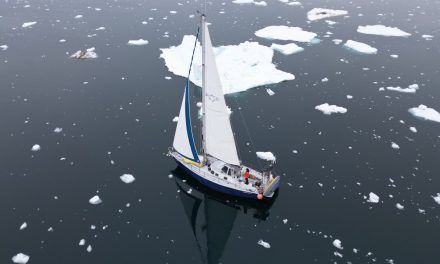
My sailboat is a 12-meter steel ketch with two masts and a central cockpit. It has a semi-running keel, is very heavy and solid, perfect for safe ocean sailing. I equipped it with autonomy and comfort in mind on long voyages: a watermaker, generator, solar panels, hot water, refrigerator, hydrogenerator, a good electronic system, radar, autopilot, and more.
It was more than a boat; it was my refuge, my floating home, and my companion in my challenges.
What route did you follow on your round-the-world trip? How did you plan it, and what factors did you take into account?
I followed the classic east-west route, taking advantage of the trade winds. During the six months I prepared the boat in Melbourne, I soaked up information, especially from Jimmy Cornell’s guidebooks. I adjusted the route and timing, taking into account the cyclone seasons in the Pacific and hurricane seasons in the Caribbean.
I wanted to go through the Strait of Magellan, but the pandemic made that impossible, so I crossed through the Panama Canal after rounding the Cape of Good Hope. Every decision was strategic.

Who accompanied you on this adventure? How did you organize the crews on the different voyages?
I met my ex-partner in New Caledonia, and for a time he accompanied me on the boat for periods of time. But I made many of the great voyages alone: I crossed the Atlantic alone, as well as the Pacific from the Marquesas to Australia.
I liked sailing alone. There’s something magical about the rhythm of the waves, how the days follow one another, without distractions. It’s a deep routine, impossible to find on dry land. I spent many hours by myself, and although the loneliness weighed on me at times, I never wanted to have a crew. That voyage was mine, an inner reunion, a longed-for search for peace.
Is life aboard a sailboat difficult? How many hours of sleep do you get a day when you’re out on the ocean? Did you miss anything about life on land?
It’s clear it’s not for everyone. I don’t know if there’s a middle ground: you either fall in love with the lifestyle or you can’t handle it. If you like it, you quickly adapt to the confined spaces of the boat. In the end, what matters isn’t the comfort, but the experience: traveling, meeting people, immersing yourself in other cultures, experiencing adventures, and feeling a freedom that’s hard to explain.
On ocean voyages, I slept in hour-long chunks. I’d get up to check everything was okay, check the chart plotter and radar for storms, and go back to sleep. Near the coast, I slept in the cockpit with alarms every 20 minutes. The body gets used to it. The mind, too.
Honestly, I didn’t miss anything on land. Sometimes, maybe the variety or access to certain foods… but it was part of the journey, the challenge. I never felt a great need. I was where I wanted to be, living with just enough, connected to the essentials. And that, more than a sacrifice, was a choice.

Carlos, you’ve sailed many miles during your round-the-world voyage. What would you highlight about your voyages in the Atlantic, Pacific, and Indian Oceans?
The Indian Ocean was, without a doubt, the toughest. Waves came in crosswise and crashed sideways, and a larger-than-usual one always appeared without warning. The storms were more violent, with a wild energy that commanded respect every mile.
In contrast, the Atlantic was the most rewarding. Steady winds, tail currents… I managed to set records of 180 miles per day. I left the mainsail up at night without worrying, and I rarely had to reef in an emergency.
The Pacific had its thing: from Panama to the Galapagos, the wind was fickle and often headwinds. But once past that stretch, reaching the Marquesas was a delight. Every ocean has its own personality. And all can be a bed of roses one day… and transform the next.
From the Marquesas to Australia, you have to be very careful with the number of reefs there, and also with arriving in Australia in good conditions. Everything requires planning.
What technique did you use against the storms? What sails and equipment did you use in this situation?
Before setting sail, I thoroughly studied Peter Bruce’s *Heavy Weather Sailing*. It analyzes real-life cases that ended badly and explains why, as well as what could have been done differently. It helped me gain perspective and prepare strategies.
On my boat, I had a storm jib and could reef up to three times in the mainsail. In rough conditions, I sailed with two or three reefs, depending on the situation. And if that wasn’t enough, I resorted to an emergency maneuver that worked perfectly for me in the Indian Ocean: heave-to. It was key to maintaining control amidst the chaos.

You’ve also had the opportunity to meet different people and cultures. How was that experience? Is there any country, port, or island you’d particularly like to return to?
Yes, without a doubt. I would love to return to Polynesia. In the book, I explain how much that place shaped me and why it was so transformative for me… but I prefer not to reveal it here. It’s a special chapter that deserves to be discovered in its own pages.
I also have a voyage pending that I dream of taking one day: the Strait of Magellan, Tierra del Fuego, Ushuaia, the Chilean fjords… that whole wild and remote region calls to me strongly. I feel like I still have a story to live there.
How did this trip around the world change you? How did it change the Carlos who set sail from Melbourne?
It changed me completely. The Carlos who set sail from Melbourne was looking for answers, peace, and purpose. The one who returned did so with fewer certainties… but with much more clarity. I learned to let go of control, to live with the essentials, to listen to myself without the noise around me.
The sea taught me patience, humility, and gratitude. It reconnected me with a part of me that had been buried under the pressure of high performance. I didn’t come back a different person; I came back more of myself.

After everything you’ve been through, what does sailing around the world mean to you?
It means healing. My tennis career ended too soon, leaving me with an open wound and a void that was difficult to fill. The sea offered me another court, a more unpredictable one, without visible rivals but with constant challenges.
Sailing around the world was, for me, much more than a nautical achievement. It was a way to reconcile myself with who I was and who I am. Leaving behind the noise of the past, listening to the rhythm of the waves, learning to be alone without feeling lonely.
In every port, in every storm, in every dawn with no land in sight, I let go of expectations and discovered a peace I had never known. The real journey wasn’t around the world… it was inward.

Finally, Carlos, your book “An Unpredictable Rival” has just been published. What does it tell us and what messages does your book convey?
“An Unpredictable Rival” is the story of a life marked by sport, self-improvement, and the search for meaning beyond success. It’s a journey that begins on the tennis courts of Spain, passes through Roland Garros, injuries, falls, learning experiences… and ends with a round-the-world sailboat trip, crossing oceans and facing storms, both inside and outside the soul.
The book speaks of reinventing oneself when all seems lost, of embracing uncertainty, and of listening to the silence when the noise no longer serves. It’s a tribute to resilience, to postponed dreams, and to the beauty of living without guarantees.
It’s not just a story for sailors or athletes; it’s for anyone who has ever felt trapped by what “should be” and has had the courage to ask themselves: what if I try another course?
From “Navegantes Oceánicos” we thank Carlos Cuadrado for sharing with us all in this fascinating interview what he has represented and his experiences during his round-the-world sailing trip.
We wish you much success in the publication of your book “Un rival impredecible” and good luck in the future.