
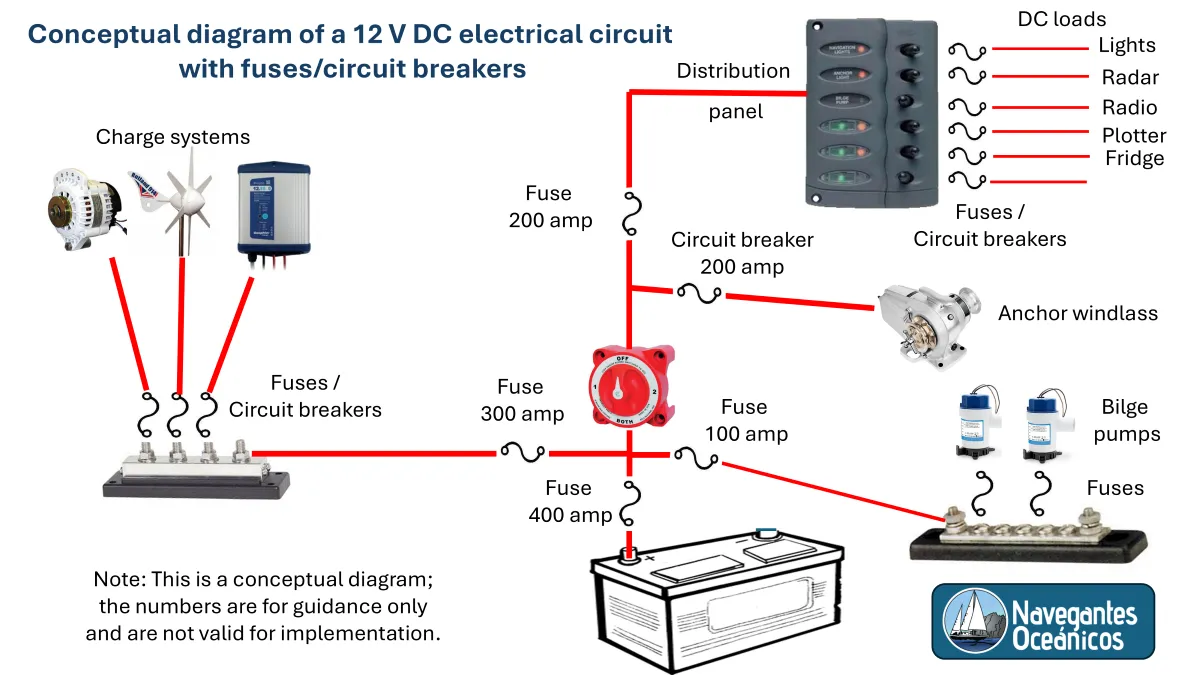
Introduction.
There’s a common misconception that a sailboat’s 12V DC (or 24V DC) (diret current) electrical system is less dangerous than a 220V AC (alternating current) system, since the relatively low voltage makes electrocution less likely.
This idea is completely wrong. The current in a sailboat’s DC circuit can be very high. For example:
– A 1500-watt anchor windlass, when in operation in a 12V system, will draw a current of I = Power / Voltage = 1500 / 12 = 125 amps, potentially reaching peaks of 300 amps.
– In the event of a short circuit, a powerful battery bank on a sailboat can deliver currents exceeding 2000 amps. If the cables aren’t protected, they can melt, leading to a very dangerous fire.
If our circuit is not properly sized and protected with adequate cables and fuses/circuit breakers, there are two main risks:
– Risk of fire due to short circuits and overheating of cables. More than 50% of fires on sailboats are electrical (mostly in the 12V/24V DC circuit).
– Risk of damage to electrical/electronic equipment and circuit components (switches, etc.).
The overcurrent protection devices used in marine environments are fuses and circuit breakers. While fuses are single-use, meaning that when a fuse blows, it burns out and must be replaced, circuit breakers, when they trip, can be reset and are ready to act again in the event of another overcurrent.
There are multiple types of fuses with different characteristics (ATO, ANL, MRB, Class T, etc.) and circuit breakers (thermal, magnetic, etc.); and choosing the right fuse/circuit breaker for each application on the boat and section of the circuit is crucial. Among other considerations, the placement of these devices is also important to ensure adequate protection for each circuit component.
In this new chapter of the online book “Onboard Electricity,” we will cover the following aspects of DC electrical circuit protection on a sailboat:
– Basic considerations for electrical circuit protection.
– Properties of fuses and circuit breakers.
– Types of fuses and circuit breakers most commonly used in marine environments.
– Basic procedure for selecting a fuse/circuit breaker.
– Considerations for onboard installation.
Este contenido solo está disponible para subscriptores de navegantesoceanicos.com
Efecúe Log In para desbloquear.
Este contenido solo está disponible para subscriptores de navegantesoceanicos.com
Efecúe Log In para desbloquear.
