Introduction.
It’s very helpful to revisit the previous chapter of this book online: The Mainsail (I): Control Elements, and review it several times if necessary, before starting this new chapter, in which we’ll see more specific recommendations on how to trim the mainsail on different points of sail and in different wind conditions.
It’s also advisable to recall the theoretical fundamentals of sailing, which we covered in the first chapters, the importance of the angle of attack and the sail’s sweep (position and size) for proper mainsail trim.
In the chapter Sailing Courses, we reviewed the concepts of true wind and apparent wind and some general considerations on how to sail a sailboat in different situations.
In this new chapter, we’ll go into more detail and see the importance of the mainsail’s telltales, how to adjust the twist, and some considerations on trimming this sail when sailing close-hauled, with the wind across, and with the wind across. for both light winds and moderate to strong winds, and using all the control elements already mentioned in the previous chapter.
Mainsail telltales.
In trimming genoas and jibs, telltales play a key role, as we saw in the chapter “Headsails (II): Trimming and Telltales.” Telltales are also important on the mainsail.
Telltales on the mainsail are not placed near the luff (as on the genoa/jib) but rather on the leech, as shown in the figure below. The reason for this is that if the telltales were placed on the mainsail’s luff, the mast itself would create small turbulences that would completely distort their readings. Furthermore, it is useful to observe the airflow at the leech of the mainsail; therefore, this is where the telltales are typically placed on this sail.
On the mainsail, we usually have at least three telltales:
– Lower telltales, also called control or trim telltales.
– Mid-level telltales.
– High telltales, also called twist telltales.
As a general rule: with apparent winds from a beam reach, the mainsail is properly trimmed when the telltales extend straight and horizontally from the tip of the sail.
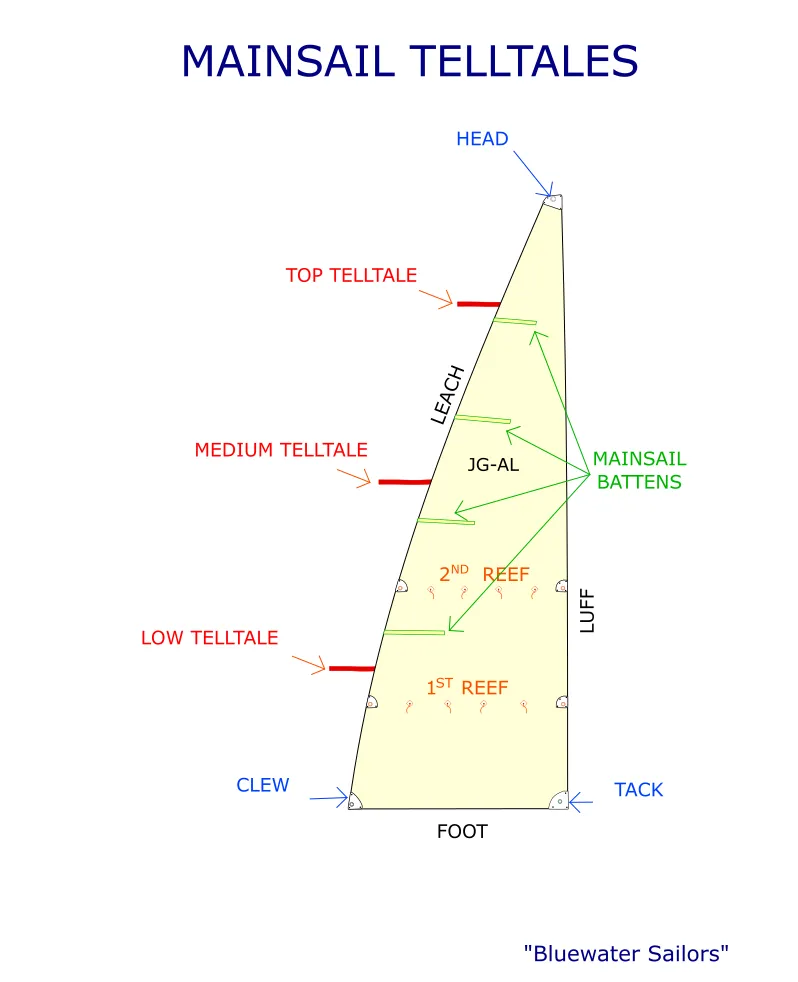
We’ll begin by adjusting the mainsheet so that the lower and middle telltales are perfectly horizontal, as these are the most important. Then, by adjusting the sail’s twist, we’ll ensure the upper telltales are also horizontal, as we’ll see later in this chapter.
Este contenido solo está disponible para subscriptores de navegantesoceanicos.com
Efecúe Log In para desbloquear.
Este contenido solo está disponible para subscriptores de navegantesoceanicos.com
Efecúe Log In para desbloquear.