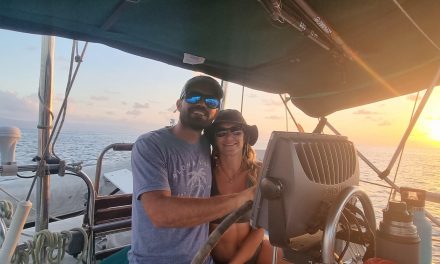
Elena Araque is a sailor, scientist, and lover of the sea and nature. She studied chemistry at university and, after several years of academic work, decided to take a major turn in her life and dedicate herself to what she truly loves: the sea and the nautical world.
Currently, aboard her home and sailboat, “Ciencia,” and under the brand name “Elena Oceánide,” she sails and promotes expeditions related to the study and care of the marine environment. Among her new projects is “OceanLab” (Sailing Oceanographic Laboratory), which seeks to combine sailing with scientific research, technological development, and marine, nautical, and ecological products.
We thank Elena in advance for sharing her experiences and new projects with our readers in this interesting interview.

Elena, when and how did your relationship with the sea begin?
Since I was little, I was a synchronized swimmer, and thanks to that, I had the opportunity to work in dolphinariums and have my first direct contact with marine life. That’s how I discovered diving, which sparked my passion for the sea. After finishing my doctoral thesis in chemistry, I decided to leave Madrid and move to the coast to become a diving instructor.
During that time, I discovered the world of sailing and the possibility of living on a sailboat, cruising the world, and that’s when I found my path in life: sailing the world on my sailboat and contributing to its conservation through scientific research.
What motivated you to make the big life change and turn to the sea? Has it been easy?
The reason was the search for meaning in life. I lived by going with the flow, but I wasn’t really happy. On the other hand, the sea made me feel alive and opened many doors for me. It also made me see life in a different way, one that made more sense to me than what society and the system have always shown us.
It hasn’t been easy, because every life change entails sacrifice and many blind alleys. Overcoming many barriers, especially on a personal level. These last 10 years since I changed my life have not only been a path of professional, maritime, and nautical learning, but also on a personal level. In fact, this has been the most difficult and important part, since it’s something they don’t teach in school and I didn’t have the opportunity to learn it as a child.
But honestly, now that I have control of my life and I dictate my course, I realize that this path of personal growth and self-knowledge is essential in life and what makes living so beautiful. I also now think that I wish all of this was talked about more generally in society and that there were more tools given to us from a young age, because people would be much happier and live more peaceful lives.

How did “Elena Oceánide” come about and what are its objectives??
I chose the name “Elena Oceanide” because it symbolically encapsulates my history and my deep connection with water. Since I was a child, freshwater was my world thanks to synchronized swimming, and over time, my path led me to the sea.
The “Oceanides”, in Greek mythology, are nymphs, daughters of the “Titan Ocean” and “Tethys”, and they represent all forms of water: rivers, springs, but also the sea. I identified with that image of an aquatic spirit, born in fresh water and finding her destiny in the ocean.
So, it’s a name that honors my history, my present as a sailor, and also my commitment to nature.
Can you tell our readers what the sailboat “Ciencia” is like, the one you sail on?
Well, “Ciencia” is a beautiful “Grand Soleil 46.3” sailboat built at the prestigious Cantiere del Pardo shipyard in Italy in late 2002. It is 14 meters long and 4.40 meters wide, with a draft of 2.2 meters.
It has 3 double cabins and 2 full bathrooms with hot-water showers. There is a large sofa with a table that seats up to 10 people and also converts into a bed and a home theater. We have a kitchen with 2 burners and a gas oven, as well as a refrigerator and freezer.
The cockpit is spacious and has a large steering wheel. Being an ocean-going boat, it is well protected, making it safe on the high seas. We have solar panels to charge the batteries and a water desalination plant to be as self-sufficient as possible.
We also have a dinghy (auxiliary boat) with a motor, so we can explore shallow waters. It makes it easy for us to stay at anchor and go ashore when necessary.
It’s a wonderful houseboat!

What is the “OceanLab” project and what opportunities does it offer the scientific community?
“OceanLab” is a project that combines both my scientific and maritime careers. I named the boat “Ciencia” with the goal of it becoming a sailing oceanographic laboratory. This way, while we sail around the world, we can contribute to oceanographic research. We collaborate with scientific institutions, either by collecting samples and data or by conducting more specific expeditions with scientists on board.
On the other hand, we also collaborate with technology and R&D companies to whom we offer the boat as a platform to test their products under real-life sailing conditions. These companies create and develop equipment for research, navigation, products and materials for boats, for life on board, and more ecological and sustainable products to reduce the human impact on nature.
I also open my doors to offer the opportunity to join these expeditions to people interested in experiencing this way of life and contributing to ocean conservation. By collaborating, we can create more projects and alliances to continue caring for this wonderful and essential ecosystem.

What expeditions or voyages do you have planned this year with the sailboat “Ciencia”?
We’re currently in Lanzarote, and on May 1st we’re setting sail for Madeira, where we’ll be for the entire month of May. This month we have three one-week expeditions (you can see all the info on the website (https://elenaoceanide.com/expediciones/), and in June we’ll head to the Azores, where we’ll be until the end of August.
From there, we’ll head south to the peninsula because I want to make some improvements to the boat. We’ll return to the Canary Islands to collaborate on a shark research project. If all goes well, we’d like to cross the Atlantic Ocean in January!
How do you organize life on board the “Ciencia” during its voyages?
What is the routine??
Well, it depends on whether we’re doing longer or more coastal voyages, and on the people on board and their experience. On longer voyages, we do 3-4 hour watches, and I like to always have two people in the cockpit, so one person stands watch and the other keeps them company for safety, and also to make it more enjoyable and avoid napping.
As for food, my partner, who’s a cook (and mechanic), and I usually take care of it. We usually prepare things before long voyages in case it’s uncomfortable while we’re sailing and to make everything easier.
Otherwise, we keep an eye out for possible sightings of marine life, especially if we need to take samples at certain times, record for future audiovisual projects, etc.
And whenever possible and the weather permits, we play games or do things to liven up the hours. This is something that depends on the preferences and personality of the crew on board the voyage. But I really like music and doing things that make us laugh a bit. No more shame!

Finally, Elena, do you have any other projects planned for the coming years that you’d like to share with our readers?
Pues hay muchas cosas que quiero hacer la verdad. Lo más cercano va a ser lanzar mi canal de Youtube, algo que llevo años queriendo hacer y en lo que ya estoy trabajando también.
Quiero llegar a crear mis propios proyectos científicos, y algo que me hace mucha ilusión es darle vida a un concepto y marca que he creado que se llama “OceanFulness”, que va encaminado a la parte de crecimiento personal que comentaba al principio de esta entrevista, con la que poder ayudar a personas en procesos de desarrollo personal y autoconocimiento de sanación de traumas o heridas, pero siempre ligado al mar y a la navegación que es algo que a mí me ha ayudado mucho a crecer y a salir del hoyo. Por eso siempre digo que “el mar me salvó la vida”.
You can find more information at the following links:
Instagram Elena Oceánide: https://www.instagram.com/elena_oceanide/
Facebook Elena Oceánide: https://www.facebook.com/ElenaOceanide
Instagram OceanLab: https://www.instagram.com/oceanlab_ciencia/
Facebook OceanLab: https://www.facebook.com/OceanLabCiencia/
YouTube (próximamente): https://www.youtube.com/@ElenaOceanide
From “Navegantes Oceánicos” (Bluewater Sailors) we congratulate Elena on her exciting project and thank her for her collaboration with this interview.
Good luck and happy sailing and exploring!