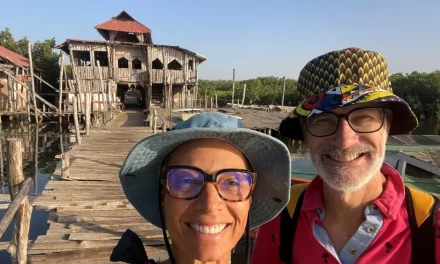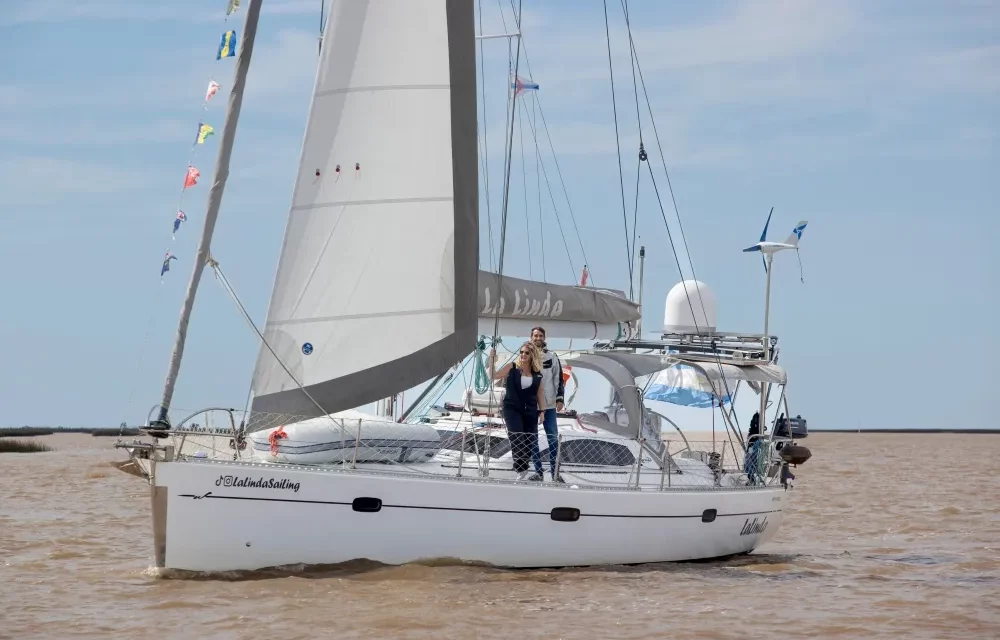
Paula and Carlos, a couple from Córdoba, sailed around the Atlantic Ocean on their sailboat, LaLinda, covering 22,000 miles. They spent 20 months at sea, visiting 23 countries, a journey guided by the wind, the weather, and their unwavering determination. Now back in Argentina, they reminisce about their adventure and plan new voyages.
This Sunday morning, in early May 2026, in the port of San Isidro, about 30 kilometers from the City of Buenos Aires, Paula and Carlos, fresh from their adventures around the world, acknowledge that the experience undoubtedly changed them forever: aboard their sailboat LaLinda, they left Argentina on September 1, 2024, and returned with the Southern Hemisphere autumn on Saturday, April 11, almost two years later. Just a few miles from reaching
Buenos Aires, they only heard greetings from other vessels on VHF radio, such as “Welcome to the Río de la Plata.”
Between the wind and the tides, they learned to live and enjoy the simple things, to let go in every sense, to thank the sea that sheltered them during these years, and to take care of LaLinda, which allowed them to experience so much joy on this voyage..

How did you get your start in sailing?
—(Paula) I got into sailing when I met Carlos 13 years ago. Before this trip, I had only sailed in Córdoba, on the Río de la Plata, Angra dos Reis in Brazil, and the British Virgin Islands. Although I’m a helmsman and a diver, you could say I christened my sailing license with 22,000 nautical miles (laughs), from zero to one hundred nonstop!
—(Carlos) I started sailing when I was little, at age 5 in Optimists and Snipes. From age 8, I dreamed of crossing the Atlantic, and everyone told me, “What a dreamy kid!” Over time, I took various courses, such as Helmsman, Skipper, Pilot, meteorology, survival, etc. Each time, I undertook longer voyages, from the J24 World Championship to the Buenos Aires-Rio de Janeiro Regatta, the Galapagos Cup, and even crossing the Atlantic four times.
How did they get to La Linda?
—(Carlos) One day she crossed our paths, and it was love at first sight. We saw her advertised online, went to meet her, and fell in love. LaLinda is a Wind 43, designed by Néstor Volker and built in Argentina by Southern Boats. It’s a vessel designed and built for the sea, weighing 17 tons, making it very robust and solid for ocean voyages. Shortly after acquiring her, we began planning our trip around the world.
—(Paula) The ship was built in a shipyard that specialized in cruise ships, which is why it has so many incredible details. The interior design features curved, laminated wood, creating a very modern and inviting atmosphere.
How did you decide to embark on this adventure?
—(Carlos) It was a long process. It all started a year before we cast off, when we began asking ourselves, “What if… we sailed around the world?”. One day I told Paula, “I have to tell you something. We’re going to sail LaLinda for a year in the Caribbean.” She was stunned, speechless.
—(Paula) On a personal level, I was looking for something that would tell me no, but everything just fell into place and our lives began to unfold. That’s how the most beautiful adventure of our lives began to take shape.
—(Carlos) Paula always describes the trip in a very beautiful way: “We close the door of our home to open the doors of the world.”.

How did you plan the route of this journey?
—(Paula) The entire route was planned according to the weather, designed to be in each location at the best times for sailing. Initially, we were only going to the Caribbean and return to Argentina via the Azores, the Canary Islands, and Cape Verde. It was at that point that I said to Carlos, “Are we going to pass right through the Mediterranean and not even go in?” And that’s how the route was refined and the trip extended by months.
—(Carlos) The planning took us over a year. I always say there are several chapters: one is preparing the boat, another the route (depending on the weather), the ports, the administrative procedures for entry in each country, the anchorages, the local tides; and finally, the tourist aspect. All of this required prior research and planning. We planned an itinerary with deadlines for each place, which was obviously very flexible since we stayed much longer than planned in several incredible locations.
As I mentioned before, planning was the foundation of the trip. For example, six months before setting sail, we had already emailed every marina from Brazil to the Bahamas asking about prices, berth availability, depth, and the services they offered.
We also analyzed locations where we could carry out major repairs on LaLinda if necessary. We even researched the basics of each country, such as the language, currency, entry requirements (immigration, customs, visa, vaccinations, etc.) and the location of the best hospitals. The journey was always intended to take place within a specific timeframe, with a beginning and an end.
—(Paula) Returning to the topic of weather, we could only stay in the Caribbean for a maximum of six months, as hurricane season began after that. Crossing the Atlantic was ideally done in May or June, due to the winds. Everything was always planned to complete each leg of the journey at the best time. With the key to the Mediterranean in hand, we entered through Gibraltar, sailing along the Spanish coast until we reached the Balearic Islands, where we spent the entire summer. With the first European cold, we sought refuge in the Canary Islands, continued on to Cape Verde, and celebrated the New Year by crossing the Atlantic to Brazil. With the arrival of autumn, we reached Buenos Aires.
I imagine that with so much planning they also received first aid training.
—(Paula) Carlos’s mother is a doctor and gave us some pointers: we learned how to suture a wound and how to give an injection. Obviously not open-heart surgery (laughs)… but we learned basic things to know in a pinch and what to take for each symptom. We carried a large first-aid kit of all kinds of medications stored in three large Tupperware containers and inventoried them on a spreadsheet, noting the exact quantity, expiration dates, and their use.

Did you continue working?
—(Carlos) As the trip was quite demanding and time was very limited, we opted to take a break from our office jobs.
How was living together?
—(Paula) We’ve always gotten along really well, and now living together full-time, we’ve gotten to know each other even better. In our daily routine in Córdoba, between work and other commitments, we spent a lot of time apart, but on the boat, we’re together 24/7. We always say that the most important thing is to communicate and be completely transparent if something happens. A really nice synergy has developed between Carlos, Linda, and me…
—(Carlos) A love triangle… (laughs).

What equipment does LaLinda have?
—(Carlos) This boat was always designed for ocean voyages. It’s a 43-foot cutter with a rig, weighs 17 tons, and has a very thick hull. It’s equipped with a 54 HP Yanmar engine. The fuel tank holds 500 liters, giving it a range of 1,000 nautical miles under power. We also have a 500-liter water tank and a desalination system that produces 60 liters of potable water per hour.
LaLinda boasts a comprehensive power system, consisting of three solar panels (500W total), a 400W wind turbine, and a generator. Its electronics are state-of-the-art, and everything is in triplicate, including the autopilot: sector pilot, wind pilot, and electronic wind pilot. For communications, we have three VHF radios, and for satellite communication, we have Starlink, Iridium, and Inreach antennas. For positioning and navigation, we use 7 GPS units, radar, and AIS, all operating on the NMEA 2000 network. Finally, we have 2 life rafts (for 6 people each) and a dinghy.
—(Paula) We are like a sustainable cell powered by the wind; we get our water from the sea, and our energy from the wind and the sun.
—(Carlos) When you’re self-sufficient on a boat, you’re truly free.

What criteria did you use in navigation?
—(Carlos) When we started the trip, we said we wanted a zero-risk voyage. In any sailing trip, the most important question is, “How much do you want to push the boat?”. We always prefer to sail without overtaxing the boat: La Linda’s mast is almost 22 meters high, meaning its sail area is very large. For this reason, we always sail with two reefs in the mainsail. In fact, for a large part of the leg up the Brazilian coast, we sailed without the mainsail, using only the staysail or the genoa.
We opted for a trip that combines comfort and safety, which is why the itinerary is dictated solely by the weather. Good planning means traveling comfortably and being able to sleep and cook peacefully. We also chose to avoid dangerous countries or areas to minimize the risk of any incident.
What apps do they use on their journeys?
—(Paula) There are many apps, but I think Noforeignland is the one we use most. It’s collaborative; you create your profile and can access all the super useful information any sailor needs. Like, for example, where there’s a laundromat, where to refuel, marine parts, mechanics, etc.
During the voyage, they also collaborated with the European Environment Association, a non-governmental organization that works on ocean conservation.
—(Paula) Yes, we collaborate on one of the citizen science projects run by the European Environment Association, called the SEALABS project. This initiative is for sailors who, while undertaking long voyages or long-distance journeys, contribute to scientific research for the protection of the seas by collecting data on seven water parameters (temperature, pH, salinity, conductivity, dissolved solids, etc.) using the SeaLabs kit. This kit consists of a collection cup, a sensor, and an app to upload the collected data. The database is public; all the surveys can be viewed.
What were the most incredible things that happened to you?
—(Carlos) On the stretch from the Azores to Lagos, sailing at night, we received a radio call. I couldn’t quite make out his name; he was a Frenchman speaking to us in English. Very friendly, he told us he had left France for Martinique and expected to arrive in a week. I couldn’t believe it; he was traveling on a 70- or 80-foot trimaran, at 35 knots, on a stretch that would take any sailboat at least three weeks. We started talking, and I told him we were traveling from Argentina. He asked if it was my first time crossing the Atlantic. I proudly told him I had crossed three times.
He told me his name again, and I didn’t understand, but he said that when he was younger he sailed with a chicken. I told him I knew a French sailor who traveled with a chicken and went to the North Pole. He said, “That’s me.” I asked him again, “Is the chicken’s name Monique?” “Yes, yes,” he said. It was Guirec Soudée, a sailing legend. I couldn’t believe it; I’d seen all his movies, I knew his story inside and out. He’d raced the Vendée Globe four months earlier and was now training because he wanted to sail solo around the world, but in the opposite direction and nonstop: he broke the record.
—(Paula) I think sailing teaches you a different kind of humility. We gave him our contact information, invited him to Argentina, and then he contacted us through Instagram. It was incredible.

And where would you return to?
—(Paula) To the Caribbean, without a doubt. The people are so friendly, it’s absolutely beautiful. You have sailors who see you in trouble and come over to lend a hand. I would also go back to the Bahamas a thousand times: when the tide goes out, beaches appear with unique sandbars. There are natural aquariums with fish of every color and size imaginable. Another place I found incredibly beautiful was the Azores Islands; it’s an amazing place, a wild island, the closest thing to Jurassic Park.
—(Carlos) If you enjoy diving, the Bahamas has every kind of fish imaginable. You sail in mineral water, where you can see the boat’s shadow on the sandy bottom. I also really enjoyed the Canary Islands and Bermuda
How do you feel now? In what ways do you think this experience has changed you?
—(Paula) We miss sailing the world, meeting new people, having new experiences, and living on the ship. We could say we lived a thousand lives in one. Now, we’re transitioning and adjusting to returning from the sea to the city. We’ve come back changed; we’re different from who we used to be..
—(Paula) We learned to value the simple things in life, to live more presently, consciously, and in harmony with nature. And also, to pursue our dreams until we achieve them.
What are your plans now?
—(Paula) We have a couple of long-term projects: I love the heat, so the Caribbean is my place in the world! But this time we would cross the Panama Canal to travel up the Pacific Ocean to the Sea of Cortez, known as the aquarium of the world.
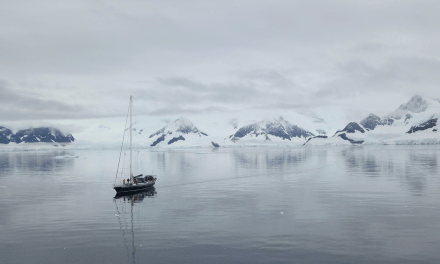
—(Carlos) I’m fascinated by Antarctica; I’ve wanted to go for a long time. It’s a tougher, colder voyage, and it requires a lot of planning. I think some of the most beautiful landscapes in the world are there.
—(Paula) Carlos is trying to convince me by saying we’ll see tons of penguins and whales along the way! In the meantime, you can follow our adventures on Instagram @LaLindaSailing. Greetings from the sea!.
From “Navegantes Oceánicos” we thank Paula and Carlos for sharing their sailing and life-onboard experiences with our readers in their passionate project, “La Linda Sailing.”
Congratulations, and we wish you the best of luck in your future endeavors. Fair winds and following seas.