
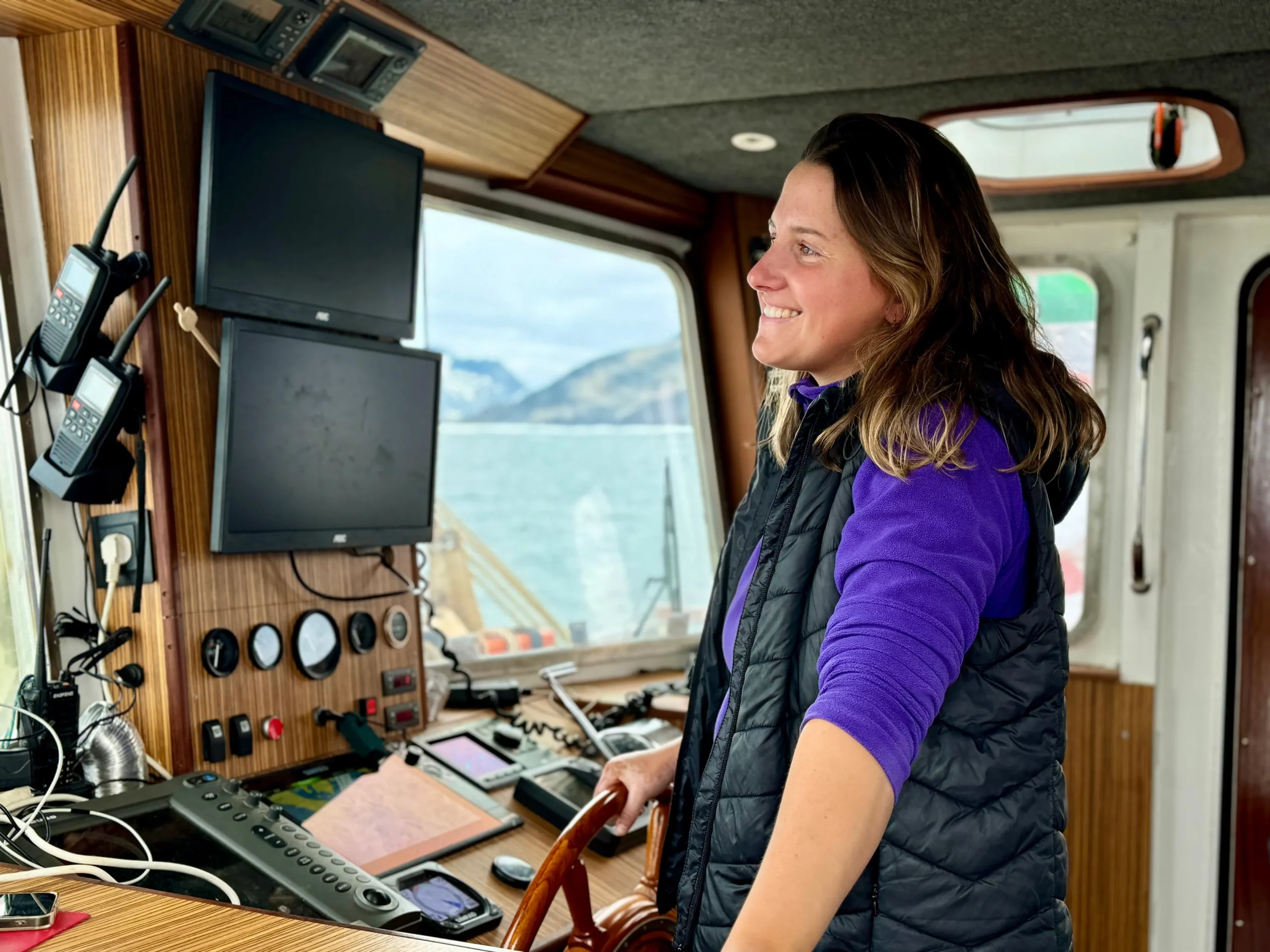
Rochi Costa on the bridge of the schooner Elsi, on duty, 2024
This young captain has sailed over 40,000 nautical miles in the last three years: first as a cook, then as second mate, then as first mate until she captained the company’s ship. From regattas on the Río de la Plata to icebergs at the North Pole, she embarked on a nonstop voyage across the world’s most challenging—and icy—seas.
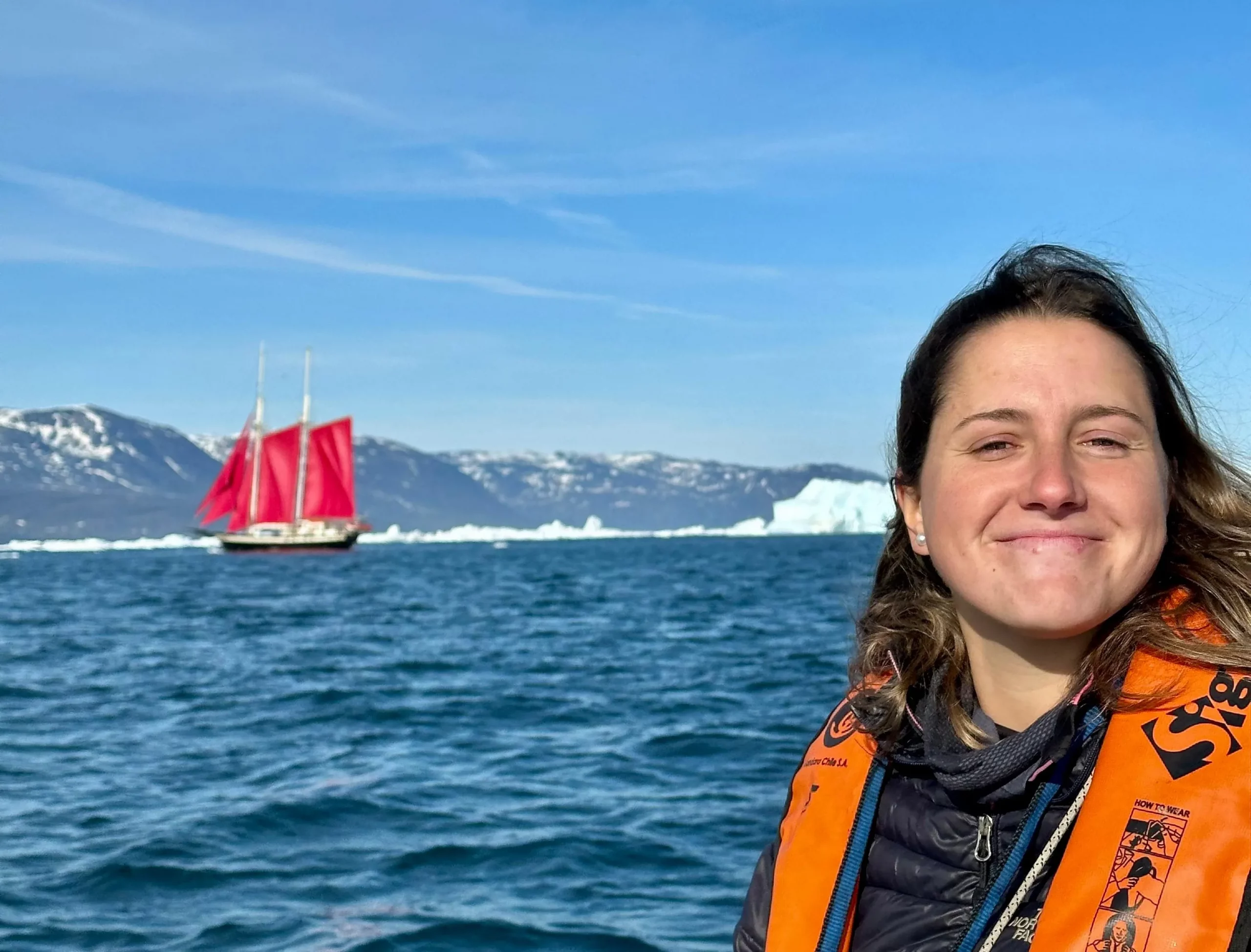
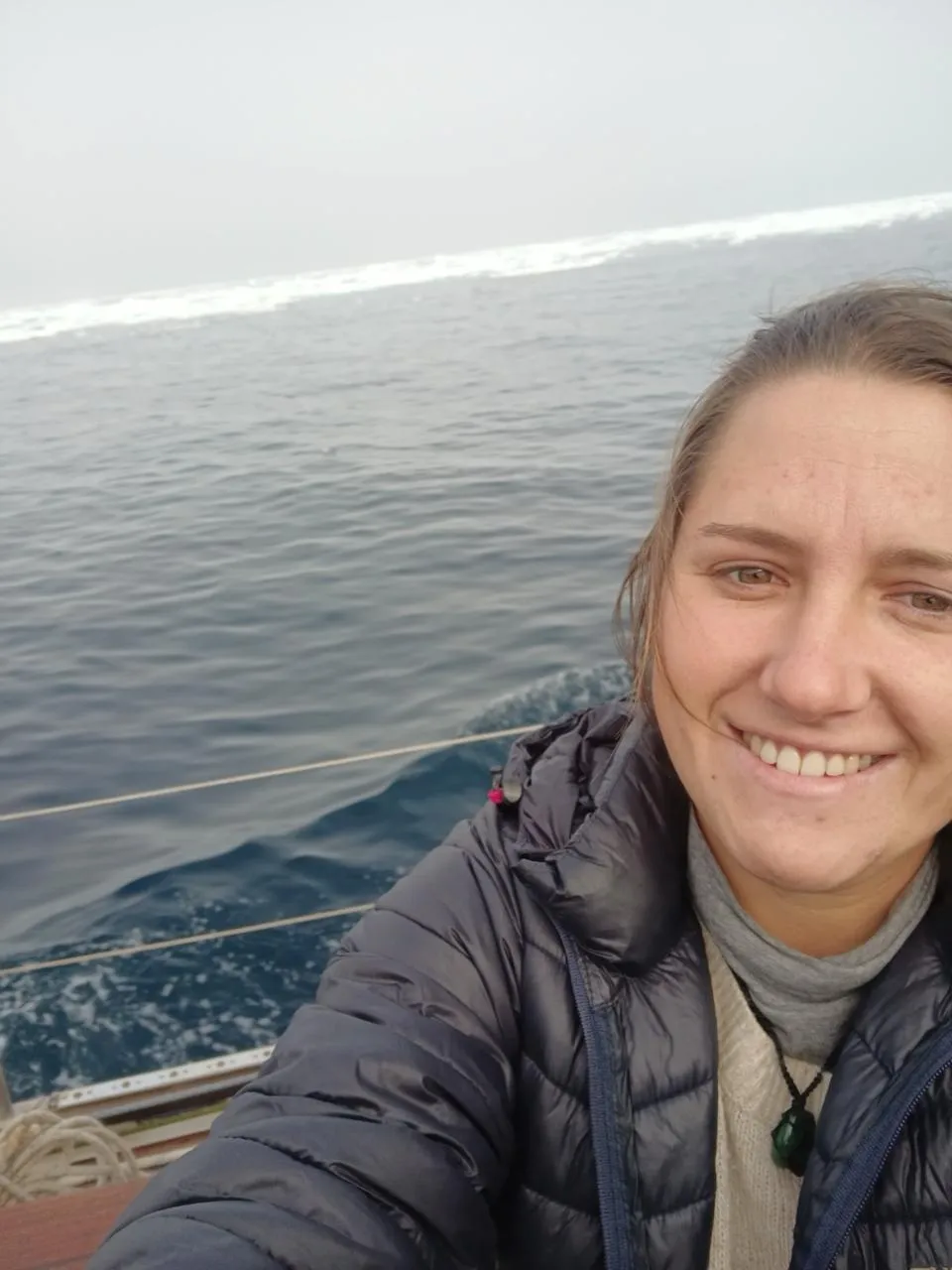
Rochi Costa, Captain of the schooner Elsi, Greenland, 2025
Rochi Costa began sailing on the Río de la Plata as a child, alongside her father, who owned a Pandora 31 for many years. Later, she started sailing dinghies at the Club Universitario de Buenos Aires (CUBA), in Optimists, from the age of eight to fifteen. She continued with ILCA, and when she reached adolescence, she took a couple of years off “because I was missing out on all the plans with my friends” due to regattas, training, maintenance, and championships, because “sailing is very intense for children.”
It wasn’t until she finished high school that she began the helmsman course: “I had always sailed one-design boats. My dad didn’t teach me much about his boat because there are eight of us siblings, and the boys were the ones who took care of the sailboat,” she explains. “Back then, I didn’t even know how to rig a spinnaker or a genoa. It was great because I started connecting with a lot of sailors when I began the course, which lasted about a year.”
She never imagined, however, that those first voyages would take her so far. After a few attempts at traditional jobs, she dedicated herself to ocean sailing: first as a cook, then as second mate, then as first mate, until she captained the company’s ship. In the last three years, she has covered more than 40,000 nautical miles between the Arctic and Antarctic, crossing the coldest and most challenging seas in the world.
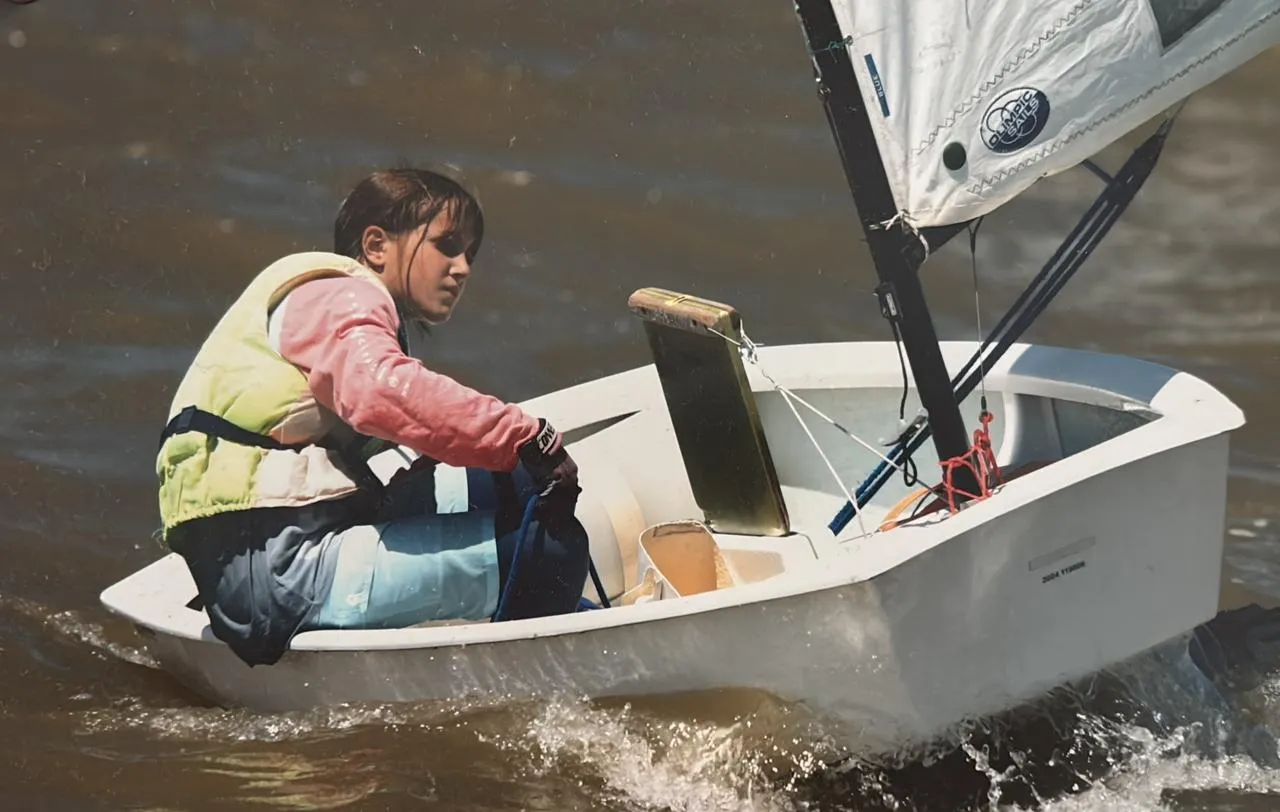
Rochi Costa, Optimist, 2007
Rochi, How did you get started in sailing?
My sailing journey began with my dad, who owned a Pandora 31 sailboat. But I didn’t know how to rig a spinnaker or a genoa; my brothers always did that. When I finished high school, I took a helmsman’s course and started connecting with other sailors who had bigger boats. I began racing. I got involved in the big championships with several boats from the club—ten or fifteen sailboats that have been racing together for years, and there are regattas to participate in throughout the year. During the course, I met a girl, and we became very good friends. The following year, we also started racing in the J24 class. We kept improving, and we formed a women’s team, which was very successful.
What happened next?
I started studying Business Administration and, around the age of 21, I made a radical change. I didn’t feel at home in Buenos Aires: I was working at an accounting firm, attending the Faculty of Economics, all in the city center, with fixed schedules. I didn’t really like working and studying all day, and only having two weeks of vacation a year.
I moved to Australia, then to France. I started traveling, working, and saving some money. During that time, I really missed the routine of the weekend, getting on my bike, going to the club, and going sailing. So, in Australia, I joined some regattas that were held on Fridays at a club after work, but the language barrier held me back.
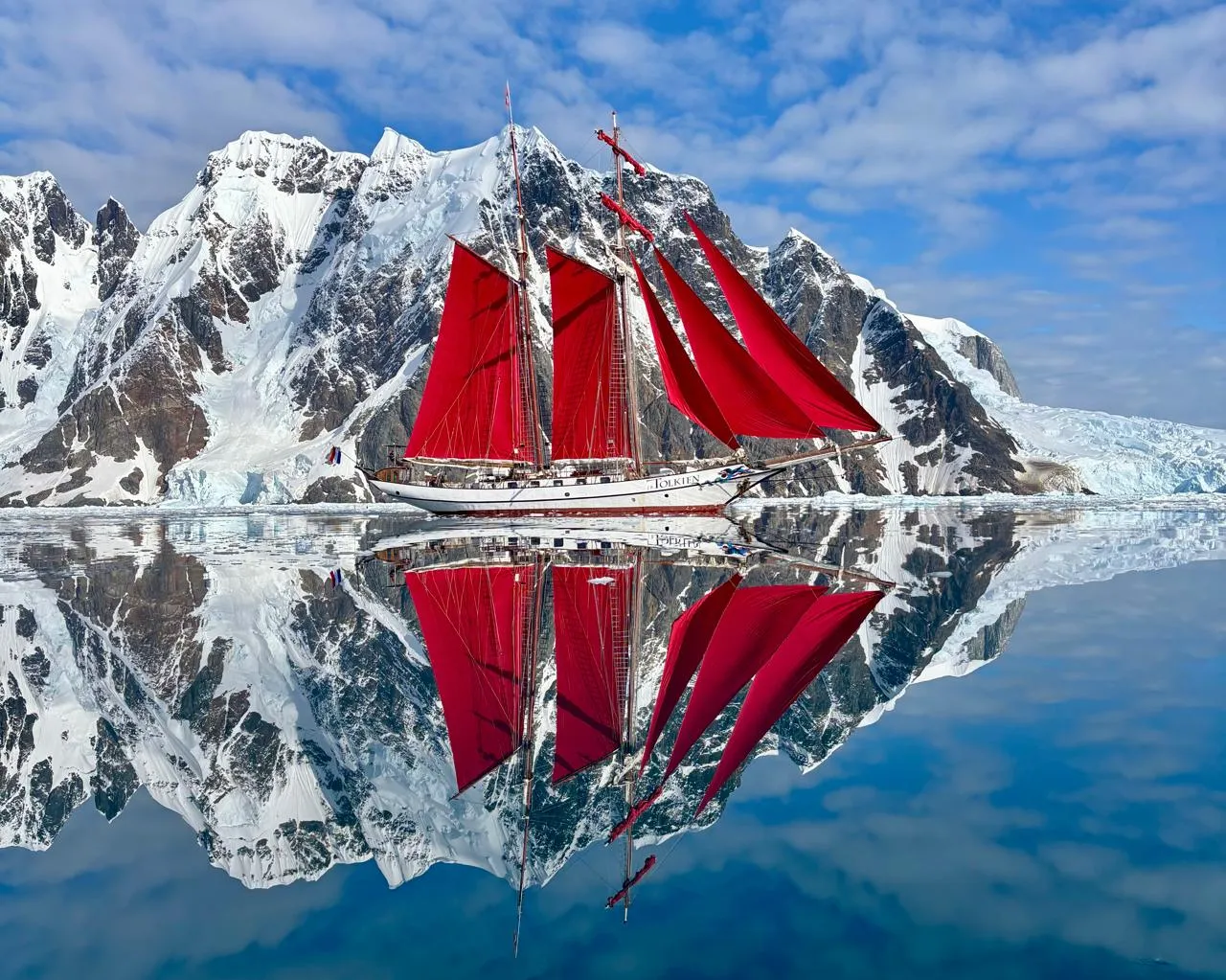
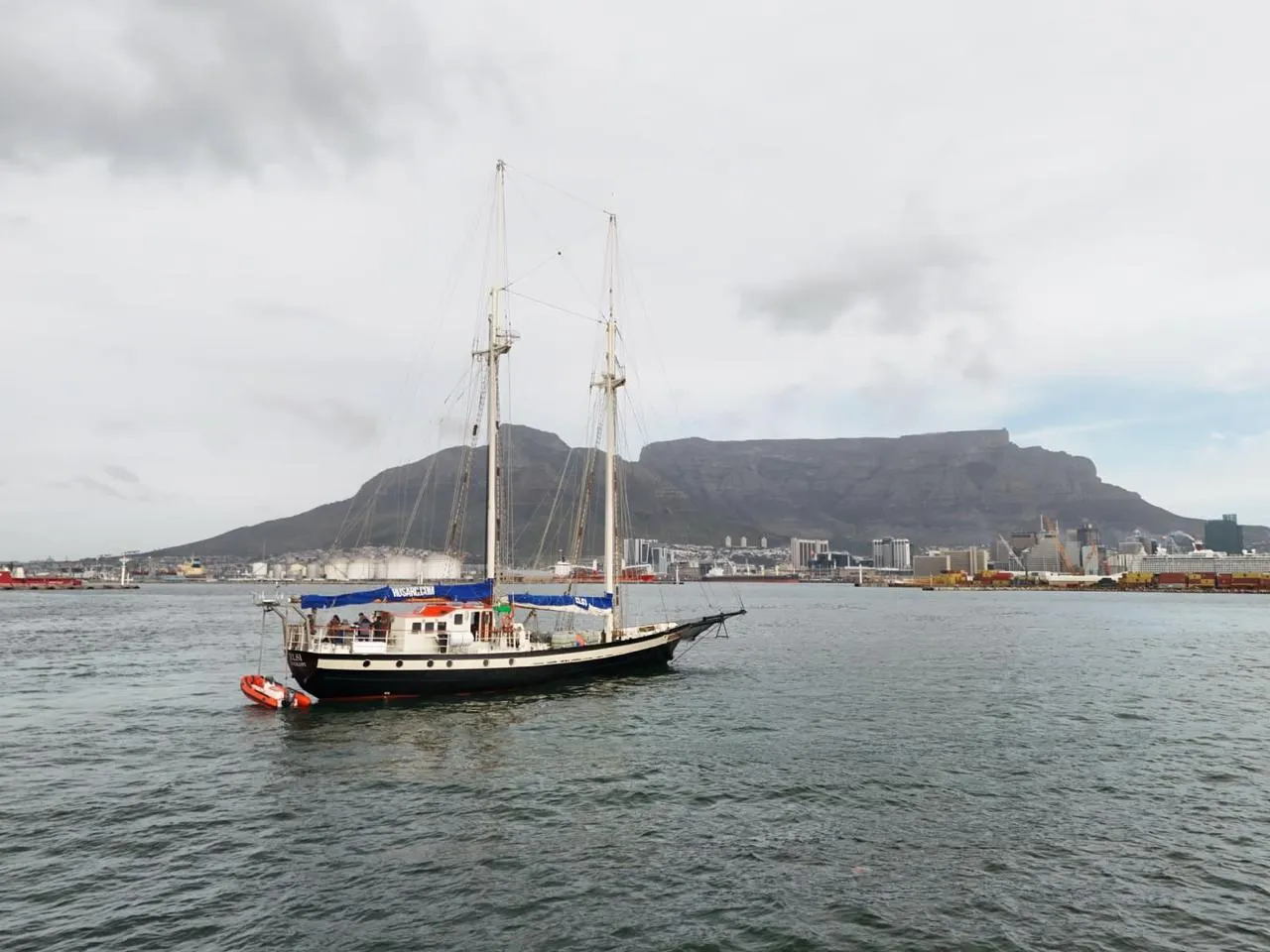
Tolkien Schooner, Antarctica, 2026
Were you missing something?
Yes, that year I spent in France I didn’t sail at all: I was thinking, I love to travel, but I miss the water. I started talking to my instructor from the helmsman course at the club because I wanted to start working in the nautical industry in Croatia, Greece, and Spain, where I had some friends who also combined traveling and sailing. I returned to Buenos Aires, took the skipper course, and once I did that, I could go to Europe to further my training and pursue a nautical career. That year I got hooked on sailing again; I realized it was part of me and that I couldn’t give it up again. At that time, the instructors also told me that since I’d been sailing my whole life, I had a much more intuitive sense of the wind than others: that motivated me a lot because it came easily to me (laughs). But then the pandemic started, and I couldn’t travel to Europe to complete those studies.
So how did you start sailing professionally?
Towards the end of 2020, I ran into a friend at the club who asked me what I was finally going to do, because they had bought a sailboat in the Caribbean and needed to get it ready for some regattas and then sail it across to the Mediterranean. In two weeks I was in Antigua: it was a 60-foot boat, huge, beautiful, and very race-ready. We stayed for three months, but the championships were canceled due to COVID. It was very difficult to remain in the country given the health situation on such a small island. I returned to Buenos Aires, sailed in a regatta in Uruguay, and something clicked: at that moment I focused solely on finding work on boats. I started giving tourist tours on a boat on the river, but I was also very tempted to begin longer ocean voyages.
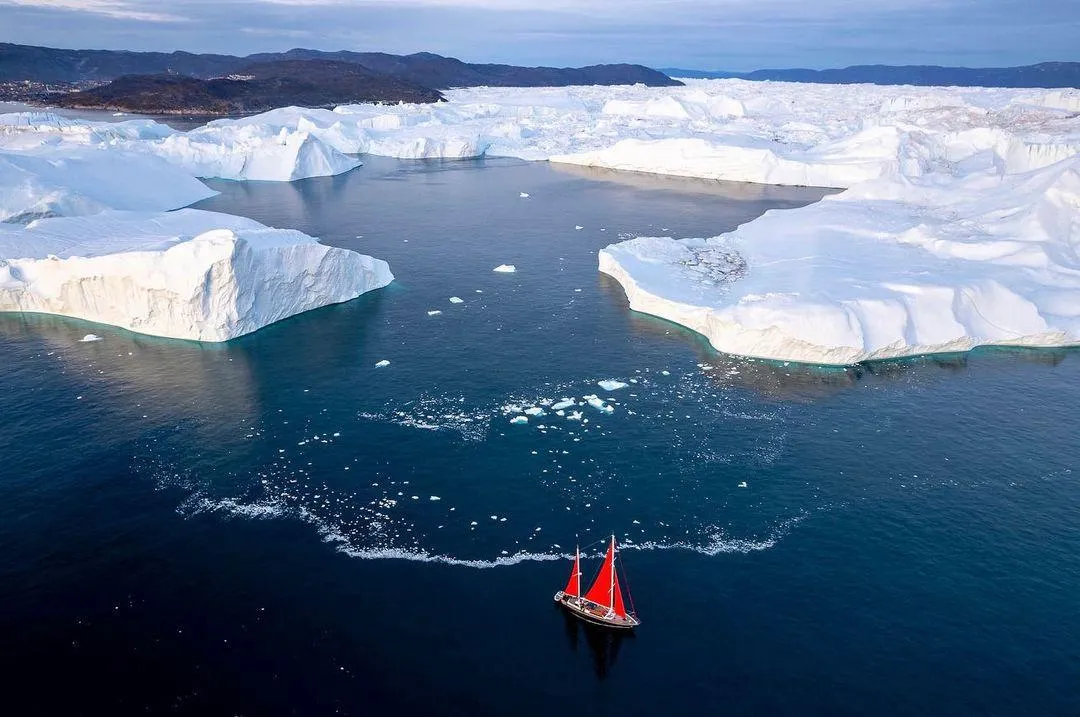
Photograph in Greenland, 2023
Had you, up to that point, made any longer sailing voyages?
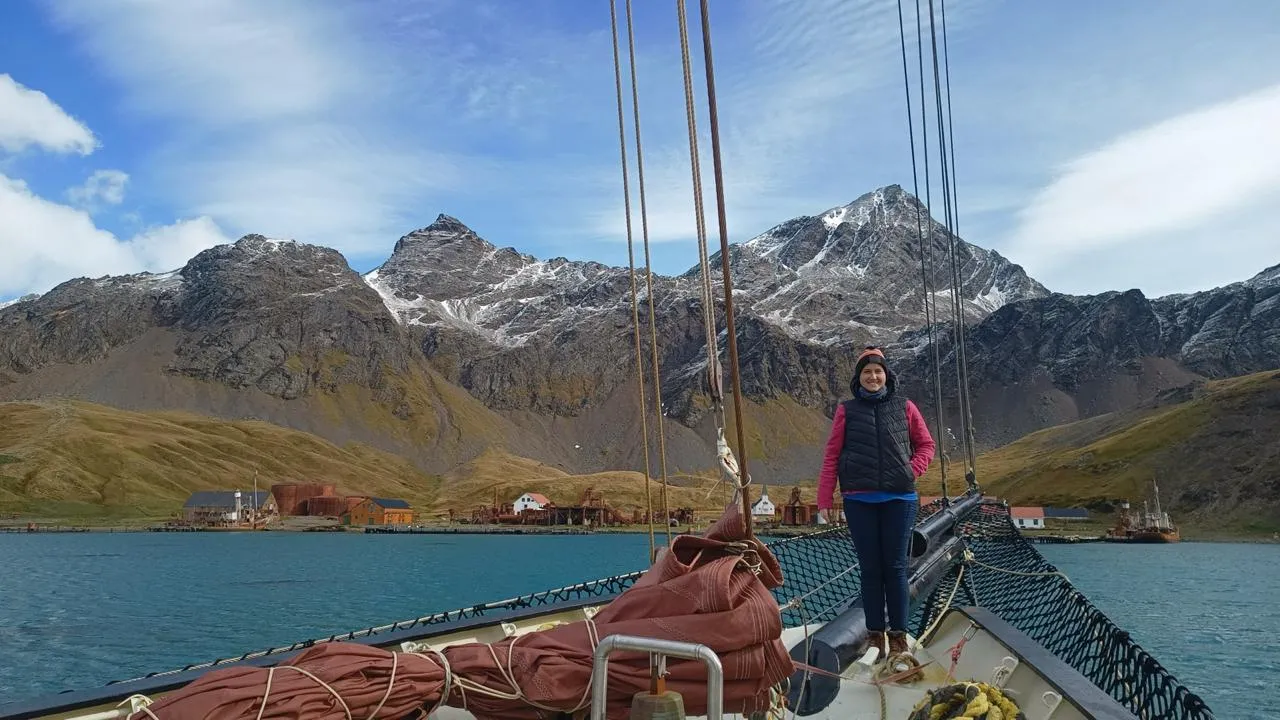
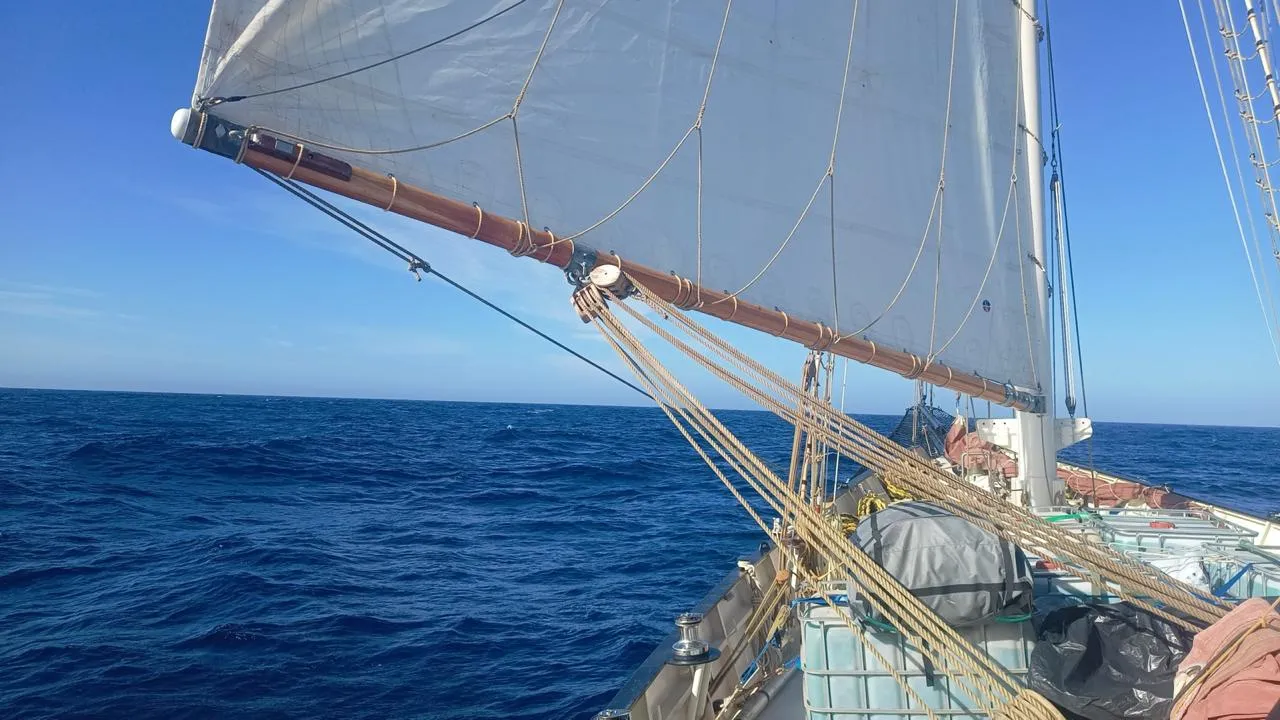
No, not at all. All my experience was limited to the Buenos Aires to Punta del Este leg of the journey. I happened to write to a friend who worked with a Russian company that regularly traveled to Antarctica and Greenland. She told me they were looking for a cook for a voyage. I thought, “How easy: just a couple of phone calls!” (laughs). I told her no, that I wanted to sail, but she insisted it was a way to get on the crew. In three days I was in Punta Arenas, Chile, heading for the Strait of Magellan. The trip was all the way to Brazil, on a 37-meter schooner.
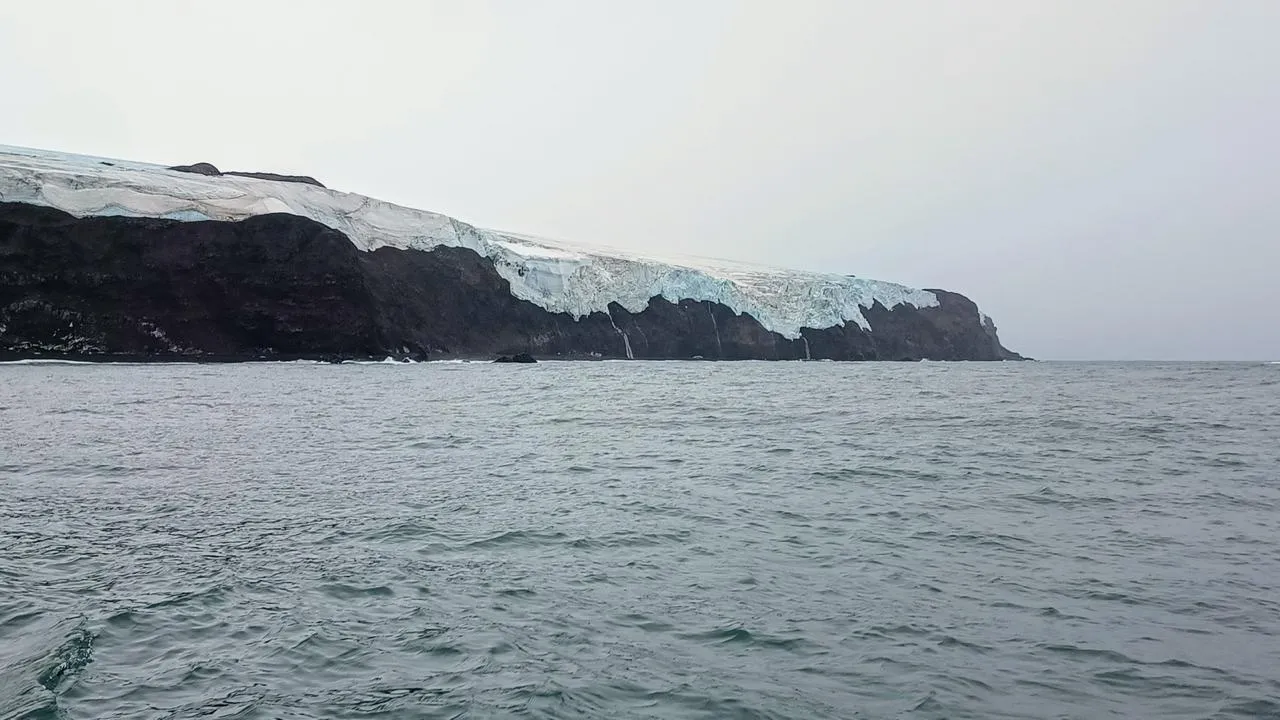
Bouvet Island, the most remote island in the world, 2024 – Elsi schooner, Rochi embarked as first officer
But did you have any idea how to sail a schooner?
No, I had no idea. When I saw it, I thought it was the Libertad frigate (laughs). The most powerful ship I’d ever captained was a Pandora 34. There were five Russians, an Argentinian, and me, who was my saving grace because no one was speaking to me; I didn’t understand a thing. The company owner wanted to try me out as a cook for a trip to Greenland, but even though I loved to cook, I wanted to be a sailor. Finally, there was someone on that ship who was in charge of the kitchen, and she did an incredible job. I did a little bit of everything to get hired, but I didn’t have an assigned task. Every morning I’d get up, go to the bridge, and ask the captain where the wind was blowing from, what the tide was like, and what the planned route was.
That voyage was for 15 days, from Punta Arenas to Brazil. They were coming back from a season in Antarctica and were leaving the ship there… I was left with the feeling that this wasn’t sailing: I was used to being in regattas, sitting on the side, getting hit by the waves and soaked completely. Everything here was so big that you were inside, with heating, drinking coffee, the cook was making sushi for you—for me, that wasn’t exactly what sailing felt like (laughs). However, the experience was great, and I disconnected for two weeks, back when Starlink didn’t exist yet.
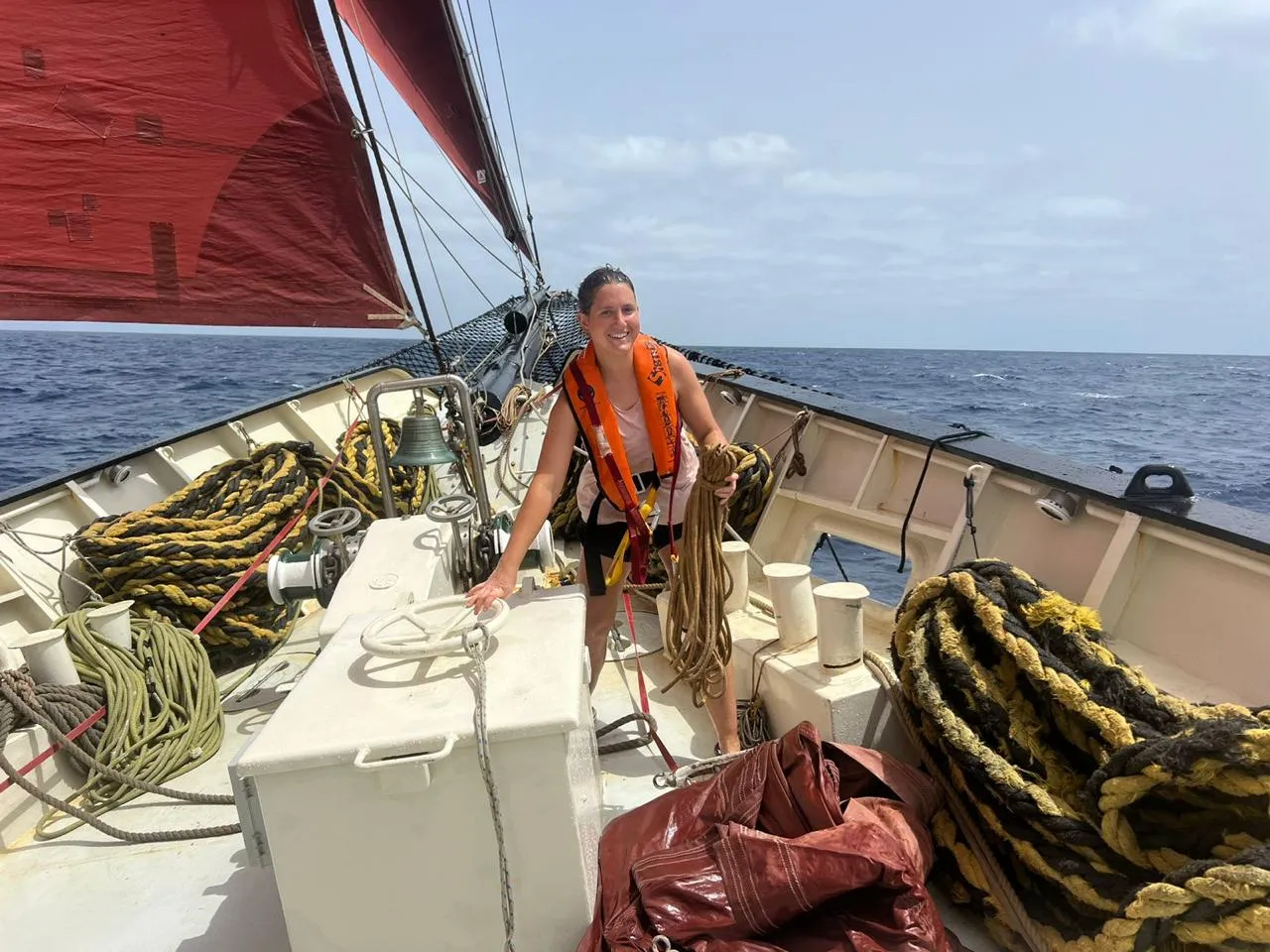
What happened when they arrived in Brazil?
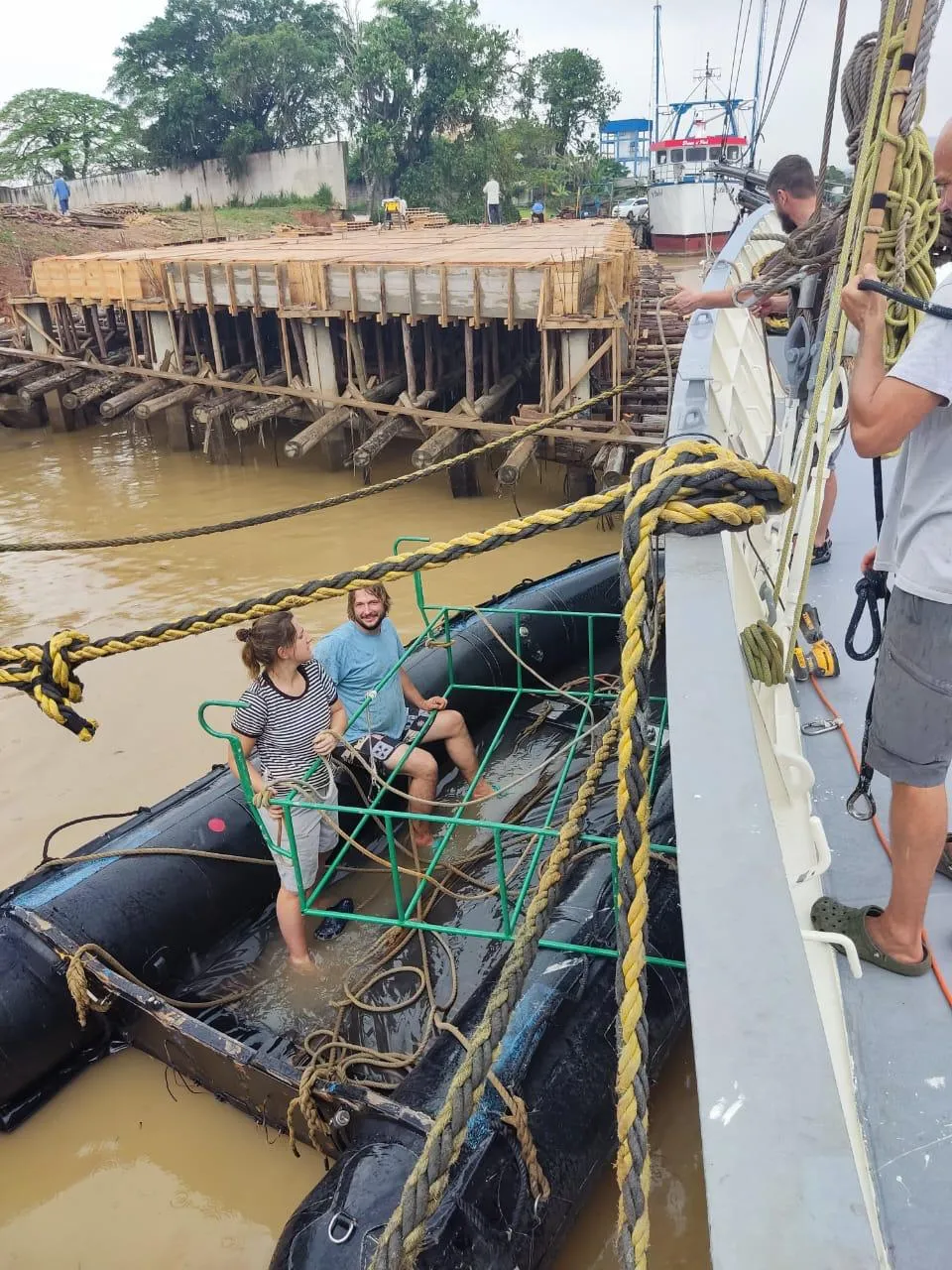
Once we arrived in Brazil, the company owner asked me if I wanted to go to Italy, saying they were leaving in three days. I told him to make me an offer, that I wanted to sail, not just be a cook. We went to Sicily to repair a 65-foot steel sailboat that had been abandoned for four years and needed to be refitted before sailing to Greenland to work for two months during the season with passengers. The return trip was to the Azores.
But did you have any knowledge of restoration?
No, I had no idea. I’d never even held a drill, an angle grinder, or a sander in my life. But there I was with the hammer and the putty knife, from eight in the morning until ten at night. I loved learning carpentry and painting skills, which were absolutely essential for ship maintenance. I’d end up with my face covered in dirt, we’d sleep on the filthy boat, I’d shower in the shipyard, but I was happy because I was going to cross the ocean. It’s a company that primarily organizes trips to the Arctic and Antarctic for tourism: they’re photography tours, which you can probably see on their website because the schooner has red sails, and the contrast with the icebergs makes it look epic.
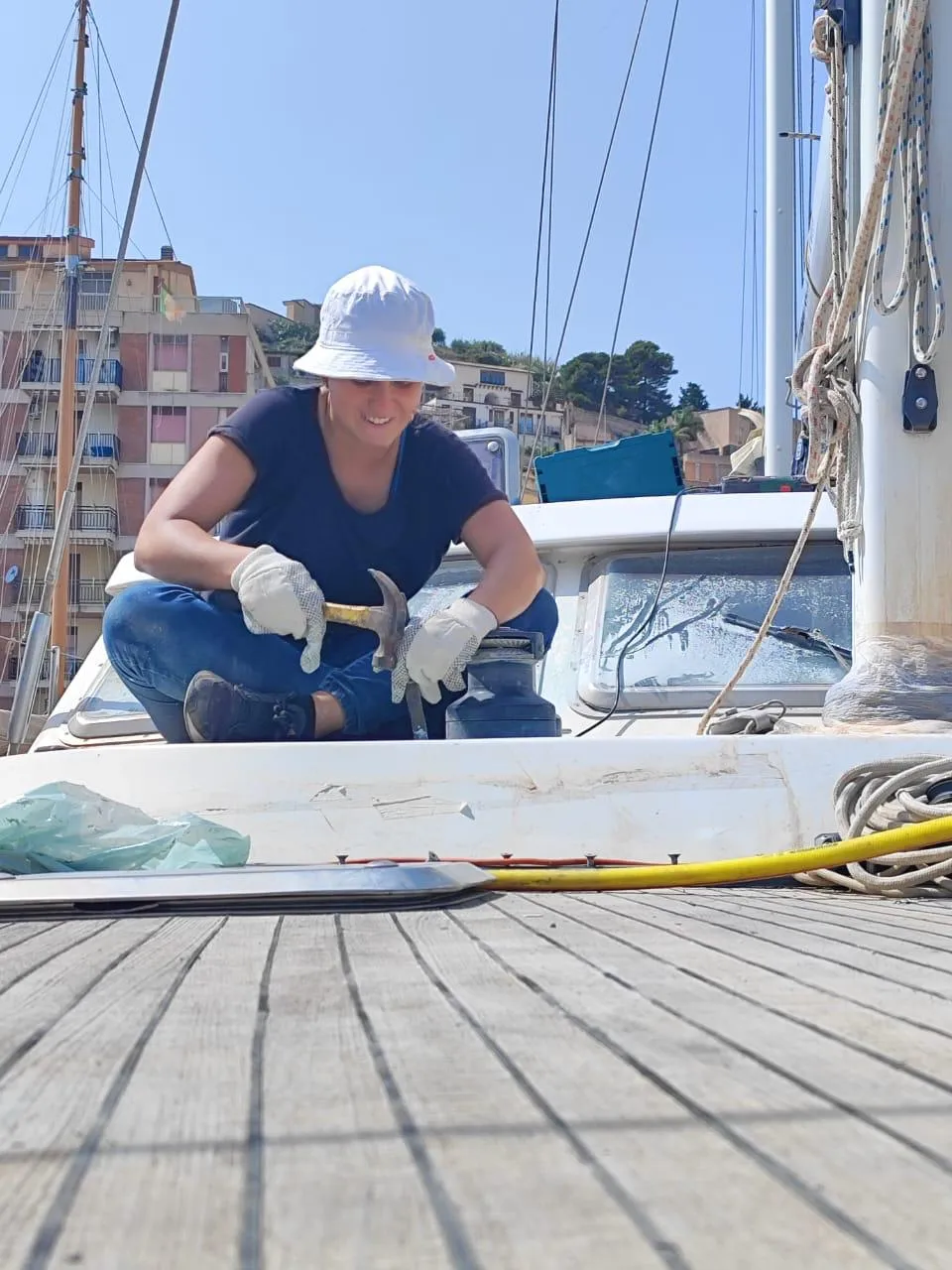
Efectuando reparaciones a bordo, 2023
After that you continued traveling regularly to Greenland, what were those experiences like? What stood out to you about the journeys?
In that first experience, I cooked for the crew but also stood watch at night. It was all very intense. We started in bad weather, with 40-knot headwinds, three- or four-meter waves, no water, the batteries died the next day, and we were always lacking something to bathe or cook. At one point, there was so little electricity left that my boss told us to cook some sausages or heat some water, and that was it. But I was happy to be crossing the Atlantic, perhaps with a certain degree of recklessness because I didn’t know about the dangers, but delighted with the experience.
During those times, I also took advantage of the opportunity to write, which I love, because there was no satellite internet yet, so it also allowed for a certain amount of introspection. I was always the youngest in every crew; I only sailed with another woman once in all these years, mainly with the Russians because they think we’re not strong and aren’t good crew members. I’m always saying—and I proved it to them—that it’s not about strength but about skill. You have to use your head. Besides, you have turnstiles and some of them are electric (laughs).
Why schooners?
Schooners are made of steel, can carry more than 20 passengers, have greater capacity and a different level of comfort, and are usually taller and have a longer beam: inside, it’s like a hotel. People who want to go to Antarctica do so because they want to see the continent, not just sail, so this is an intermediate option between a cruise ship and a sailboat (which might only have room for 10 people). Although you’re still sailing…
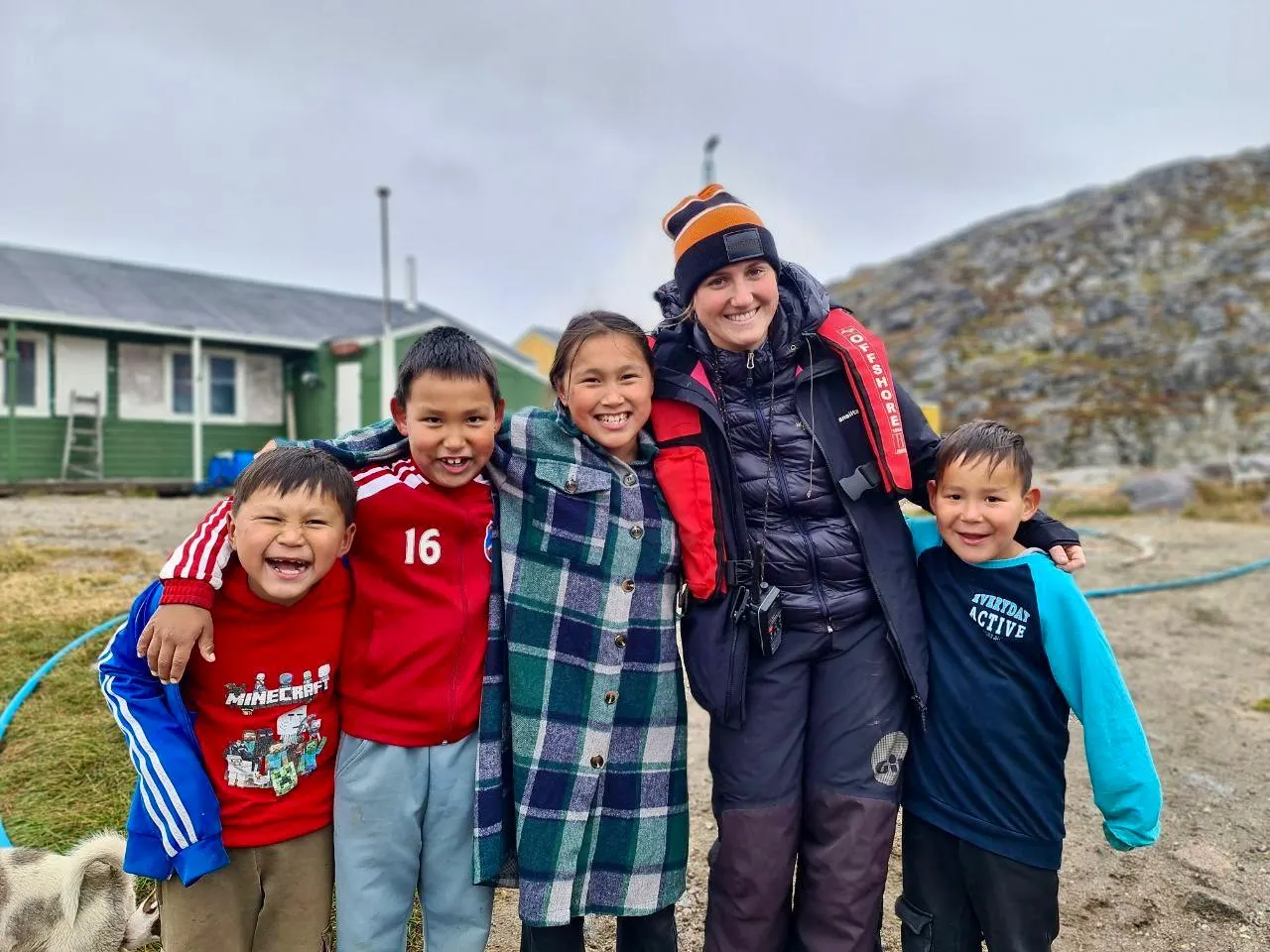
Visiting settlements in Greenland with children, 2024
I imagine that sailing in the thaw must not be easy. What were the main difficulties you had to face on the schooner, considering the number of masts or sails it carries compared to a traditional sailboat?
Yes, one of the things that struck me most on those early trips was the height of the mountains, especially in southern Greenland, and also the icebergs. I have a pixelated photograph of when I saw the first one in the distance. That was about 150 miles away, and yet millions more appeared afterward, even a whole wall that broke off and formed a barrier. It’s a problem because you never know when it will end, the ice is so thick you can’t get through it, and you have to go very slowly, trying to find a way across. The route that day was incredible; we were going back and forth, trying to find a way through. At one point, we put up a drone to see when it would end, and we saw some fishermen behind it, so we had to go slowly, clearing a path with the boat.
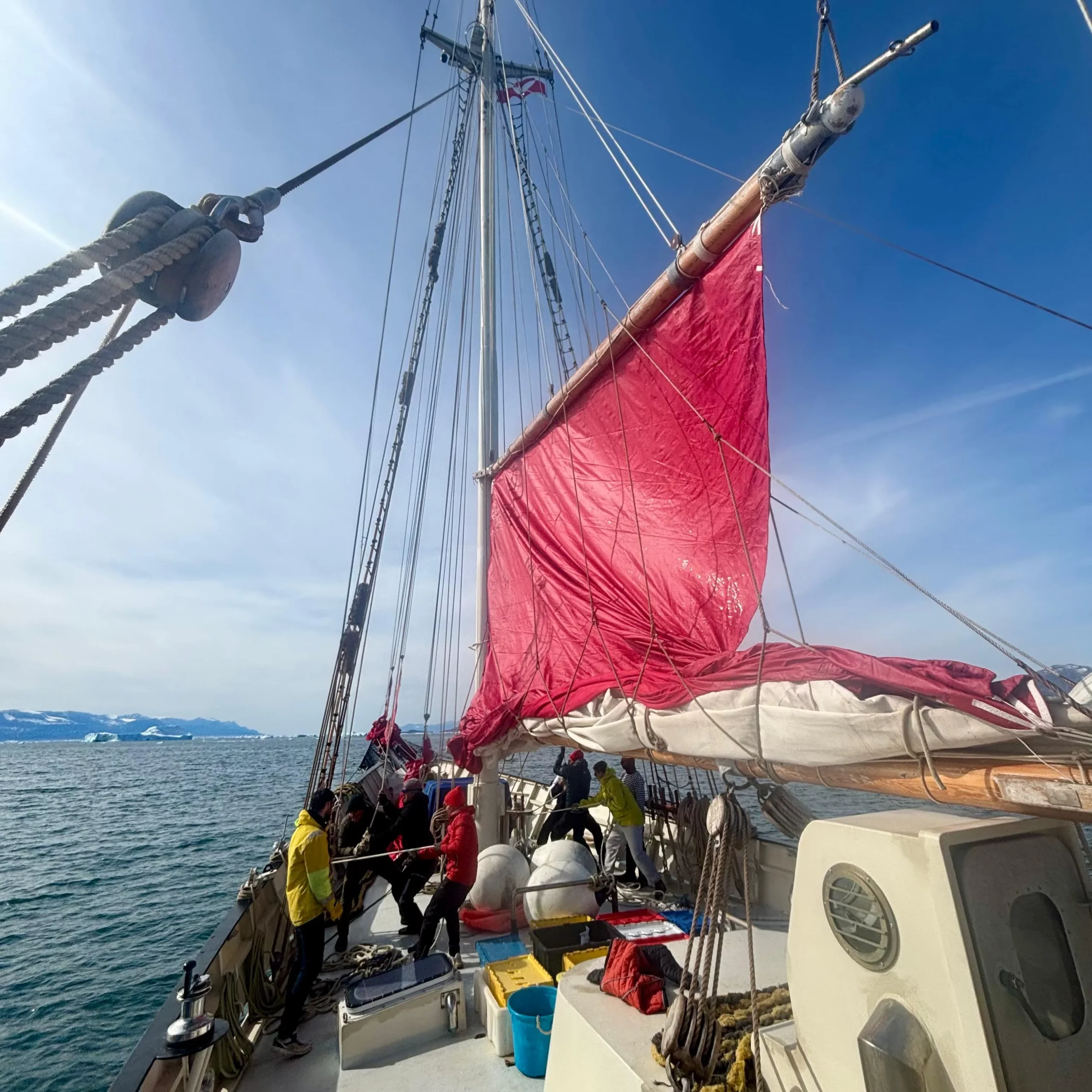
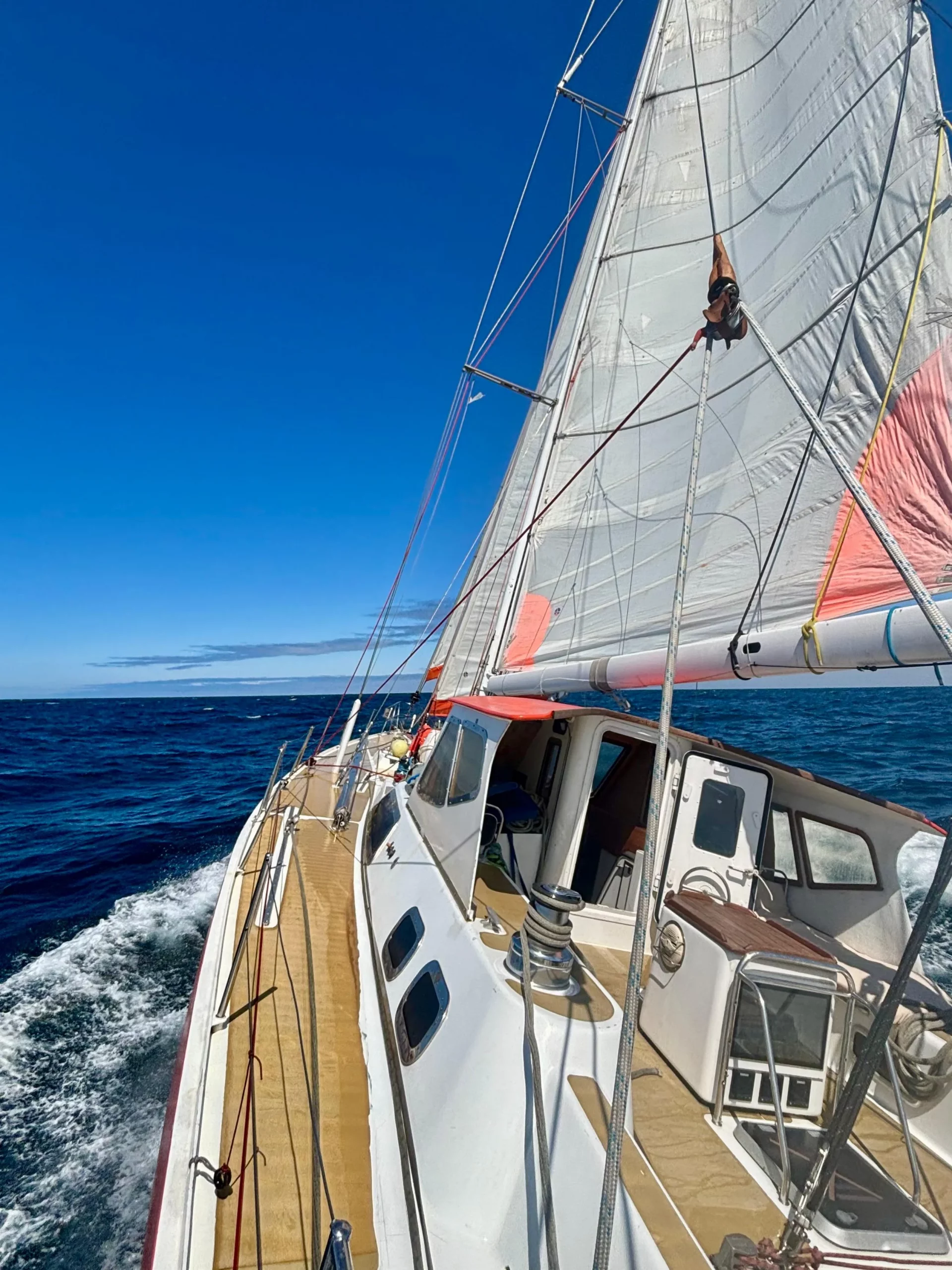
Also, in the summer, there’s no wind and usually a lot of sun, so the sunsets are dreamlike. The first time I saw that landscape, I thought I had died, that I was in heaven (laughs). As for the sails, they’re more complex to raise because they weigh over 100 kilos and the gaff is made of solid wood. But if there are passengers, we raise them manually, without an electric windlass, because you need at least three people for one halyard, and it’s a fun task. Folding or furling those sails can take hours and requires a lot of strength: they’re made to last for years and years. It’s like folding a rug. The red sails are only meant for taking photos; they’re very light, so you can raise and lower them without any problem. Just raising the mainsail takes an hour and a half.
On these boats, we carefully monitor the forecast because you can’t raise and lower the sail so easily. For example, if it’s calm, we leave the mainsail up, tuck it in mid-sail, and secure it; when the wind returns, it’s already set. We never sail downwind either, because it’s very dangerous: a snag with that boom is fatal. It needs a stay to secure it completely.
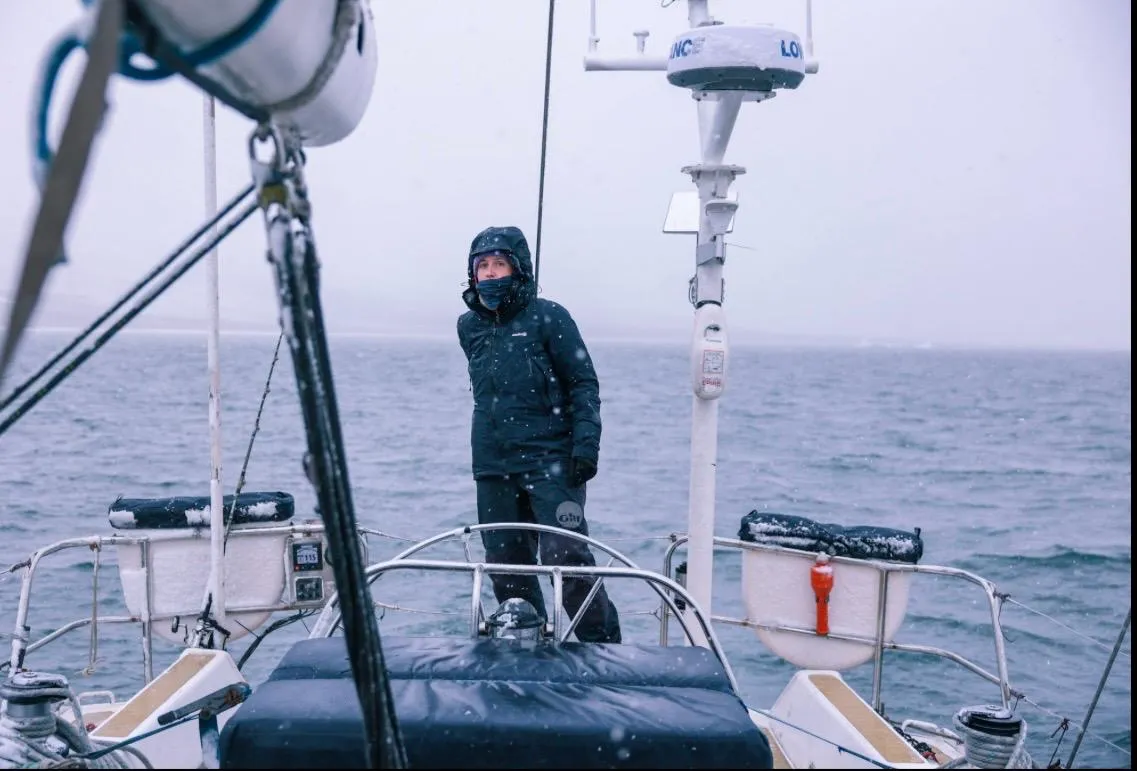
Rochi Costa, captain of the Challenger 67 in Greenland, with icebergs and snow, 2025
How did the promotions within the crew occur?
After that first trip to Greenland, the company offered me a job as a cook in Antarctica, because I love to cook and eat well, and they must have liked me. But I told them I wanted to go as a navigator, as first mate. He kept saying no, how could I, since I was a woman. That whole thing about having to prove we can really do it. So every time something happened and I solved it, I’d say, “See? Here I am, first mate” (laughs). I gradually convinced him, and the following month, they called me to finish preparing another ship that was in Brazil for maintenance, with a team of carpenters, electricians, and welders. I learned a ton about each trade and really gave it my all.
I went all the way to Ushuaia. Then they called me to go to Antarctica, but I broke my wrist. Shortly after, they called me to go from Ushuaia to Cape Town, in Africa, passing through the remote islands of the South Atlantic. It was a 45-day voyage, now as first officer, with a crew of seven and five passengers: all men and Russians. It was a super interesting trip because it’s a fairly unusual route. It took us 22 days to reach Bouvet Island, which belongs to Norway, is uninhabited—only penguins, whales, and sea lions—and has a volcano and glaciers.
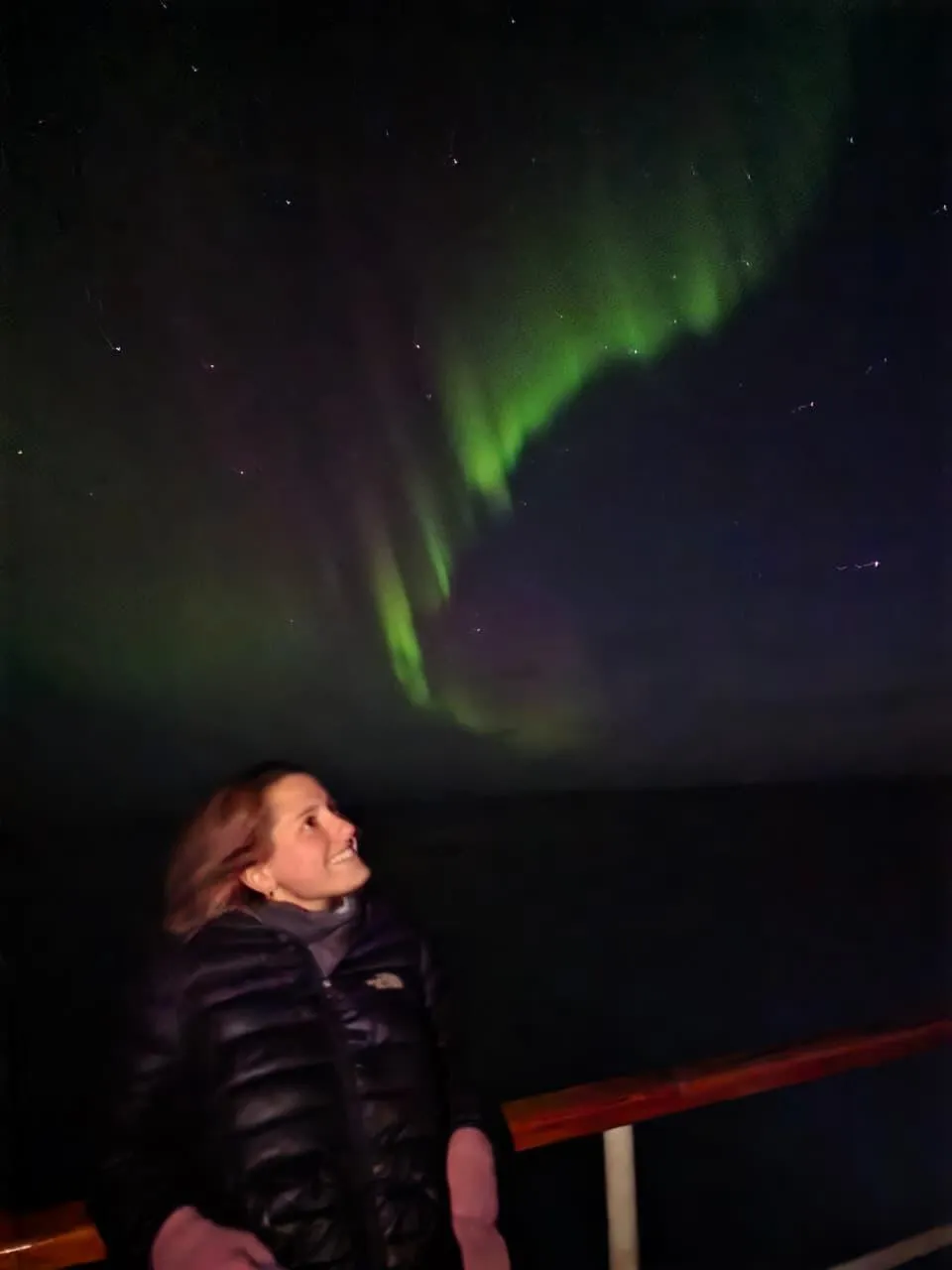
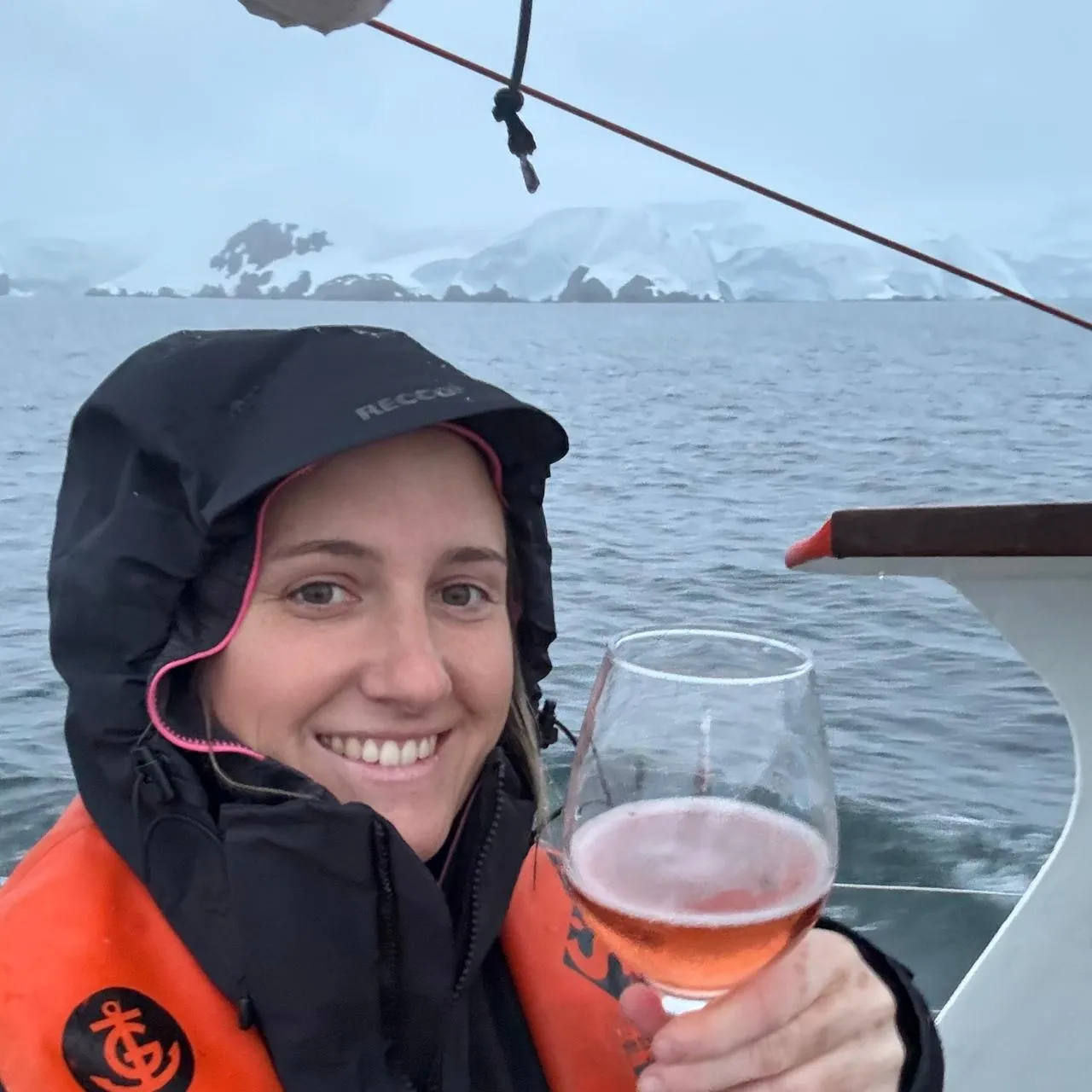
And how did you feel in the role?
That first voyage was really tough. I felt like someone was constantly trying to take my place or questioning my decisions. Luckily, when someone tried to undermine me, the captain would ask them to listen to me. I also had to figure out how to give an order, what the best technique was as a woman leading a whole crew of Russian men (laughs). It was really hard to start leading.
After that, I continued on to Iceland, East Greenland, and back to Brazil and Antarctica. That year I spent nine full months at sea as first officer—intense! Last year, I went to Greenland as captain of a Challenger 67, which I crossed from the Azores, and then I was in charge of a 37-meter schooner. We did cruises in Greenland for two months, and on the way back, we crossed to the Azores.
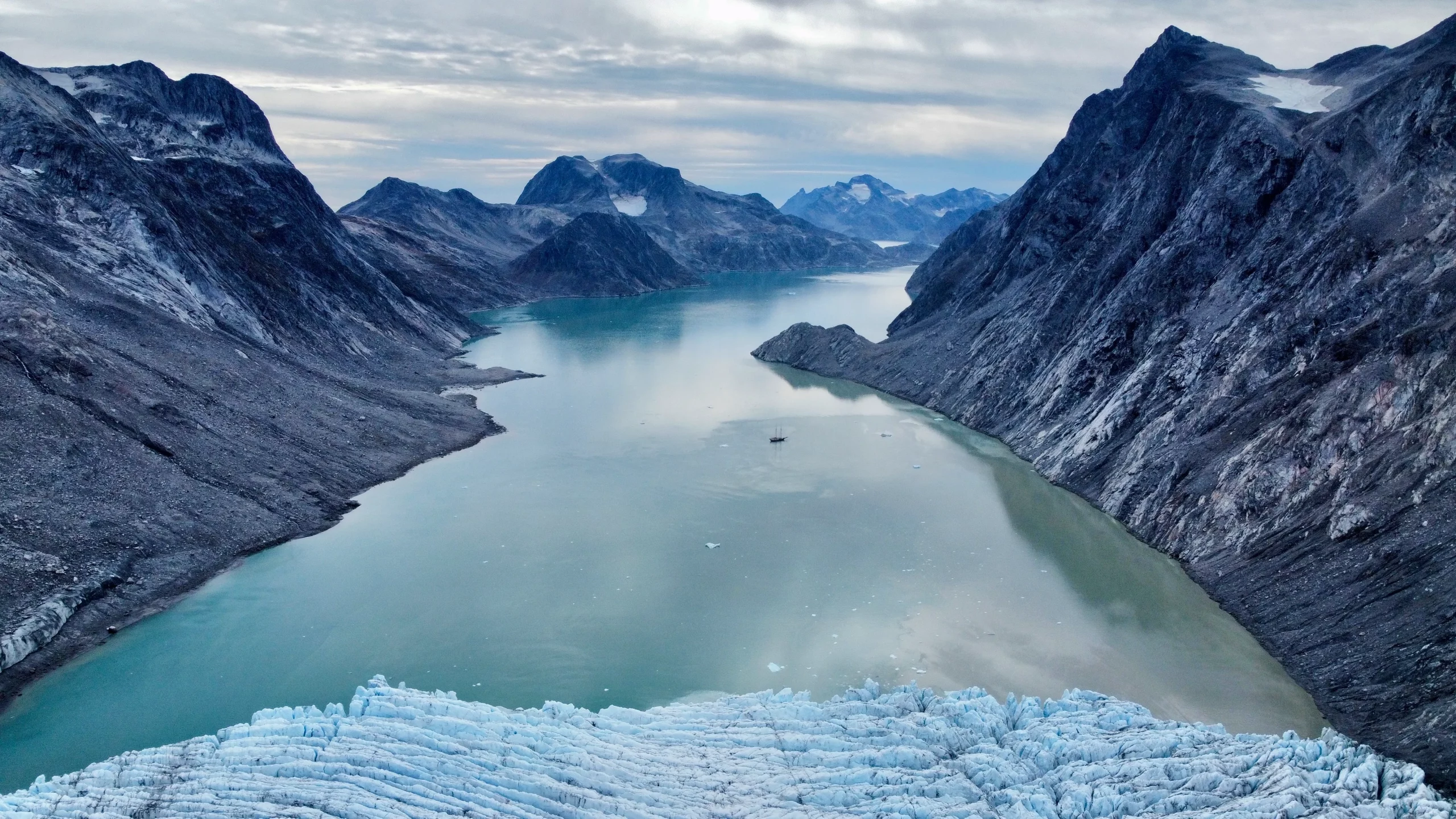
Elsi in Greenland, glacier, 2024
Rochi, to wrap things up, what are your plans now? What other destinations would you like to explore?
Now I realize I’d like to have a bit of a city life and also some time at sea: when I’m not sailing, I stay home in Buenos Aires. The company also gave me logistics work for those months when I’m not on voyages, which gives me a bit more certainty because otherwise I only got paid when I was sailing. The hardest part of this life is that when you leave, all your projects are put on hold: your family, your partner, your friends. The idea of traveling is very exciting, but after a couple of years, I also want some stability in one place. A bit of balance between the two.
Right now, for example, I’m organizing the whole season for the trips to Antarctica, where we have bases in Ushuaia and Punta Arenas. In May, I’m setting sail as captain for a trip to Greenland and Canada—where we’re going to visit an indigenous community, which I’m very excited about because nobody goes there and there’s practically no tourism.
As for voyages, I’d love to explore all the Polynesian islands in the middle of the Pacific, and also sail the Northwest Passage to Alaska and Kamchatka. At the same time, I want to lead some expeditions on my own, with passengers who want to join me, and I’ll organize them entirely myself. As I gain more financial independence, I’ll be able to plan any project, but for now, I’m focused on Antarctica and the Arctic as well. What I love are the little-known places, the ones no one talks about or only vaguely known because they’re not tourist destinations. I’ve already made the leap from cook to captain, so I’m wondering, what’s next?
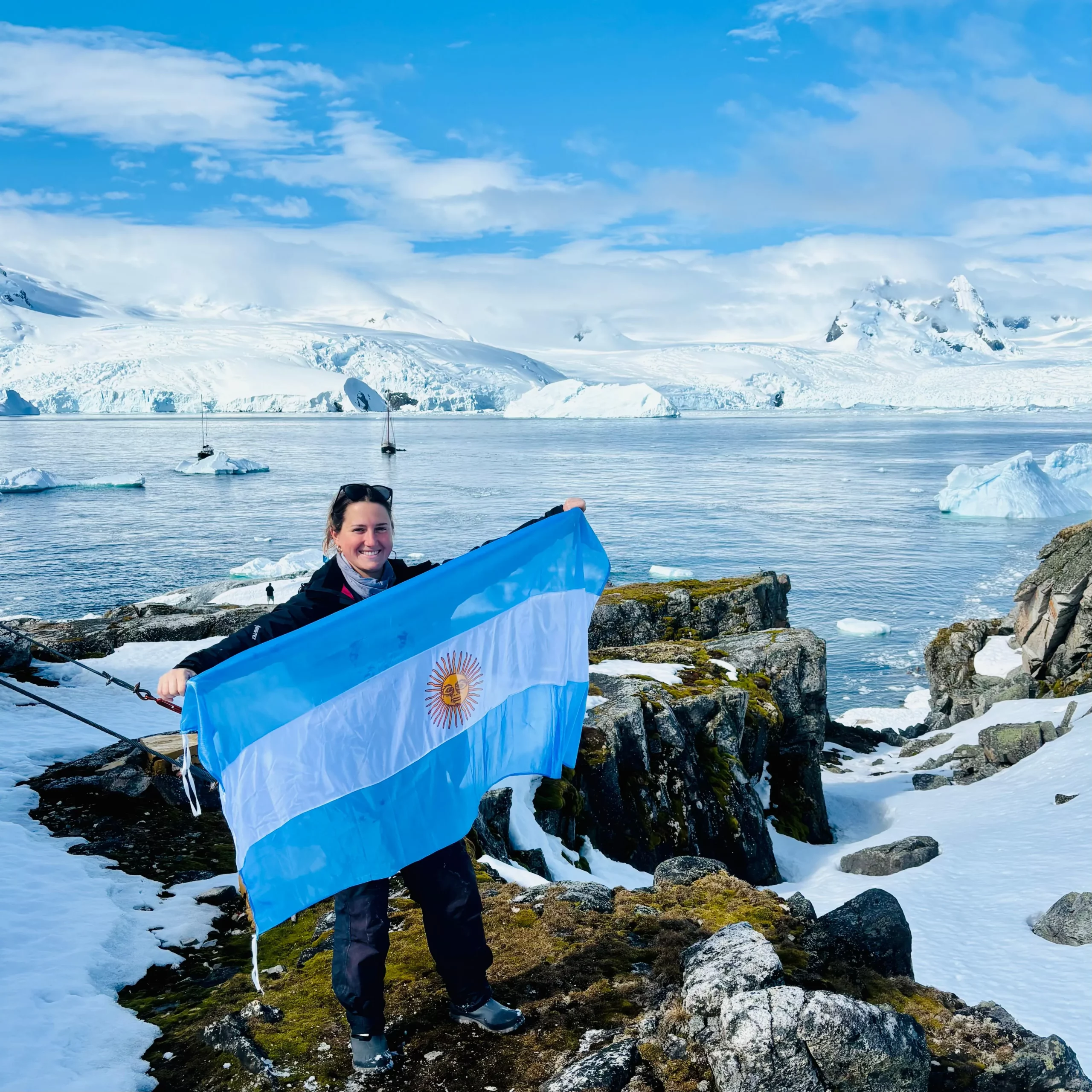
Rochi Costa, first time in Antarctica, as first officer of the schooner Amazone, 2024
From “Navegantes Oceánicos” we thank Rochi Costa for her collaboration in this fascinating interview and wish her the best of luck in the future.
Fair winds and following seas!



