
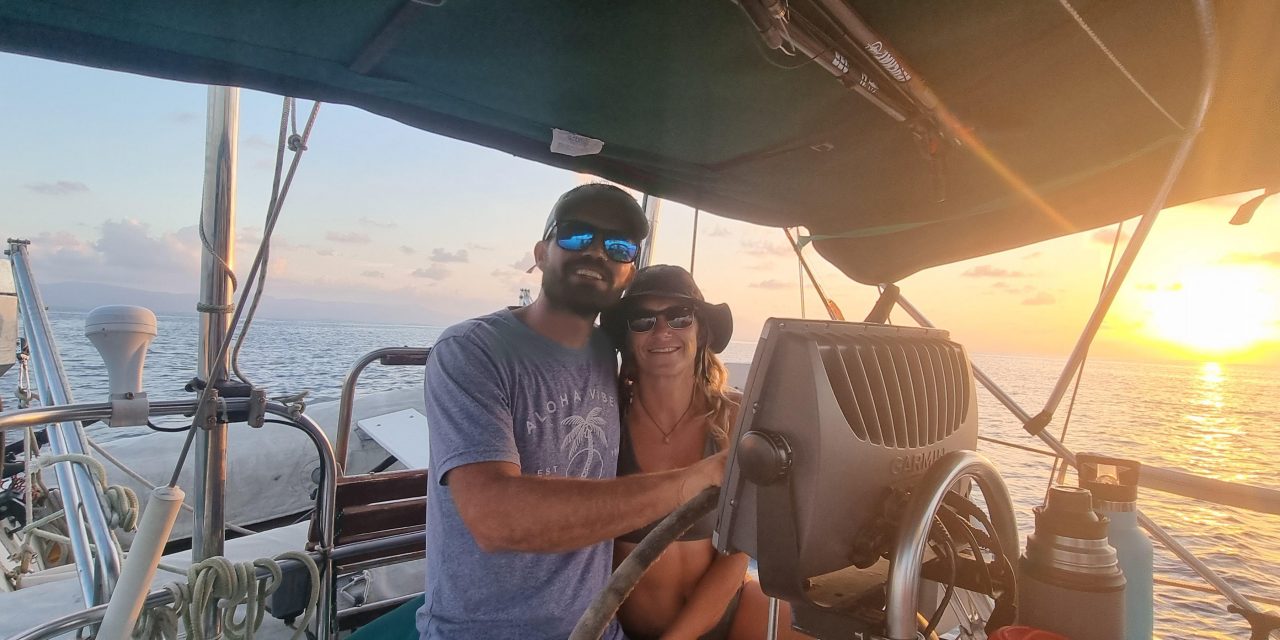
An Argentinian couple, María Minuto and Sebastián Spigolon, left their lives on land to sail the Caribbean: after a couple of years in San Blas, they ventured out to Baja California and plan—in the future—to reach Polynesia. Today, from the Gulf of Panama in the Pacific, they tell us how this adventure began with their three teenage children.

One day, María Minuto and Sebastián Spigolon, an Argentinian couple with three teenage children, made a decision: when they turned 48, they would set sail around the world, using whatever savings they had and whatever boat they could afford at the time, no matter the cost. Work, raising children, their parents, an accident that changed everything, and COVID-19, which had sickened some friends, had pushed them to their limits: in short, life itself, with all its ups and downs. So, without waiting for that deadline, they decided they had to stop postponing their dreams until they no longer had the strength to drop anchor or raise a sail.
However, the plan was ultimately moved up a few years. The twins were older now, starting university. Their youngest daughter, Joaquina, was about to start high school. They all joined the adventure (although sometimes they would disembark in one port only to re-embark a few months later in the next). The transition meant spending some months at sea, others on land (when their work on the coast, a restaurant, during peak season allowed for these trips back and forth), until they finally decided to cast off and buy the big boat: a Beneteau Oceanis 473. The “Martini”.
“We’re currently sailing through the Gulf of Panama. We’re heading towards Costa Rica, past the famous Punta Mala, a region known for its very strong swells and wild waves. Luckily, we’ve been sailing very well: we chose a window of wind that promises a comfortable crossing, and we’re enjoying calm seas and a beautiful moon,” they told Navegantes Oceánicos one sunny morning from the coast where they anchored in the early hours of yesterday. They were surprised—and amazed—when they woke up, went up to the stern, and saw the mangrove landscape and the damp scent of the jungle wafting along the shore.
The plan for this voyage—which they are undertaking in partnership with another family, El viaje del Bohemia—includes continuing to the Sea of Cortez, reaching Baja California, and, perhaps a few years later, crossing over to French Polynesia. “Our youngest daughter is 16, she’s in her last year of high school, and she might want to study Marine Biology in Baja California. She scuba dives, spearfishes, and also freedives. We’ve already looked at some possible universities. That will also determine the timing of the trips we’ll take in the coming years.”

How did you begin sailing? What were your beginnings and what resources did you have?
(Sebastián)
I was born in Mendoza and always worked as a mountain guide. I loved the sea and boats, but I didn’t have access to them (it’s a province at the foot of the Andes Mountains). María is from Buenos Aires, but her family had a business in Cariló (on the Argentine coast, in the Province of Buenos Aires). In fact, we met on a horseback riding trip, the Crossing of the Andes, where I was her guide. When we decided to be together and start a family, we moved to the coast to work in her family’s restaurant, because she had just graduated with a degree in economics.
Around that time, about 20 years ago, we started traveling from Pinamar to Mar del Plata (about 100 kilometers away) for her to take a sailing course. We also went back and forth to Mendoza in our small car with our three-year-old twins, Josefina and Mateo, until we had a very serious accident on the highway. María survived by sheer luck; she was in very bad shape. At that point we abandoned the helmsman course, but we really liked diving and started traveling and connecting with it.
What happened next?
(Sebastián) We always thought about getting back into sailing. At one point, I completed the course again, and in 2020, we bought a 26-foot sailboat that was moored in Mar del Plata. We would go back and forth on weekends, in the middle of winter, to sail. It was difficult.
(María) Because we had the restaurant on the coast and worked the entire summer season, with those work hours we could only go sailing in the dead of winter. We were freezing.
(Sebastián) The pandemic then brought the world to a standstill and allowed us to think about what we wanted to do. We were working so much, the restaurant was so all-consuming, every day, at any hour, that we set a date: we had said we were going to retire at 48, with what we had earned up to that point, because our youngest daughter was finishing high school. What we wanted was to make that youthful dream a reality, even though we saw the date approaching… (laughs). We didn’t want to be 60, save up the money, buy a boat, and then no longer be physically able to raise an anchor. Up until then, we had a conventional family, our business, a house on the coast of Argentina, with a desire to explore and travel, but the pandemic helped us make up our minds.
As soon as the borders reopened, we got a 34-foot boat in the Caribbean, and I called María (whose mother was very ill, in an ambulance, with COVID). She didn’t even open the link I sent her and told me :
“Yes, buy it, without hesitation. Let’s go”.
It was the first boat we’d seen in San Blas that we liked, owned by a man from Córdoba, who had just put it up for sale. We realized that we were going to spend much more time on board that boat than we had thought, even though at that time we were traveling back and forth depending on the season in Argentina.

How did you come to own this new ship? What are its features?
(María) Two years ago we went from Bocas del Toro to San Blas and, since the kids were finally spending a lot of time with us, surrounded by friends, we decided we needed a bigger boat to be able to travel and sail comfortably: in Panama we bought this sailboat.
(Sebastián) Yes, we had been looking for boats in Spain or the United States, but then the opportunity arose to buy this boat, the Martini, which belonged to a friend of ours. At that time, we had been in San Blas for three years, and that’s why we also prepared it for charters. Along the way, we decided to sell our restaurant on the coast of Argentina. All the transitions we made over these five years finally led us here. Because everything from our goal of 48 years to the present was brought forward.
What elements do you consider essential for ocean voyages? What are the main qualities of this ship?
(Sebastián) Safety, for me, is non-negotiable. I’m quite obsessive about everything; I study it in depth. I have a lot of experience in safety from the expeditions I’ve done in my profession, with weather conditions that must be taken into account both in the mountains and at sea. The preparation, the meteorology, the safety procedures, how to manage risks—it’s all very similar.
The Martini is a 2004 Beneteau 473. In the two years since we bought it, we’ve dedicated ourselves to equipping it, knowing what we needed for crossings and what we expected from this boat: we changed the sails, bought a watermaker, and we really liked that the stern is open because we spend a lot of time on the water—fishing, windfoiling, freediving, everything. It’s a very solid boat; it sails very well. Then, of course, there’s comfort. At one time, on our other sailboat, we’d collect rainwater, and you can live perfectly well, but obviously, adding comforts makes it better. But they are not a determining factor.
What features does this ship have for this voyage?
(María) It was a big change going from a 34-footer to a 47-footer. It moves less, everything is more comfortable. On the 34-footer, everything was manual; we didn’t even have an electric windlass. That boat was a great training ground. It was an ’80s boat that sailed close-hauled a lot; it was built to heel over. It got really annoying with big waves. Now we feel like we’re on a cruise ship. We have four cabins, two bathrooms, a spacious stern, it’s super calm, and we feel very safe. Also, here in the Caribbean, if something breaks and you call someone, they tell you they’re coming tomorrow, but they don’t arrive for three months. You have to try to be self-sufficient with everything because one of our sails broke, and we had to sew it all over again with a generator and a small machine.
(Sebastián) In the Southern Caribbean, we also learned a lot because it’s quite a rough sea. When the trade winds pick up and the waves are big, conditions become difficult. From the Colombian coast to Bocas del Toro, where we used to sail, there are large waves and cross currents, and strong winds. Another thing is that we’re quite obsessive about maintenance, which is essential for the isolated places we like to be: we did everything from the sunshades to the parasols, we updated the entire electrical system. They seem like very expensive things, but since we studied and did them ourselves, it’s not so bad. I think that having the tools and some knowledge gives you a lot of confidence and independence. Now that we’re back out on the water, we’ve seen that the boat is very well prepared and very comfortable for a pleasant sail.
But you’ve surely had less happy experiences too.…
(Sebastián) Yes, one night, while we were crossing the Panama Canal with all the big ships, our engine broke down. It was a classic problem with the filter and the diesel fuel, but we didn’t know that. There were three of us on board. We had a rough time at the time. Yesterday, for example, we were left without an autopilot, and now I don’t stress about it as much because we have more experience, or it’s more natural to figure out how to fix it so we can keep going. What we do know is that you have to have the engine and sails in good working order, and electricity and water. That’s essential. In the Caribbean, we didn’t have any major problems either, because where we were there aren’t hurricanes or high or low tides, but there are very violent storms with lightning (which is very common). We experienced nights with very strong electrical storms, where every boat was struck by lightning.
(María) Having internet access all the time also changed things a lot for us. Because you can look up anything, even for security purposes.
(Sebastián) I think Starlink was a complete game-changer. Without it, I think we would have had to wait a bit longer, because we wouldn’t have had school or the communication with our children that’s so important at this stage when they’re on land. It would have been impossible without this possibility. I think it opened the door for many people to this kind of life…
Is it an expensive life?
(María) No, not at all. We live very frugally here; we don’t spend money on anything. Money isn’t that important. In fact, there are people sailing around the world for the second time in a tiny boat while others are doing it on a giant cruise ship. The cost of living is infinitely less than, for example, in a house with taxes, if you pay for school, the gym, the car, gas. We once did the math: if we left our house in the winter, we’d have enough to live on the boat without working at all. Obviously, we had that job during peak season, and we closed the shop to come here and sail for the whole winter.
Now we have to rethink how to continue without the restaurant and finance this rather austere lifestyle. In the city, we spend much more money than here, where there’s hardly anywhere to eat. For starters, you get sick more often on land (laughs). We also eat a lot of what’s available, what’s left over, what might go bad, not what we really want. Even a lot of what we catch. That’s why at some point you have to take a chance, not always just stay in the “let’s go” phase.
What changes did you notice when crossing from the Atlantic to the Pacific?
(Sebastián) These days we’re blown away by all these changes, seeing everything for the first time, because it’s so different. The marine life: the landscape, the animals, the sea, the way we sail—it’s truly beautiful. Two days ago we were on a dry island, with cacti, nothing, and now we’re on a coast teeming with mangroves, birds, and monkeys. We arrived last night and didn’t even know where we were; this morning we woke up and couldn’t. It’s all so gorgeous.
Three days ago we went to a freshwater river. I don’t know, it’s constantly changing. I realized last night that we were in the jungle because even the smell changed with the humidity. We tried it in the Balearic Islands now, after spending two months in Spain, but this is spectacular because we really love the wild, the tropical.
Unlike other families who live and sail aboard boats with young children, you have teenage or young adult children, how do you handle this?
(María) At first, when we started, the kids were excited about the adventure. But in the beginning, it wasn’t so easy taking them out to sea without them complaining. The older ones were starting university, and with Joaquina, we’d ask for permission from school to take her for a month or two. We were constantly going back and forth. Two years ago, she started homeschooling because she loves marine life, but also because of her own typical teenage lifestyle. So she spends some time there and some time here, going on some trips with us and returning to Argentina at other times. We planned to keep it up until she was ready, because the plan was also to do it when they became independent. We didn’t want to be stuck watching movies at home (laughs).
However, everything fell into place and happened a bit faster than expected. It happened a little sooner than anticipated, almost five years of transitions, knowing that we’d have to abandon the plan if she didn’t want to continue this life on board or if she decided she wanted to study medicine. Now, for example, he traveled to be with his friends from his previous school at UPC (a celebration to commemorate the last first day of classes at school) and he put our house as the venue, meaning he asked me to arrive three days later to arrange everything (laughs).
(Sebastián) In the end, everyone ended up spending much more time with us than we initially expected, which is why we decided to expand the boat. In fact, Mateo is with us now, doing this leg of the trip. He’ll get off in southern Mexico or Costa Rica because he’s finishing university in Mar del Plata. Josefina is finishing university in Mendoza. Joaquina is 16 and finishing her last year of high school. Last year, she made a big point of wanting to go to her friends’ quinceañeras, and her last first day of high school, understandably, was a bit chaotic. But at the same time, she really loves nature. Now she wants to study Marine Biology at university, which is why we were going to Baja California to see if we could spend a couple of years there until she settles in and then continue our own journey.


So what would be the ideal situation for living on board with a family?
(Sebastián) Ideally, we would have had the younger children with us, because it’s true that we don’t see boats sailing with teenagers; they need their peers, their own space. Joaquina was always with older people or looking after the younger ones. Over the years, we’ve met many families with children in school, either virtually or in person, accustomed to life at sea, who live well on the boat, but who at 12 or 13 years old already want to go to school for social reasons. It’s vital. I was trying to remember what my last year of high school was like, and exactly, my whole world revolved around my friends and school.
(María) I think she’s the one who guided us here. Now that she’s finishing high school, I think she has a clearer vision of what she wants to do. Just yesterday we spoke with her, who’s in Argentina until next month, because we were telling her that we saw whales and dolphins here, and she was saying, “I really want to be there.” She’s also a girl who spearfishes, does freediving, and for her, this whole life is ideal, because if she were another teenager, it wouldn’t flow so naturally..
What are your next plans? Are you staying in Baja California?
(Sebastián) The plan is to go to Baja California and later, once Joaquina is settled here in a year or two, continue on to Polynesia. There’s a state university there that we want to apply to, because she also wanted to study Marine Biology, thinking about all the animals she’s seen here. They say Baja is very large, perfect for exploring, and also for building a community with other families and friends’ boats that we’ve met over the years. We have to get there before May, which is when the hurricane season starts.
After that, we envision continuing to sail. We’d like (in a few years), if we have the opportunity or the possibility arises, to also have a catamaran so we can live on board full-time when we’re older. If I end up living there permanently, and it becomes my home, I think it will be more comfortable for sailing or anchoring that way. A few years ago, we didn’t have the time, the money, or the lifestyle: we got here by dreaming, and we have nothing to lose by thinking about these new possibilities.

Links:
Sailing Martini: https://www.instagram.com/sailing.martini/
From “Navegantes Oceánicos” we thank María and Sebastián for their collaboration in this interesting interview, in which they shared their experiences of life aboard a sailboat with their Sailing Martini project.
Best of luck in the future, fair winds and following seas!

