Introduction.
As we saw in the chapter “Ocean Currents: General Characteristics,” surface ocean currents are primarily influenced by the prevailing winds in each region and at each time of year.
In the case of the Indian Ocean, these ocean currents follow a similar pattern to those of the Atlantic and Pacific Oceans, but with the following important differences in the Northern Hemisphere:
– The portion of this ocean located in the Northern Hemisphere is relatively small, due to the vast landmass of the continent.
– The monsoon winds have a significant influence in this northern part of the Indian Ocean, completely altering the current regime depending on whether the monsoon blows from the southwest or the northeast; these currents can also become very intense.
In the Southern Indian Ocean, however, the general circulation of the currents is counterclockwise throughout the year and is less affected by monsoon winds.
Monsoon winds are greatly influenced in winter by the position of the powerful Siberian anticyclone, and by the position of the Intertropical Convergence Zone (ITCZ) which rises significantly in latitude in summer (and falls in winter); as we see in the following figure.
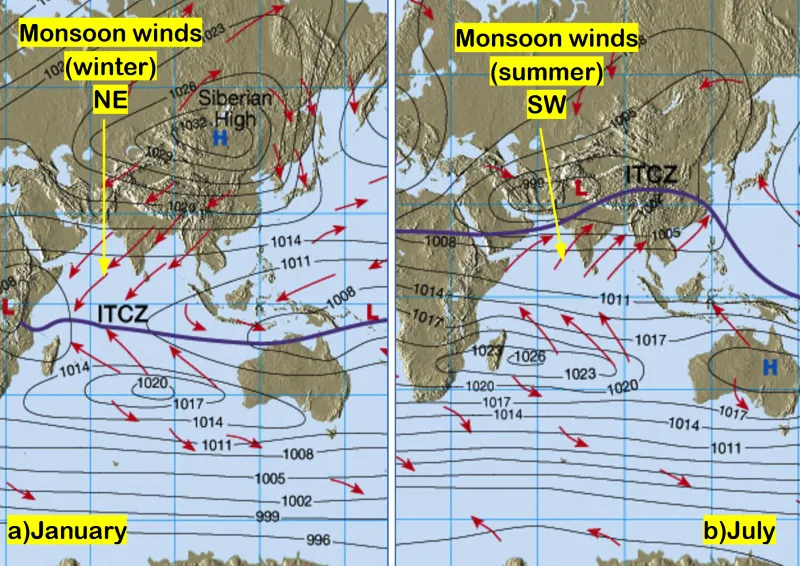
Monsoon winds in winter and summer. Image source: Wikipedia
The northeast monsoon prevails during the Northern Hemisphere winter, while the southwest monsoon prevails during the Northern Hemisphere summer.
In this chapter, we will describe the different currents of the Indian Ocean. In the North Indian Ocean (heavily affected by monsoons), we will highlight the differences between the two main periods of the year: the northeast monsoon (winter) and the southwest monsoon (May to October). In the Southern Indian Ocean, there are fewer differences throughout the year because it is practically unaffected by monsoon winds. Efecúe Log In para desbloquear.Este contenido solo está disponible para subscriptores de navegantesoceanicos.com