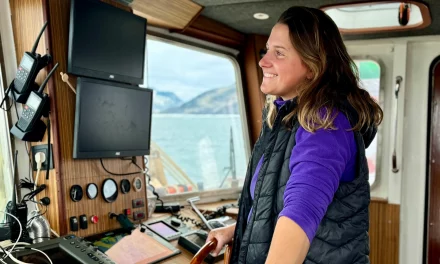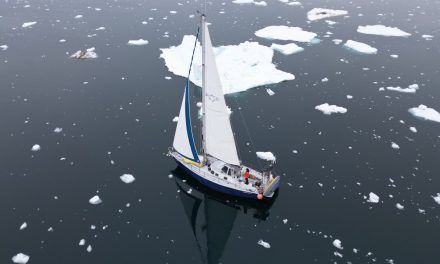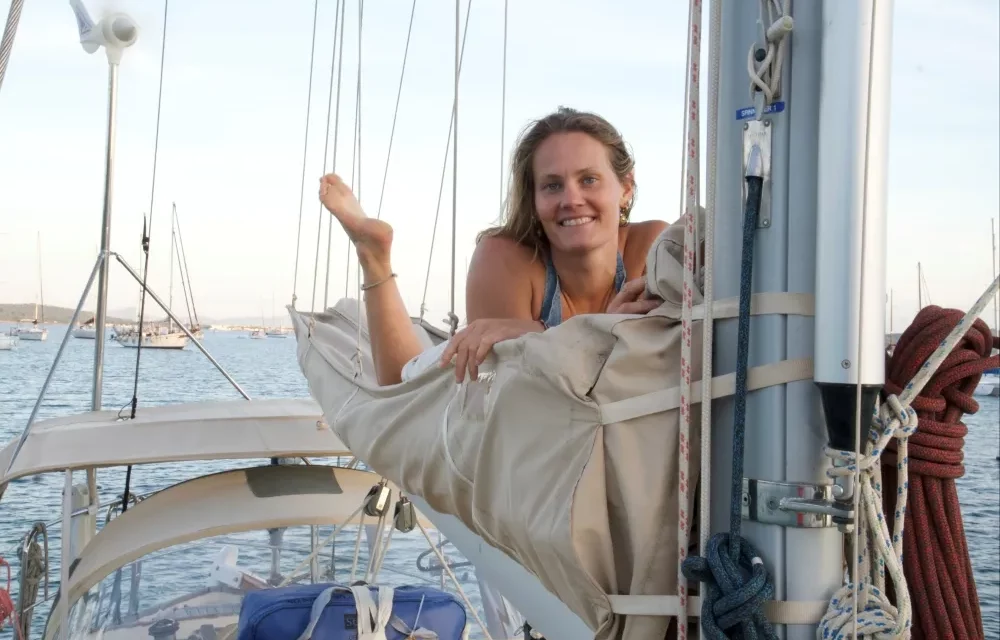
Mara (Helga Marie Løvenskiold Kveseth), born in Norway, is an adventurer, former elite athlete, and offshore sailor with a passion for nature. Norway has the longest coastline in Europe and a rich maritime tradition, making sailing an important part of the country’s culture. However, Mara grew up in the middle of the forest – far away from any sailboats. She sailed for the first time when she was 15, but it has been over the last 4 years she has actually started to sail a lot – gathering over 45.000 nm of offshore sailing, a circumnavigation and 6 ocean crossings. On something that might have seemed like a whim, she decided to sign up for the longest and maybe toughest sailing race in the world. All without any experience sailing solo.
The Golden Globe Race is a retro solo, non-stop, around-the-world yacht race in which sailors circumnavigate the globe using boats and technology similar to those available for the original 1968 race. Competitors navigate by celestial navigation and traditional methods, without GPS, satellite communications, or other modern navigational aids.
After acquiring a Saltram Saga 36, a proven classic ocean-going yacht, Mara embarked on an extensive refit and preparation programme. This included qualifying ocean passages, safety training, and meticulous preparation of both herself and the boat for a solo circumnavigation via the world’s three great capes.

Mara, can you tell our readers about your beginnings in sailing?
What experience do you have to face this challenge?
I grew up in the forests of Norway, so I definitely wasn’t one of those kids who grew up sailing. I first discovered sailing when I was about 15 years old after my uncle took me sailing in Greece. He had crossed the Atlantic himself, and I remember being completely fascinated by the freedom and adventure of it all. From that point on, I just wanted to spend as much time on the water as I could.
Before joining Sailing Ripple Effect, I sailed recreationally with friends whenever I had the chance, and later, while living in Greece, I earned my first sailing qualifications and gained more experience. Then Sailing Ripple Effect came along. What was supposed to be a six-month project turned into four years of living aboard, crossing oceans, eventually becoming captain, and learning what it really means to be self-sufficient at sea.
Preparing for the Golden Globe has been about building on that foundation while learning to do it all alone. Over the past months, I’ve focused on developing my solo sailing skills, including completing my first solo Atlantic crossing, learning celestial navigation, and preparing both myself and Showgirl (my boat) for the challenges of a non-stop circumnavigation. I think every step has taught me something new, and that’s probably what has given me the confidence to take on this race.
What motivates you to face this solo ocean sailing challenge?
I think it’s a combination of a lot of things. The more time I’ve spent at sea, the more I’ve realized it’s where I feel most alive. After Sailing Ripple Effect ended, I remember feeling a bit lost because for four years I’d been part of something that had a real purpose. I knew I wanted whatever came next to feel just as meaningful.
I’ve also always enjoyed pushing myself and learning new things. The Golden Globe Race is one of those challenges where there’s always more to learn, whether it’s celestial navigation, weather, boat preparation or simply becoming a better sailor. That process has been just as rewarding as the race itself.
What really draws me to this race is that it strips everything back. It’s just you, the boat and the ocean. There are no shortcuts and no modern technology to rely on. I find something really beautiful about that simplicity. It’s demanding, but it’s also incredibly honest.
I also hope that by sharing the journey, people can see what this kind of adventure is really like. There are amazing moments, but there are also difficult, ordinary and even boring days. I think showing the whole experience makes it much more relatable, and if it encourages someone to take on a challenge they’ve been dreaming about, then that’s a wonderful bonus.

How do your family and friends feel about you doing this challenge?
I feel incredibly fortunate to have the support of my family and friends throughout this journey. They know how much this challenge means to me, but they also understand what it involves. Ocean sailing is unpredictable, and I think it’s only natural that the people who love you carry some of that uncertainty with them.
For me, the hardest part has never been the sailing itself. It’s leaving. I chose this challenge because it’s something I deeply want to do, but the people I leave behind didn’t make that choice. My mum has told me that she’s afraid every day I’m at sea, even though I’m having the time of my life. That has made me appreciate that an adventure like this isn’t experienced by just one person. The sailor may be the one crossing the ocean, but the family makes the journey in their own way.
That is also why preparation has been so important to me. Every mile sailed, every system checked, every qualification passage completed, and every skill learned hasn’t just been about preparing myself. It’s also about giving the people who care about me confidence that I’ve done everything I possibly can before I leave the dock. I don’t think you can remove all of the worry, but you can show through your preparation that you’re taking the responsibility seriously.

How was the selection and purchase process for your sailboat for the GGR?
What qualities of the boat were decisive?
Choosing the right boat was probably one of the biggest decisions of the whole campaign because, for the next eight or nine months, she’ll be my home, my workplace and the thing I have to trust completely – and I cannot leave. I looked at several different boats, but I was never looking for the fastest one. For me, safety and reliability were much more important.
I was actually drawn to a heavier boat because it gave me a greater sense of security. I also knew I would be carrying a lot of equipment and provisions for a non-stop circumnavigation, and a heavier displacement boat is generally less affected by that additional weight than a lighter one. That gave me more flexibility when preparing for such a long voyage.
I chose a Saltram Saga 36 because it’s a proven offshore design with a strong reputation for looking after its skipper in difficult conditions – but also because it felt like home. Honestly, after I saw Showgirl it was not really a question any longer. Buying the boat was really just the beginning. The months that followed were about getting to know every part of her through the refit and many miles at sea. Every mile has helped build trust, and today I feel we know each other very well.
How has the boat preparation been? Did you have to make any modifications? What equipment is essential on board?
Preparing the boat has probably taken far longer than I expected because every time you solve one problem, you discover something else that needs attention. It’s been a constant process of improving, testing and learning.
We’ve done a complete refit, including replacing the entire rig, installing a second foresail and a second Hydro-vane. I also had to fit the communication equipment I’ll need for the race, which basically means downgrading everything to 1968 standards like my SSB radio. Inside the boat, I’ve also secured everything that could become dangerous if the boat were knocked down, because once I’m in the Southern Ocean there won’t be anyone to help.
The Atlantic crossing was a really important part of the preparation because it allowed me to test the boat properly over several weeks at sea. It confirmed some things, but it also highlighted areas I wanted to improve before the start.
As for essential equipment, I’d say the Hydro-vane is incredibly important because it will steer the boat for most of the race. My sextant, paper charts, and HF radio are also fundamental because they’re how I’ll navigate and communicate under the Golden Globe rules. But more important than any single piece of equipment is understanding how everything works. I’ve spent a lot of time learning mechanics because during the race, if something breaks, I’m the one who has to fix it.

What sailing trips have you done as part of your preparation for the GGR?
My preparation has been quite gradual. I already had several years of offshore sailing experience through Sailing Ripple Effect, where I spent four years living aboard, crossing three oceans and eventually becoming a captain. That experience gave me a strong foundation, but preparing for the Golden Globe meant learning to do everything completely on my own.
The biggest sailing trip as part of that preparation was my solo Atlantic crossing from just outside Casablanca, Morocco, to Saint Martin. It was my qualifying passage for the Golden Globe, but more importantly, it was the first time I was completely responsible for every aspect of the boat for several weeks. There was no one else to discuss decisions with, no one to take over a watch, and no one to solve problems but me.
The crossing gave me the chance to see how both the boat and I performed over a long period at sea. It confirmed a lot of the work that had gone into the refit, but it also showed me where I could still improve. I came back with a much clearer understanding of what worked, what needed changing, and what I wanted to refine before the start of the race. Every passage has been about arriving at the start line knowing both the boat and myself as well as I possibly can.
Have you completed any specific training for the GGR (e.g., first aid, safety, or mechanics)?
Any advice from previous participants?
Yes. Preparing for the Golden Globe has involved much more than just sailing. I’ve completed basic first aid, a medical course specifically for sailors, and a survival course. I also hold both long-range and short-range radio certificates, in addition to my captain’s licence. Some of those qualifications I already had, while others were part of preparing for the race.
Beyond the formal training, I’ve spent a lot of time learning celestial navigation, marine mechanics, and understanding every system on the boat.I’ve also tried to learn as much as I can from people who have already experienced the Golden Globe. Meeting Susie Goodall and hearing her talk about what she lived through during the race was incredibly valuable. I’ve also been reading books about the race and speaking with experienced sailors whenever I have the chance. Every skipper has a different perspective, so I’ve tried to learn from all of them while finding the approach that works best for me and my boat.


Can you tell us about your typical days routine when sailing alone?
How do you organize your meals and sleep?
There isn’t really a typical day because the weather always decides what the day looks like. If the wind changes in the middle of the night, that’s my priority. If everything is calm, I can catch up on jobs around the boat, cook a proper meal or simply enjoy a quiet moment. I’ve learnt to be flexible rather than trying to stick to a fixed routine.
Most mornings start by checking the boat and the sails, making sure everything is working as it should, and then checking my position and planning for the day ahead. Throughout the day there’s always something to do, whether it’s trimming sails, navigating, making small repairs or keeping the boat organised.
Meals also depend on the conditions. When the weather is calm, I enjoy taking the time to cook. For the Golden Globe I’ve planned my food so that I can choose meals depending on the day. I’ll start with fresh fruit, vegetables, eggs and cheese, then gradually move to my preserved food stores. Some evenings I’ll be able to enjoy one of the gourmet meals prepared by a French chef, while on rough days I’ll probably reach for a dried meal because it’s quick, hot and easy.
I also always squeeze in a workout, it can be a proper strength session or just some light stretching. The important part is just to keep that a part of my routine. It always makes me feel better – no matter what.
Sleep has probably been one of the biggest adjustments. Close to shore and other boats you have to survive with 20 minutes at the time, while out at sea its almost scary how quickly you get used to just sleeping while zooming through the water. I have noticed how very much sleep affects my days, so it is something I prioritize very strongly. I always reef before the night. I don’t want a bad night of sleep because I worry about the wind (more than I already do).

The GGR is a tough, self-sufficiency test. What do you consider to be the biggest challenges you will face?
For me, one of the biggest challenge will be carrying the responsibility alone. Every decision, whether it’s about the weather, navigation, sail changes or a repair, will be mine. When you’re sailing with other people you can talk things through, but in the Golden Globe there isn’t anyone to do that with.
I also have a great deal of respect for the Southern Ocean. It’s one of the most demanding parts of the race, and I know how important it will be to look after both myself and the boat. Once the race begins, the boat is my home, and if something breaks, I’m the one who has to deal with it.
I have learnt that there will never be a moment when everything just clicks and I feel like I could stay at sea forever. Instead, I’ve realised that life at sea is made up of good days, difficult days, and very ordinary days. I think accepting those ordinary days, and continuing to make good decisions regardless of how I feel, will be just as important as handling the storms.
In addition I am a but worried about my water consumption. It is usually very high. But I have limited water, so I need to take care.


Finally Mara, what do you still have to do before the GGR starting line?
There’s still a very busy month ahead. Once I’m in Les Sables d’Olonne, August is dedicated almost entirely to the Golden Globe preparations. There are inspections, medical briefings, equipment checks, tracker testing, media commitments and the SITraN challenge, so it’s a chance to make sure both the boat and I are ready before the start.
At the same time, I’ll still be working through the final details on Showgirl. I want every system, every spare part and every piece of equipment to have been checked and tested. Once the race begins, there won’t be an opportunity to go back and fix something I overlooked. I am still missing my solar panels, my SSB-radio needs to be tested properly, and I have a bunch of small things to do. And of course: pack my boat! I need to find space to store everything – it will be a big challenge.
The Golden Globe has been part of my life for a long time now, so I think arriving at the start line will be a mixture of excitement and relief. After months of preparation, there comes a point where you have to stop preparing, cast off the lines and trust the work you’ve done.
Links:
Website: https://www.classicmara.com/
Instragram: classicmara
Youtube: Life on the Showgirl | Classic Mara
From “Navegantes Oceánicos” we thank Mara for her collaboration in this fascinating interview and wish her the best of luck in the Golden Globe Race.
Fair winds and following seas!