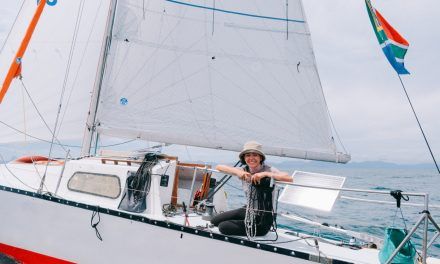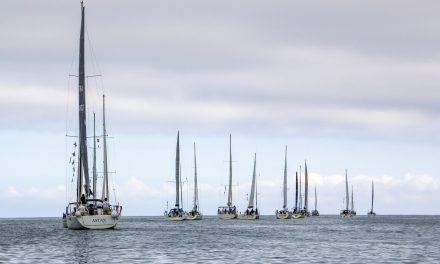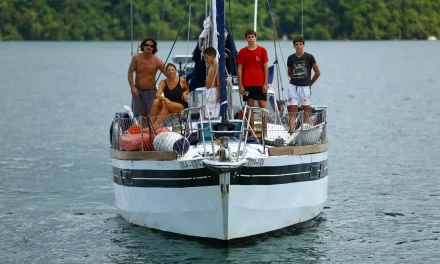
Maria, Michel, and Tristan set out to circumnavigate the globe in six years. Instead, they found themselves “circling the world,” traveling between the Americas, Europe, and Africa, on a journey that would forever change them. After five years of exploring three continents and sailing the seas aboard a Beneteau Oceanis 42.3, they wonder why eating, sleeping, confronting their own fears and limitations, stocking up on supplies, or dropping anchor in port are the most crucial factors for making sound decisions when undertaking a voyage across the ocean.
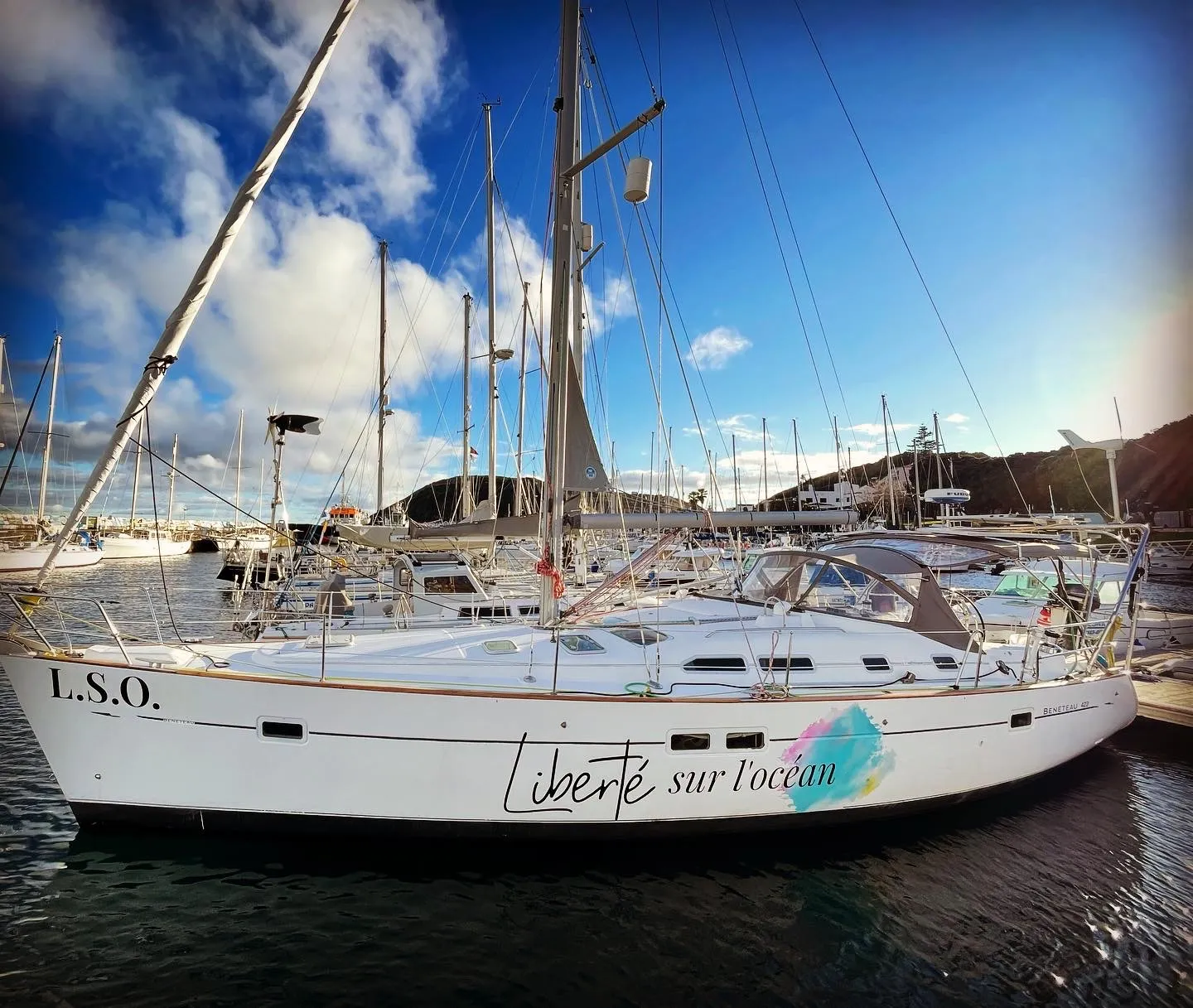
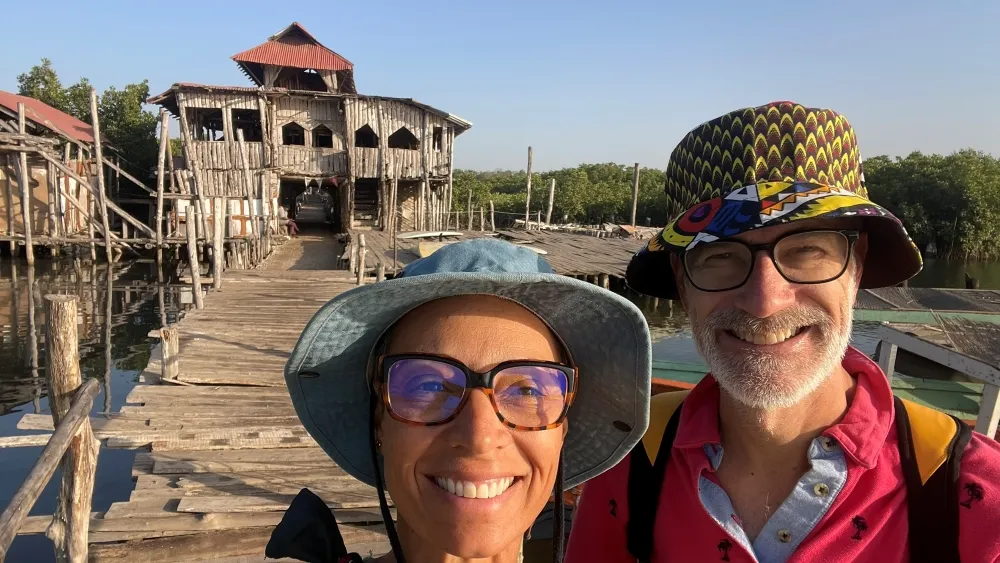
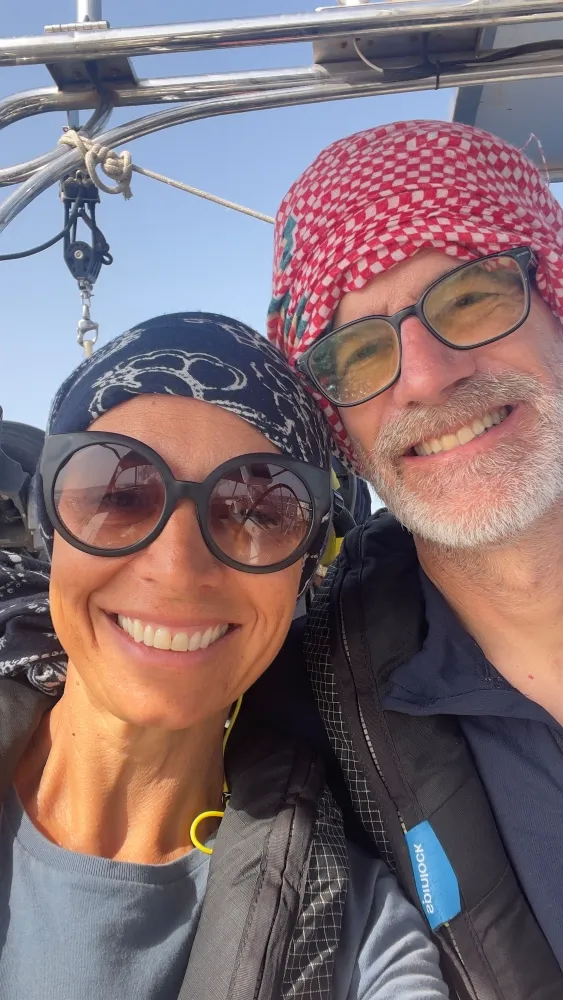
María San Emeterio and Michel Gendron set out to circumnavigate the globe aboard a sailboat in six years. However, instead, they found themselves “circling the world,” sailing between the Americas, Europe, and Africa, on a journey that marked them forever. “Ours is the story of a family that sails like any other,” María would repeat to me, like a mantra, when I told her I wanted to know how they began this journey, what their voyages were like, or how they managed with a teenager on board and the rest of their family far away. Finally, we connected to talk about this story from São Francisco do Sul, in Santa Catarina, Brazil, after their time in Argentina and Uruguay, where—for now—they have dropped anchor.
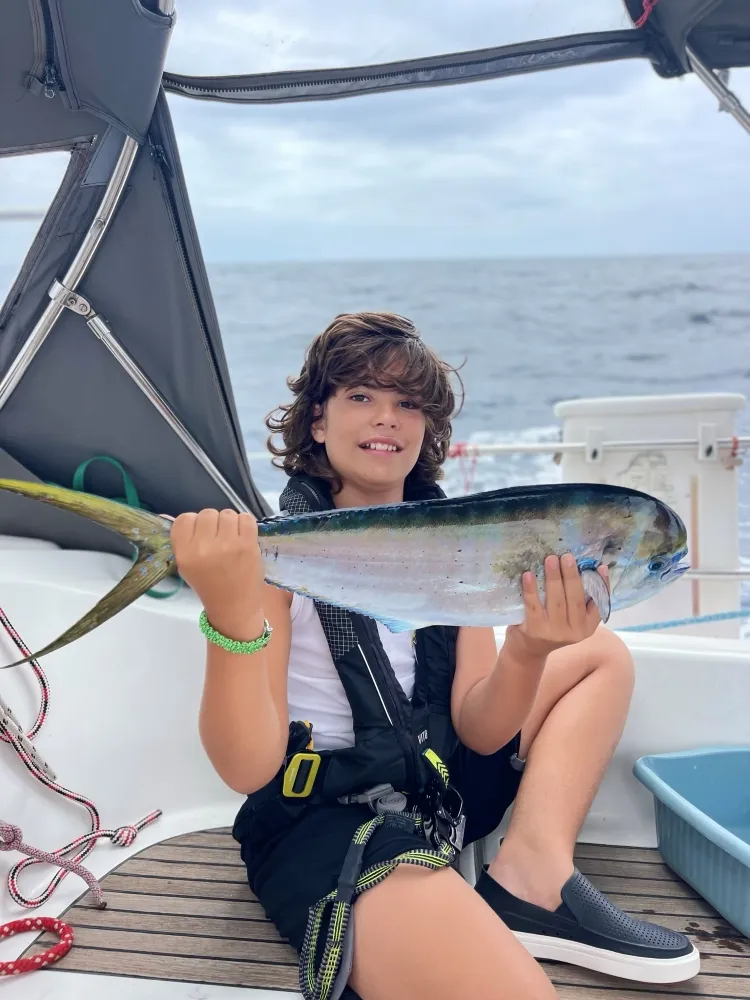
The morning we started this conversation, I burst out laughing when I saw, to my surprise, on the screen a cat named Nami, who has been traveling with the family for two years. She’s already been to two continents because they found her in Cape Verde. “We brought her when she was five weeks old, and she adapted very well to the boat. She’s already crossed the Atlantic, fallen into the water a thousand times, escapes through the hatches, loves wandering around marinas, but doesn’t want to spend much time on land,” María tells me, gesturing with her big smile, which complements her tabby nose. She clarifies, though, that when they’re sailing, the little one wears her own harness with a lifeline.
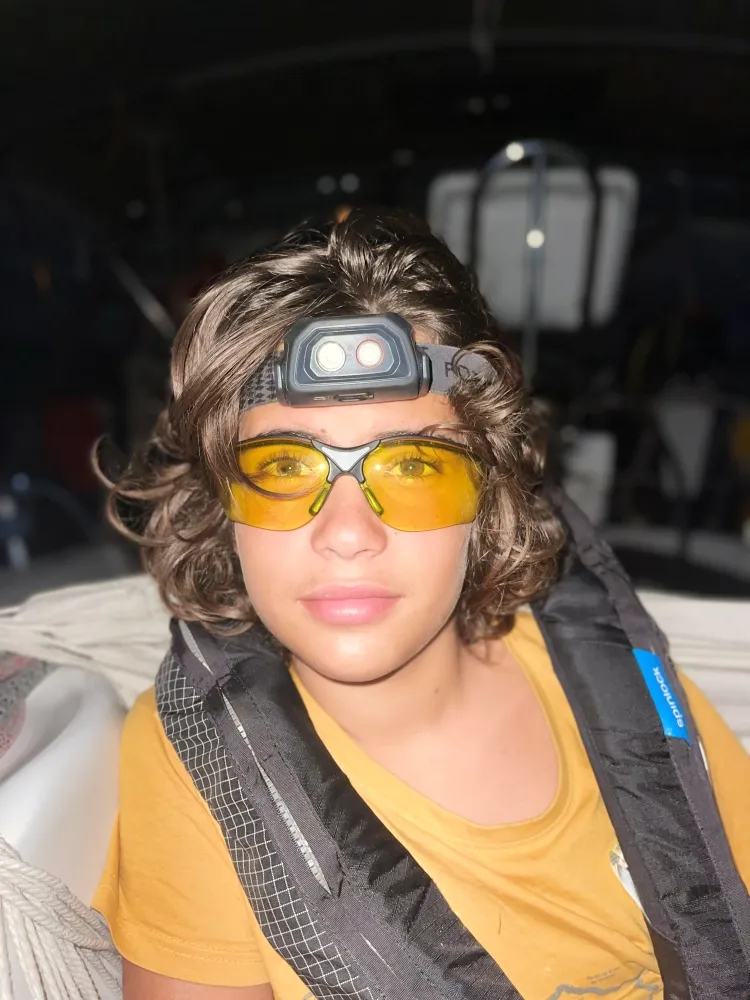
The fleet, besides this curious and charming cat, is completed by the couple’s youngest son, Tristán. “Many people think that living on a sailboat is just swapping a house for a boat. I used to think that too. After more than four years living at sea, I understood that the real change wasn’t where I live. It was the person I became,” says María, now on the other side of the screen. After five years of exploring three continents and sailing the seas aboard a Beneteau Oceanis 42.3, they also created an immersive school where, in addition to ropes, sails, and hulls, they explore why eating, sleeping, understanding one’s own fears and limitations, going for supplies, or dropping anchor in a port are key to making good decisions when undertaking a voyage across the waters.
How did you get started in sailing?
How did you come up with the idea of living aboard a sailboat and traveling the world?
Michel was always fascinated by sailing: he’d owned a small sailboat on Lake Champlain, which lies between the United States and Canada. He had it for two summers, and then life went on day by day… He worked as an engineer on all the ecology and energy projects for the Canadian government. I, being Mexican by birth, had never been on a sailboat in my life: because I’m from Mexico City, the sea is far away from us.
What happened then?
A little before the pandemic, in January of that year, my parents wanted to leave Mexico: their dream was to live in Spain. My dad went to renew his passport, went to have his picture taken, they took the picture, and the moment he stood up, his aorta ruptured and he fell dead. Just like that. It was his retirement; he was finally going to do what he wanted: go to Spain, live there, and everything… We went to Europe for the funeral, the burial, and when we returned to Canada, we were locked down because of COVID-19, and I, who had my wedding and event planning company, lost 25 contracts in a week. I mean, all at once: my dad died, I lost all my jobs. I remember that Michel was already working from home because they had sent him from the office, and I told him, “This is the moment.” He said, “Well, in five or six years we’ll launch it.” But I hate slow projects: “No, in twelve months,” I retorted.
How old were their children at that time?
My youngest son was eight. But we also had the house, the job, the business, our other children. But I told him in twelve months. Twelve. No more weekend getaways, we’d be living on a sailboat.
But you’d never been on a sailboat before?
Michel introduced me to sailing about three times before, but it was super relaxed and we all had skippers. The only condition I set was that the three of us had to train at the same level because if something happened to him, I needed to know what to do so I wouldn’t be 100% dependent on him, and if something happened to either of us, Tristan needed to know the same. COVID was still going on, so we literally took him out of school: every weekend we went to a training boat to learn together. It ended up being 19 months, but we got our skipper certifications through constant training. We took first aid courses, far away and in the wilderness, like we were prepared for 48 hours without an ambulance.
But in Canada, for example, stitching a wound is reserved only for doctors: so when we took that course, they couldn’t teach us how to stitch. At that time, I had a client who was a neurosurgeon, and I offered him a discount on his wedding package if he would teach us how to stitch. So off we went, the three of us, with our pig’s feet, to learn to stitch (laughs). Tristan was too young for the exams, but he completed all the training. In fact, now that he’s fifteen, he passed his international VHF exam yesterday, so he officially has the certification.
With the lockdown, how did you find the ship?
We bought it on Marketplace.
Didn’t you travel to see it?
No, everything was closed in Canada due to COVID, and the ship was in the Azores. If we traveled to see it, the government required us to quarantine for 40 days in a hotel of their choosing upon our return. We became friends with the owners, who were also Canadian, and through several two- or three-hour video calls, we arranged to visit the ship. It had only been listed for sale for 10 minutes when I contacted them.
What features did they want it to have in order to live there?
For Michel, it was important to be able to walk around the entire boat without bumping his head. He also wanted to be able to sleep with his feet stretched out. For me, on the other hand, one of the non-negotiable features was that it be bright: we have plenty of light. I didn’t want a dark, cave-like boat. We also wanted a boat that had been through an ocean crossing so that it would withstand all the equipment. Initially, we wanted a Leopard 50, which is a catamaran, but when we saw the millions of zeros on the price tag, we said no.
We have four children, and we thought, “When the kids come, we’ll have their own room,” but then you think, “Maybe they’ll only come once a year…” If one day they all come with their girlfriends and everything, we’ll just rent a bigger boat, period. So we got a Beneteau Oceanis 42.3. We had previously been set on selling our house: we managed to do it in a week, partly because of COVID and through Marketplace, since the owners were from Germany but were going to live in Canada.
What did your older children say about this adventure?
We offered them a ride with us, but they said no. They’re 23 and 24 now, not super old, but they told us, “No, forget it” (laughs). They were just 18 then, which is the age when you can do whatever you want and you’re not going to live 12 meters away with your parents, no thanks (laughs). It was hard, but we accepted it. We finally bought the boat in May, but we only saw it in October, when we set sail with just a one-way ticket, no return date from Canada. But in Europe and North America, you never buy a sailboat without an inspection, so that’s reassuring, because when the inspector came, we arranged for him to test everything, with the report on the hull below and above water.
When did they begin their journey?
We had to wait eight months because it wasn’t the best time to cross the North Atlantic. In the meantime, we got used to it, because our lessons had been on the St. Lawrence River (which has its challenges, with 15-meter tides, so the currents are very strong, and you need a current atlas, which you have to use in addition to reading the charts). Then, in June, we finally made our first crossing from the Azores to Vigo. We got caught in our first storm, a Beaufort scale 9-10 for 36 hours, on our very first ocean crossing. The forecast had predicted 25 knots. I cried every tear I could… we both lost seven kilos, and I couldn’t sleep at all because all the noises were strange. I told him, “When we get there, we’ll sell the boat, go back to Canada, and start all over again.” Michel didn’t answer me at all (laughs). A very wise man.
When we reached the coast, we met a flotilla of very experienced French sailors. When they saw we wanted to sail the Mediterranean, they told us we were too inexperienced to go alone and offered us a boat trip to learn together all summer. It was wonderful. Every time we moved forward, if we fell behind, they would come back to ask us why we weren’t catching up, checking the sails, telling us to do this, do that… One of them was a psychotherapist, and I can’t deny that I was traumatized by the storm. It was difficult, but it helped me immensely.
What happened next?
In September, they continued on to France, and we went on to the border in Bilbao. From there, we went down to Vigo and then south to Lisbon, where the orca attacks began. A French boat, identical to ours, sank the day after we passed by. Sailing there was very stressful: we didn’t go at night, we took every precaution we could, but the entire Portuguese coast was very complicated because of the difficult conditions for entering or leaving the port.
That’s why we decided to go on to Madeira, where we spent about eight months on the four islands. We went down to the Canary Islands (where we didn’t stay as long) and then to Morocco, where we stayed for almost two months. It was amazing; we went up to the northern border by bus. That’s when we decided we wanted to stay longer because we hadn’t seen much, met many people, or experienced much of the culture…
And what happened?
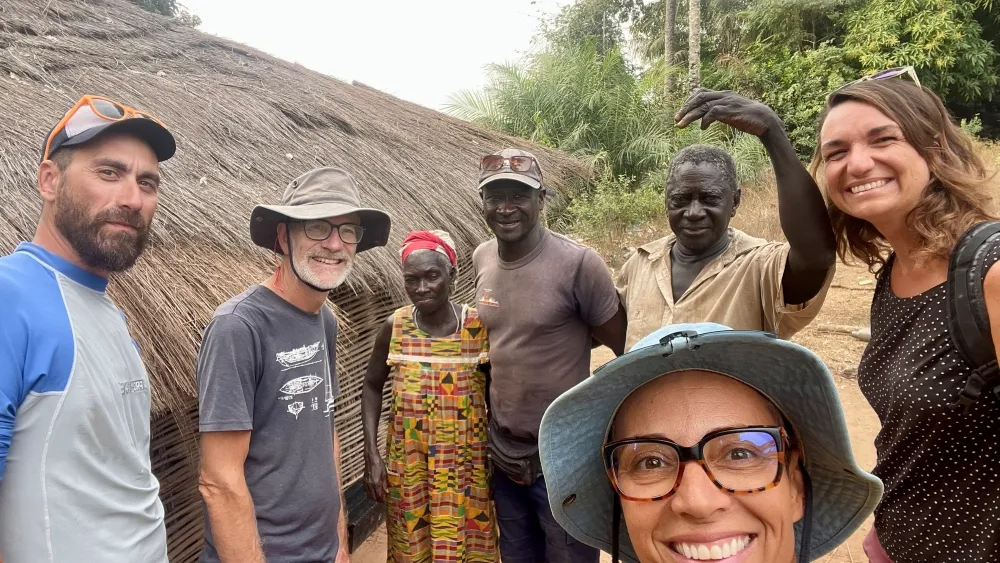
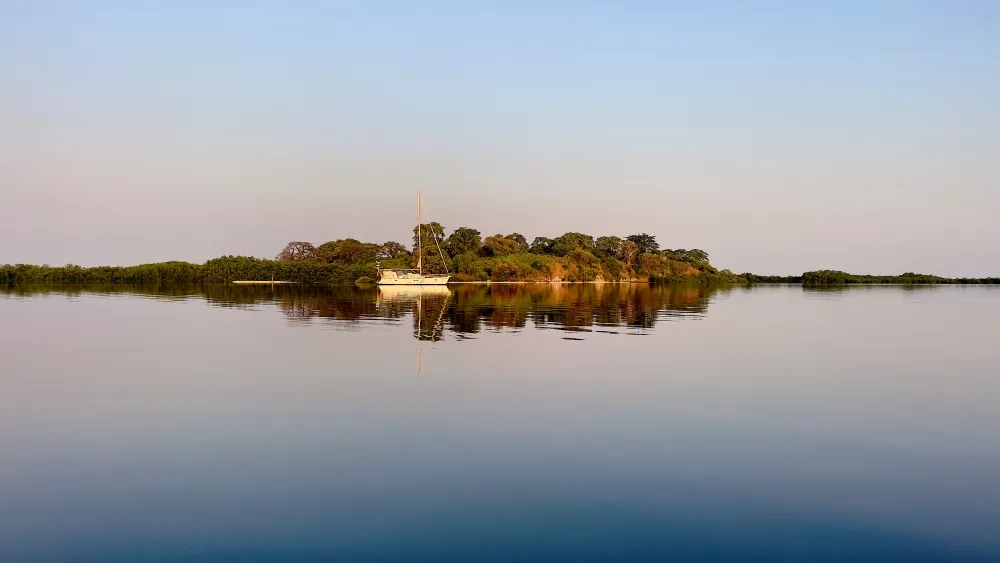
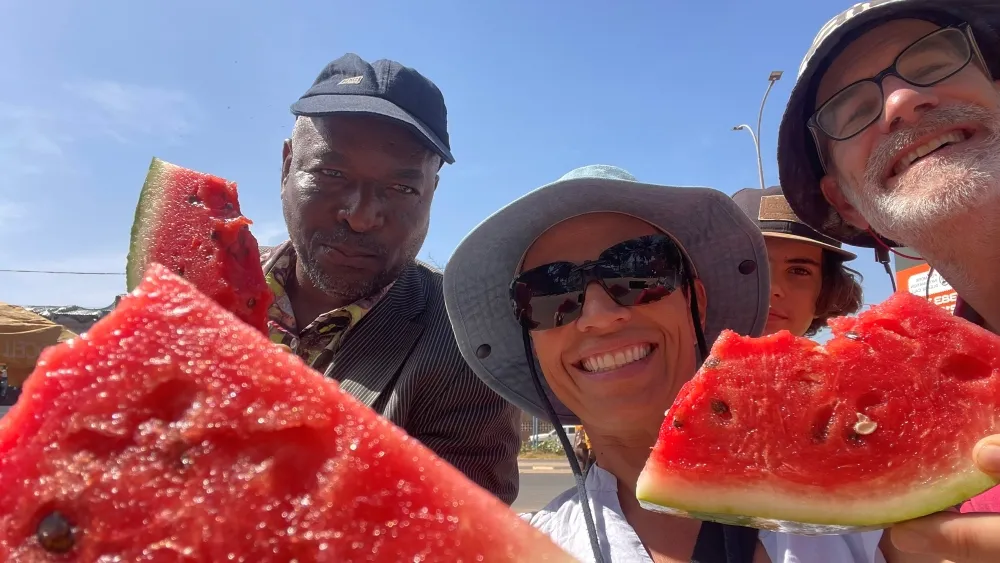
We realized that the round-the-world trip we wanted to do in six years wasn’t logical because you had to arrive somewhere, drop anchor, and leave the next day. So we decided we would sail around the world instead. That’s why, after Morocco, we returned to the Canary Islands to have the boat serviced, and from there we sailed down to Cape Verde, where we stayed for nine months: it was beautiful. We explored all the islands, made friends with the locals, and learned a lot about their culture: it was incredible. From there, everyone else was going to cross the Atlantic to the Caribbean, so we said, “If we leave, we’ll never be able to come back.” Instead of going west, we went east. From Cape Verde, we crossed to Senegal, sailed the entire Central River, but decided to go even further south and went to Gambia. We sailed a little bit of the Gambia River, and from there, someone had told us about Guinea-Bissau. It was beautiful: the villages were very small, like a dozen houses, and since we were white, we had to ask the chief for permission to enter.
At first, all the children were afraid of us; they hid. But as soon as they saw us, they’d come running up and walk hand in hand around the island. It was incredible; the people are wonderful. We swam in the sea, and they told us they wouldn’t even dip a toe in because it was teeming with sharks, which aren’t very friendly. On the beach, we had to skate, not walk, because there were so many enormous manta rays, and they could sting you. You can’t go in without a guide because there are black mambas, red mambas, and cobras. One day, we were walking with one of these guides, and he said, “Shhh…” to keep quiet. I thought it was a snake, but behind it came a herd of hippos about fifty meters away: there were about twenty of them, beautiful, gigantic. Then we continued on a very difficult voyage and had to ask for refuge because we couldn’t get up to Gambia. It took us two days to go down, and fifteen to come back. From there, we provisioned the boat for the Atlantic crossing. But Africa kept half of my heart.
I imagine they’ll have a thousand stories to tell…
One of the things that impacted me the most was this: in the Bay of Hann, east of Dakar, there’s one of the most polluted coastal regions in Africa. It used to be a beautiful area, but the government keeps all the money, and the whole region is full of garbage. If you’re on the boat, you see sheep carcasses, plastic, trash—everything is dumped into the sea. It’s a disaster. You can’t use your dinghy there because there’s nowhere to stop on the beach. People live in huts, but there’s a Piroga from a club that comes to pick you up (a rowboat). You cross a bridge, and there’s a small hut with a fisherman who lives there: Sam. I used to go by every day: “Good morning, Sam, how are you?” One day we started talking more, and at one point, he invited me for tea. But there, it’s a whole ritual because there are seven different species, and they prepare it—it’s all sticky. One day, Sam and I were there, in the middle of that beach, a total garbage dump. I arrived at noon, and by five in the afternoon, I was still there, chatting and drinking tea. In many of these countries, they wear very large copper rings that contain a protective amulet. These are pieces passed down from generation to generation, for the whole family.
The day we were about to leave, I told him we were going on another trip, and he said, “Before you go, please come and see me, all three of you.” We went ashore to greet him, he took each of our hands, and gave us his ring. “This ring has protected my family since its inception. Inside is the amulet, so since you are now part of my family, I want you to keep it so it can protect you throughout your trip.” We didn’t want to accept it, but it was so moving, so beautiful, that we still have the ring attached to the satellite radio on the sailboat. But then he tells me he has a special gift for me: since he’d caught a lot of fish that week, he’d bought mosquito repellent because they’re so dangerous in Guinea. “Everything I sold, because I had such a good catch this week, went to buy you that Off!” I love it, because as Westerners, you invite me to your house and I bring you a scarf. In Africa, when you ask permission to enter a village, what the king or queen asks for is kilos of rice to feed the whole village. They gather together until all that food is gone, they stay together until the end, even if it takes three or four days. That’s why Sam gave me something I was really going to need on the trip.
What was the Atlantic crossing like?
We were trapped for six days in the center of the cyclone/anticyclone, the intertropical zone, with the north and south winds dropping: absolutely no wind. You always try to cross through the narrowest part, but it was incredibly active. We had a meteorologist assisting remotely, telling us where to head north or north. The problem was that it was all or nothing, total calm. Suddenly, it would blow at thirty knots, with lightning, thunder, and a rough sea. We were like a sock in a washing machine. Everything was 38 degrees Celsius, with three-meter waves that would suddenly crash against the boat. There was no way to open the hatches for ventilation. On one day, we covered 10 miles, for example; by the third day, I was completely exhausted. We started the engine and saw that Fernando de Noronha was nearby, but we only had 25 liters of diesel left. We still had 1,000 miles to go to reach Salvador de Bahia, where we had planned to anchor.
It finally took us 16 days. We spent 48 hours on the island, loaded up on more diesel and fruit that we were missing, and in total, port to port, it was a 22-day voyage. Then we went to Salvador, then down to Rio de Janeiro. At that point, I told Michel I wanted to close my company because it no longer aligned with my values. If a client called me and said they had $50,000 for their wedding, after seeing and experiencing what we went through in Africa, it was completely out of my nature. I would even ask couples, “Why are you spending so much? Why don’t you go on a trip?” (laughs). But we had to make a living somehow.
How did you solve it?
We had completed the IYT Worldwide (International Yacht Training) naval certification, but in addition to the London course, we wanted to find out what was required to become instructors in other parts of the world. We were quite far along in everything: they count the days and nights at sea, the nautical miles sailed; we only lacked a couple of maritime rescue courses and the Red Cross first aid certification. Then, while searching, we discovered that they offered that course in Rio de Janeiro, so we completed it: from that moment on, we were certified as instructors.
Why do you think that a skipper’s or captain’s license doesn’t qualify you to sail the world’s oceans, and that emotions also need to be taken into account?
One of the things we were experiencing was that we had all the technical aspects covered, but we were missing half the circle: the other half needed for it to truly work was absent. Living day-to-day on a sailboat, where the vessel becomes your home, and not just for the weekend, involves the space, the shared living, the cohabitation, the exhaustion, the decisions, everything that comes with it, including the emotional aspect. I wanted to teach courses and continue the journey, so we became a satellite school, wherever we are in the world…
The question, to conclude, was this: no matter how good a captain you are, if the emotional or psychological aspect isn’t fulfilled, if you haven’t been able to rest, eat properly, if you don’t know your limits and aren’t honest with yourself because you’re not in control of your boat or because you’re afraid, you’re not going to make good decisions. We were offered online courses, but no: I’m convinced that you have to live the experience.
In that same vein then, what are the immersion programs you carry out on your boat all about?
Our immersion programs are 10-day stays aboard our sailboat, designed for people who want to learn to sail, gain confidence, or simply discover what life on board is really like before embarking on their own project. The key difference is that it’s not just about taking a course. During those days, you live with us and participate in the real life of the boat: sailing, maneuvering, decision-making, organization, meals, unexpected events—in short, daily life. We work with a maximum of two people at a time, which allows us to fully adapt the experience to each person’s level and goals. We welcome everyone from complete beginners to those who already have some training but don’t yet feel independent.
For us, the most important thing is that you leave not only with more knowledge but also with more confidence to make your own decisions at sea. There’s also the option of obtaining an IYT international certification during the immersion program, if that’s one of your goals. Someone told me, “Spending ten days with you is equivalent to two or three years of theory.” The classes last six hours a day, but when they end, you have to check the mooring lines, cook, fetch diesel—you keep learning. People are very happy; we’ve had people from all over the world come to get the international certification. It’s completely different from a classroom or lecture hall because you have to confront everything with reality. Some tell me, “I have the skipper’s course, I have my own boat, but I don’t dare go out alone.”
For those of us who regularly follow your account, one of the things that caught my attention the most is how your experience of navigating the world has transformed.
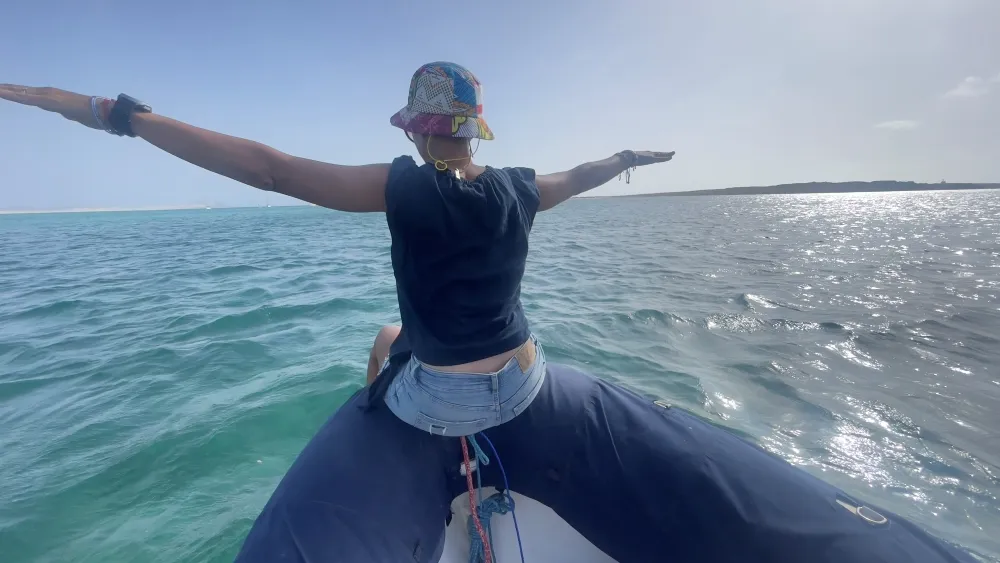
Living a much simpler life, being able to find myself, knowing that we don’t need so many material things to be happy and enjoy even the smallest things differently, with much more enthusiasm, with much more flavor, without having much money (because it’s not the same as the routine we had in Canada) and that the wealth I have today is the people I’ve met, the moments perhaps more than the landscapes, but yes, the people, because knowing that today I have friends in more than fifteen countries is the greatest wealth.
What are your next plans?
We’ll have to go back to La Plata because Tristan made a lot of friends and even a girlfriend. They even enrolled him in rowing school. It’s difficult to plan long-term on a boat, but, for example, this month the plan was to reach Ilha Belha, but there was a storm, so it was better to stay here. For the fall of 2027, the plan is to start heading north towards the Caribbean. We’d like to cross the Panama Canal and make the crossing of the Pacific.
The greatest treasure we have today is time and the freedom to decide what to do. This trip has surprised us at every turn because I knew I wanted to see Morocco, but then someone would suggest Senegal or Guinea, and we’d say, “Sure.” Everything we’ve seen in Africa has been incredible, and now the same is happening with the Americas. But I don’t even know what I’m going to eat for lunch today, so you can imagine… (laughs).
Links:
Instagram: https://www.instagram.com/libertesurlocean/
From “Navegantes Oceánicos” we thank María and Michel for sharing their life-onboard experience in this interesting interview and wish them the best of luck with their sailing project.
Fair winds and following seas. We’ll be following you!