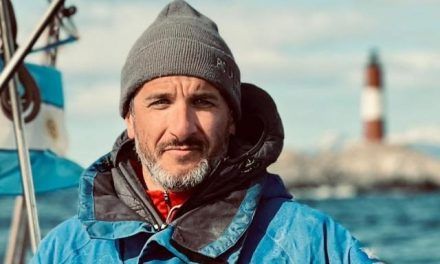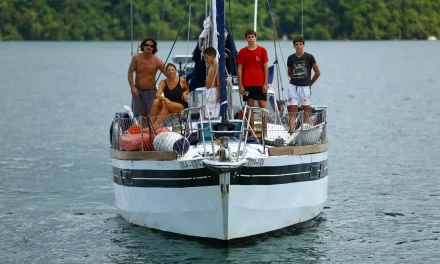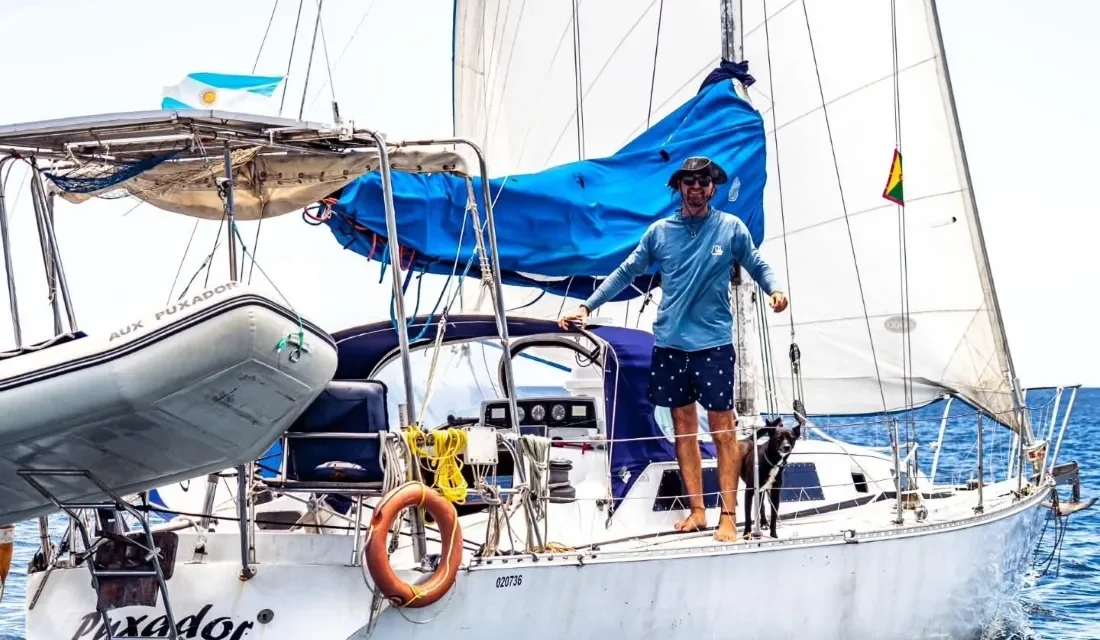
Inspired by a book by Eduardo Rejduch de la Mancha, the captain from Rosario left behind a stable job and a city apartment to buy his first sailboat—an H20—with which he set out to cross to Colonia, Uruguay. Adventures in Brazil and the Caribbean followed, leading to his current role as a catamaran captain sailing as far as Fiji. It is the story of a journey that began in the brown waters of Charigüé Island on the Paraná River and extended to the world’s oceans, where he crossed paths with another of his great mentors: Gerónimo Saint Martin.

Gastón López Simoes read *Hasta donde me lleve el viento* (Wherever the Wind Takes Me) by Eduardo Rejduch de la Mancha and decided to—literally—change the course of his life. The book, published in the early 2000s, chronicles the adventures of a sailor who, seeking to escape a predictable, preordained future, set out to circumnavigate the globe solo—with empty pockets and nothing but a small, eight-meter sailboat (the *Charrúa*). Yet, it wasn’t all smooth sailing for Gastón; when he first entered the sailing world and bought his own boat—an H20—people told him he was a bit crazy. “One day, I’m going to go sailing on my boat,” Gastón would tell his friends back in Rosario. He kept talking about it for over eight years, and many doubted he would actually go through with it. At times, he admits, he doubted it himself.
Eventually, however, he took the plunge. The hardest part was telling his boss at General Motors—his manager for thirteen years—that he was quitting. “I grew up in a traditional middle-class family, had a stable corporate job, and lived in a city apartment. I changed the course of my life and set off with the boat—without money or resources. You don’t have to be a millionaire living off investments to pull off a project like this,” he says now from Peru. He has just returned from a voyage as captain of a catamaran that took him as far as Fiji, and he is about to reunite with his own sailboat, the *Puxador*, to continue his new life at sea.
Aside from Rejduch, one of his key inspirations was Gerónimo Saint Martin. Sailing a boat of the same model—the *La India*—Saint Martin had made the journey from Argentina all the way to Spitsbergen in the Arctic. “And here I was, with that same little boat, not even daring to sail to Colonia, Uruguay,” he laughs now. He first attempted the voyage starting from Rosario; Later, he ventured further afield to Punta del Este and eventually reached Rio de Janeiro and Salvador, Brazil. Saint Martin was another major source of inspiration for him: he read all of Saint Martin’s travel accounts and studied the modifications and adjustments he had made to his boat; he also bought the documentary chronicling the time the boat was dismasted and the days he spent drifting between Norway and Iceland. He was once lucky enough to shake Saint Martin’s hand and meet him at a talk he gave in Rosario. A decade later, one afternoon in Martinique, he ran into him and invited him for *mate*. He subsequently helped him install a wind vane steering system and, later, a forestay that had been malfunctioning—leading to further encounters and a friendship they maintain to this day, despite the distance.

How did you get started in sailing in Rosario?
I’ve always lived in Rosario, a city deeply connected to the water; my grandfather had a small shack at El Embudo and a fishing canoe he’d take me out in now and then when I was a kid. It’s not that I grew up on the river, but I went there often with my family, so the water was always a part of my life. That grandfather lived in the Alberdi neighborhood—right along the riverfront—and was a member of the Regatas Club, so when I was a teenager, I got a membership and used to go out rowing. So, while the river was always a constant presence, I had never actually sailed a sailboat; it wasn’t until I was 27 that I took a helmsman course just to see what it was all about.
What was it about sailing that caught your attention?
A friend recommended I take the course. I went to the Rosario Automobile Club, where—at least the year I took the course—we trained on a Resch 26 (a classic cruising sailboat designed by Norberto González and built by the Argentine shipyard Resch in the late 70s and early 80s). It was a boat with a cabin, which I think made it interesting because we didn’t just go out sailing; we also shared life on board. For instance, if it rained on a Saturday, we’d stay at the mooring and have *mate*, wait a few hours, and then head out onto the river. Courses held on open training boats—without cabins—kind of miss out on that aspect… In my case, too—having never sailed on a sailboat, yacht, or cruiser before, and having only been on very simple craft—I really liked the idea of having a floating home: you don’t get wet if it rains, and you can warm things up in the galley to have some *mate*…

What were the first voyages like?
During that course, I took my first trip to San Pedro (150 kilometers downstream from Buenos Aires) with the instructor and some fellow students; we got caught in a *Pampero* wind… But we anchored after the storm passed and roasted some meat—it was a great 90-mile adventure. A few years later, I bought an H20; I’d head straight to the boat after work—if conditions were right, I’d go sailing, and if not, I’d just stay at the mooring, eating or drinking *mate*. Later, I took a skipper’s course and decided to buy a Colibrí 24, which I sailed to Punta del Este with three friends who didn’t know how to sail…
We arrived around New Year’s, and it was incredible to go from the brown waters of the Paraná or Río de la Plata to the crystal-clear blue sea off Uruguay. It was a wonderful experience; I think that was another turning point for me. I made that trip two more times in the Colibrí, sailing to Piriápolis and Punta del Este. What really hooked me on sailing was the idea of having a little floating home and being able to take those kinds of trips.
Enviar comentarios.
How did books—like the one by Eduardo Rejduch de la Mancha you always mention, *Hasta donde me lleve el Viento*—shape you during these journeys?
That book really shaped me; it showed me everything that could be done with so little: Eduardo—with no sailing experience or prior knowledge—bought a 27- or 28-foot sailboat in Canada and sailed down the Hudson River to the Atlantic, with absolutely nothing. He was a bohemian, a wanderer who spent 25 years sailing his boat around the world, visiting incredible places. While the houseboat had captivated me at first, that book later encouraged me to explore.

What happened next?
At the time, I was working as an electronics engineer at General Motors and would take two-week trips on my sailboat; however, the journey from Rosario to Punta del Este took a long time. I spent 13 years at that company—having previously worked at IBM and Hewlett-Packard—always as a salaried employee. If I wanted to go to Brazil, I needed more flexibility, because with only two weeks of vacation a year, I wouldn’t have time to really explore anything.
So, I started thinking about quitting my job—without a set return date—as part of a plan a friend and I were going to carry out together. However, just before we were set to leave, my friend found out he was going to be a father, and the initial plan fell through. I was left to pursue the project on my own, but then the COVID pandemic hit in 2020. Just the day before, I had sailed to El Charigüé, so I ended up stranded on the island (off the coast of Rosario) for three months; there was a ban on sailing, so returning would have meant breaking the law. For me, it was actually a great experience—spending those months on the sailboat and living the reality of life aboard a 24-foot vessel.
Then you realized it was a way of life you liked.
Of course, I realized I’d had a good time—that I liked that life—even though I hadn’t actually left the island. So, I decided to sell my apartment (I had a studio) and my 24-foot boat, and I bought the *Puxador*.
What boat model is it? What are its features?
It is a 1988 Peterson 34—a sailboat of American design built by the Meroz shipyard in Argentina. It is a very solid, sturdy vessel constructed by a reputable yard, and thanks to all those sales, I was able to outfit it for serious ocean voyaging.
Why is the boat named Puxador?
That’s the name it had when I bought it; it’s in Portuguese and means something like “thriving” or “dynamic”—like moving forward and making progress.


Had you set a deadline for yourself? What was that first crossing to Brazil like, then?
Yes, I had set a deadline to set sail, because otherwise, you never finish making all the repairs you want to do. That’s important; if you don’t, there’s always something left to do, and you end up putting it off. I set out in March 2023 with the boat, a bit of savings (since you always end up spending more money on it than you initially planned), and my dog, Ancla. I left without many possessions, but with a boat to live on.
I arrived in Brazil—a place I knew almost nothing about, and I didn’t speak Portuguese, either. I headed for Ilha Grande, near Rio de Janeiro; many people had told me it was a beautiful region for living aboard a boat. By the first day, I’d already made a few friends, as the town is full of Argentines working there—some in inns, others in bars. They started lining up tourist trips for me in exchange for a commission, so I began running day excursions on the sailboat. I stayed for a year.
Did you keep sailing afterwards?
Yes, I loved Ilha Grande, but I had prepared myself and the boat—I’d done a lot of studying—yet I was just cruising around the island under power. So, I decided to undertake a new voyage: there was the annual regatta from Recife to Fernando de Noronha, and it seemed like a great opportunity. I mapped out a route from Ilha Grande to Búzios, then to Vitória, and finally to Recife; throughout 2024, I made my way up the coast, joined by crew members for specific legs—spending 10 or 12 days on board—to tackle the open-ocean sailing.


But what happened in the Amazon River?
The coastline curves near Fortaleza, so upon returning from the regatta to Noronha, I had to decide whether to head back to Ilha Grande or continue the voyage to the Caribbean; the latter is the region of the trade winds, making the return journey very difficult. I decided to press on to explore the Caribbean islands, organized my sailing plans, and recruited some crew members who came aboard.
I experienced a major grounding incident at the mouth of the Amazon River. For the final thousand miles, I had been sailing in company with a Brazilian friend’s boat—a vessel equipped with twin rudders. First, one of his rudders snapped in open water—without hitting anything—with 300 miles still to go. Then, the second one broke near the river mouth, just five miles from our destination. I began towing his boat; it was a full moon night, and the tidal range is massive there—about five meters, accompanied by a powerful current. My own boat ended up running aground after I spent six hours trying to haul his vessel toward the coast. It was a highly complex situation—my boat’s rudder broke later on—but I discovered just how sturdy the sailboat was, as it remained heavily heeled over while waves battered us broadside.
We had planned to arrive at midday during high tide, but by the time the rudder broke and we began the rescue operation, the current had shifted against us, stalling our progress. We couldn’t move forward until the tide stopped ebbing later that evening. I began navigating close to the shore—much like I used to do in Rosario—using the depth sounder, but the charts proved unreliable; suddenly, we hit an unmarked sandbar. Furthermore, the full moon generates powerful waves known as the *Pororoca*, a phenomenon that occurs when the incoming tide surges into the river. We faced all of this at night and without a rudder: we went from calm river waters and no swell to facing tremendous winds, a fierce current, and massive waves. It was a very complex situation, not least because repairing the boat in the Amazon was extremely difficult—finding the materials, the people to do the work… Afterward, I sailed to the Caribbean, traveling from Belém to French Guiana, and then visited various islands such as Grenada and Anguilla.
How do you handle social media, and how does it influence the journey you are undertaking?
try to share both the good and the bad aspects of what happens. Sometimes people think you’re living a dream life or they idealize what they see on social media—thinking everything is wonderful—but it involves a lot of hard work. Yes, it’s great working in the Caribbean or on a boat, but you also have to give things up, like being close to family, friends, and your own culture. During voyages, I stay in touch via WhatsApp groups or Instagram. Finding crew members was a bit more challenging in the Caribbean; in Brazil, it’s always easier for people to travel from Argentina, and the cost of living is lower or the flights are shorter.

And why were you in the Fiji Islands when we spoke for the first time?
This year, an opportunity arose to work as a skipper on a 55-foot Outremer catamaran. The company offers these luxury catamarans and also organizes “Grand Large Yachting” events—regattas that bring together dozens of sailing enthusiasts to sail around the world together over three years in this type of vessel. In this instance, the catamaran’s owner wanted someone to assist with planning and decision-making—not just a crew member—because he didn’t feel confident sailing such long legs with only his wife on board. So, he hired me for the passage from Bora Bora to New Zealand. However, we set sail for Tonga—a 1,200-mile voyage—and on the second night (while I was off-watch), the owner attempted a maneuver and caught his hand in the windlass, which ended up tearing off several fingers. It was chaos—right in the middle of the Pacific—and I had to keep my cool. We headed to a nearby island where he received initial treatment, and the next day he flew to Rarotonga for surgery.
After ten days of recovery, we finally resumed the journey, but he was unable to perform even simple maneuvers, such as reefing the sails. So, I took full charge of the boat. The plan was to reach New Zealand—a safe zone—before hurricane season, but conditions leaving Tonga weren’t favorable; it was a time of year characterized by 30-knot winds and 5-meter waves. We decided to leave the boat in Fiji and resume the trip the following year. The leg from Tonga to Fiji was about 500 miles; we arrived in early September and made all the necessary preparations to leave the sailboat on land for six months. The marina where it is currently docked had experienced 160-knot winds the previous year, yet the boats remained undamaged because they are very well protected. Still, we obviously had to take every precaution: we removed all the sails, the masthead anemometer, the engines, the equipment, and the watermaker.
At the same time, despite the accident, was sailing across the Pacific a good experience?
Yes, absolutely. The whole experience was fantastic; I’d never sailed a catamaran on the Pacific before, and—given the accident—I ended up sailing it solo and taking on more responsibility. It was definitely a positive experience. I was also in contact with other boats and the Outremer regatta organizers, so other opportunities might come up. In fact, the catamaran’s owner invited me to resume sailing in the Indian Ocean next year.
It’s interesting because I stepped into a professional world that’s very different from the one I had with my own boat. Of course, you have to weigh things up and see if it’s really what you want—especially considering the freedom I gained when I quit my job to sail with my boat and my dog, doing the voyages I want to do. During those two months on the catamaran, I had almost no time to myself. But well, we’ll see what happens next year; one thing I do know is that I enjoy this a lot more than working in an office.

And how did you come across Ancla?
During the pandemic, while I was staying on the island off the coast of Rosario, she swam up to us one day. I had already been there for a month and knew all the island’s dogs, yet I had never seen her before. She was no more than four months old, and I never even found out where she had come from. The sailboat was moored, so she would climb up and down via the bow.
She stayed with me from that day on; I didn’t even formally adopt her—I simply gave her a piece of meat and a bone, and after eating, she fell asleep on the deck.
We gradually became friends, and by the time I returned to the city, we had grown very attached to each other; the rest is history, as she was already used to sailing on the boat.

What are your upcoming projects?
Now I need to reunite with my boat, which I left in Martinique; the plan is to continue on to Panama with some crew members between November and December. Last year, an opportunity arose to host a series of yoga retreats on the sailboat with an instructor who has a significant client base; we organized all-inclusive voyages—covering accommodation, lunch and dinner, and yoga and sailing lessons—in Saint Martin. We’re going to do it again this year in San Blas during January, February, and March.
One of my dreams is to sail across the Pacific Ocean, because I hardly saw anything during my previous catamaran trip: I boarded in Bora Bora and set sail the very same day I landed. The other day, I was talking to Tommy from *Bohemia*, and he mentioned exactly this: as an airline pilot, he spent his time traveling the world but didn’t really get to know any of it. In other words, I sailed nearly two thousand miles across the Pacific but didn’t visit any of the places I wanted to see… So, I’d love to explore that region in the future—but on my own terms, at my own pace, and on my own boat.

We at “Navegantes Oceánicos” thank Gastón for his contribution to this interesting interview and wish him the best of luck with his upcoming sailing projects aboard his sailboat, “PUXADOR”.
Fair winds and following seas!