It all began with the eruption of a volcano, Puyehue, located about 90 kilometers northwest of the city. The house where they lived with their two children was covered in a blanket of dust, the sky darkened, the air became unbreathable, raising the babies became impossible, and they couldn’t travel, go to school, go to work, or even go shopping. The landscape of Bariloche, in the Río Negro Province of southern Argentina, which until then had been blue, with snow-capped peaks and idyllic streams, turned into a nightmare.
Shortly afterward, another volcano, less intense but equally dramatic, also erupted. The scene repeated itself, now with another baby in the family. Herman Meder didn’t hesitate: his childhood aboard a boat in the Tigre Delta, his passion for sailing—which led him to the Merchant Marine and, in fact, until the eruption, he was working on Lake Nahuel Huapi—and the idea of continuing his journey by rivers and seas with his three sons, sealed the deal.
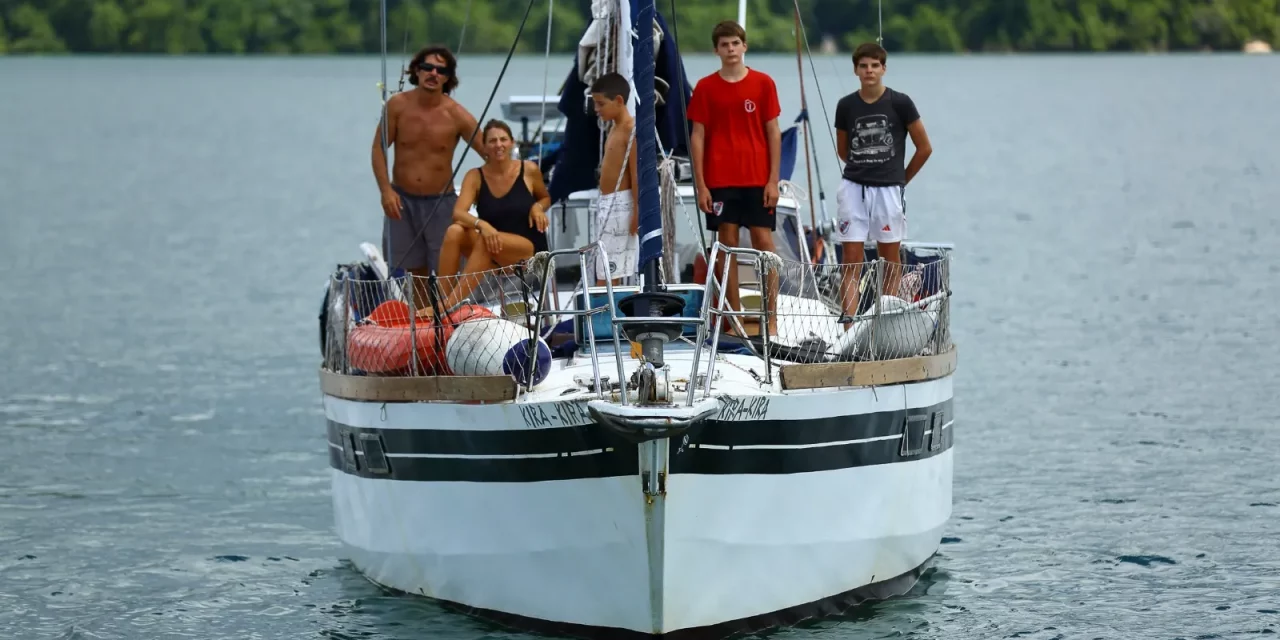
He convinced Rocío, his wife, and today, the landscape is undoubtedly different: an island of turquoise waters in the Atlantic Ocean, the wind, the currents, and the tides. The snow-capped peaks have given way to lush, green rainforest with red soil. His twin sons, Valter and Günter, 15, and Bruno, 11, complete the crew of this family of five. “I didn’t know how to steer, I had never been on a boat in my life, and I didn’t even know if I would get seasick,” says Rocío, now smiling, from the other side of the screen from Isla Grande, on Brazil’s Costa Verde.

How did you begin this adventure of living and sailing as a family, all together, with three teenagers?
—(Rocío) We were both born in Buenos Aires but grew up in the northern part of the province. Hermann sailed in San Isidro and I lived in Victoria. I had never been on a boat before. I had no idea about the world of sailing; I thought, “How nice, I’ll have a look,” I don’t know.
—(Herman) I started sailing when I was 10 or 11. I grew up in San Isidro, surrounded by iconic sailors like Enrique Celesia, and others who greatly influenced my development. Then my dad, who was also a big boating enthusiast, saw that I was always on the sailboat and decided to encourage my passion. He sold a house and bought another boat. The whole family moved to live on a boat in the Paraná Delta. Later, I studied at the Navy Mechanics School because I wanted to be a marine engineer, and I never left a boat or stopped sailing after that.
When I was 21, I met Rocío, and I immediately told her how things were going because I loved living on a boat. I didn’t know any other way at that point, nor was I interested in seeing any other (laughs). We moved to Bariloche. I was working as a chief engineer at a facility on Lake Nahuel Huapi. The children were born, and we felt secure knowing we had a certain level of support in terms of healthcare and social services, and living in a city like that, at least initially. They’re all from Bariloche. We built a house, always with the idea of selling it so we could go sailing together.

What happened next?
—(Rocío) The volcanoes erupted on us. The first one was very strong, and the eruption happened when the twins were little, less than six months old. We didn’t know if we could breathe because it was like ground glass coming in through the windows, the doors, everywhere. We were locked inside for a long time; it was truly awful. Then, when Bruno was born, there was another volcanic eruption.
—(Herman) That was a huge push to finally leave, because we’d been putting it off, waiting for the right moment with the kids. That was a sign that we had to go: in fact, since we left, no more volcanoes have erupted (laughs). Between volcanic eruptions, the value of our house fluctuated, job opportunities dwindled, even airports would close, so only when the volcanoes finally went dormant were we able to sell everything and buy the Kira Kira. That was ten years ago: we haven’t left since.

It seems Rocío liked it, or at least she didn’t get seasick on the sailing trips.
—(Rocío) I guess I liked it (laughs). The first trip was from Rosario to Buenos Aires. After that, we made a few trips to Colonia, Uruguay, like two or three test runs, to try and understand what it was all about and what sailing was all about. Bruno was in diapers. I spent the whole trip in the bow; it was rocking a lot because everyone was little, and I never got seasick. Now that I’m older, I see I have more habits, but back then, you had to change diapers while moving, with the boat constantly rocking. I don’t know how I managed. On the last crossing we made to Colonia, we said, “What if we continue to the next port?” It was the next one, and the next, and another one.
—(Herman) Keep in mind that we came from the mountains, and Rocío didn’t have much experience with sailing. That’s how we got to know all the ports in Uruguay, like Juan Lacaze, Montevideo, and Piriápolis. Except Punta del Este, because we’re always told it’s too expensive. Then we continued on to Rio Grande do Sul—the first port when you arrive in Brazil from the south—and later, we went on to Ubatuba. We didn’t tell our families so they wouldn’t worry: from there we turned back because we had to get back to work. We ran into some storms; now we pay much better attention to the weather forecast, and we learned a lot along the way. Afterward, we returned to Bariloche to work for a year to earn back the money and embark on another trip. On the second trip, we went as far as Ilha Grande, and on the third, we reached Bahia (in northern Brazil).


How did you come to this ship, the Kira Kira? What are its main characteristics?
—(Herman) I was looking for a Van de Stadt, a very classic design that I loved. I had no doubt about it; it was the one I wanted. There were very few of them in Argentina, and those that existed were in poor condition. When one came up for sale in Rosario, I didn’t hesitate. It had been built by an instructor from the Skipper’s course at the Rowing Club, who used it for ocean voyages. In fact, he named it after a Pacific island he dreamed of reaching someday. It’s a 36-foot steel sailboat, weighing 15 tons, with a 39-horsepower Yamaha engine (which is small for this boat, but economical and gives me a certain amount of range).
It has a central cockpit and a short length, which makes maintenance easy, but with a very spacious interior where we all fit comfortably. It’s rigged with a sloop. It’s a sailboat that was designed in 1976, but this one was built in 2005; it’s twenty years old. I think it was the last one built at the Gigena shipyard. This design has two types of keels: one is 2.20 meters long, and this one has a 1.60-meter beam, which makes it a very stable sailboat. It’s fantastic.
—(Rocío) It has a double forward cabin with two beds, and another one aft, well separated. The aft cabin is also double; sometimes one of the boys sleeps here, other times we sleep outside because it’s very comfortable.
Are the children in school? How do you manage with three teenagers?
—(Rocío) Yes, they study at the Army school. This week they have follow-up activities and have to hand in assignments for different subjects. The idea is that as long as they want to keep traveling, we’ll continue with this lifestyle. Technology also helps us a lot with friends because it allows them to connect and build relationships. This summer, when we were on Isla Grande, a lot of friends with children their age came to visit, and we had a fantastic time…
—(Herman) Yes, what also happens is that they’re used to sailing and traveling, so when we stay in one place because we have to do boat maintenance, anchor in a port, or they have to go to school in person, they don’t want to hear anything about it: they’re demanding to move around. Also, regarding social media and our travel channel, we’re asking them who wants to appear, who likes it, who isn’t so keen, because they’re older and we want to give them the opportunity; we’re learning to be parents along the way.

How do they manage expenses, work, and childcare?
—(Herman) We’re making a transition. We started a business called Skipper Online, which coordinates routes with other boats and recreational sailors to provide remote technical assistance. It’s great, and we’re combining it with other work. I’m a merchant marine officer, so I usually go out to work in shrimp fishing, but since the support work for other sailboats is going well, I haven’t gone this year. We also have a YouTube channel that chronicles our trips. Everything changed a lot with the arrival of Starlink because we can talk to our families in our daily lives, work together, and stay connected all the time.
What are the routines like with three teenagers?
—(Herman) We try to maintain our routines, but nice days inspire us to take them outside, enjoy the fresh air, go sailing, swimming, or take a walk. They’re not online all day either, because we have solar panels or a battery for power, and we have to conserve it. We limit it to studying or watching a movie.
—(Rocío) In fact, when the weather is nice, I tell them to leave their schoolwork for later or the next day so they can enjoy it. We can make it up later, but I prefer them to go swimming or play ball.
What are your plans now?
—(Herman) Until recently, we were in Salvador de Bahia (in northern Brazil), but we had a medical issue and returned to familiar places for treatment and further tests. That’s why we’re now on Ilha Grande, in the state of Rio de Janeiro, where we’re spending the entire summer and plan to stay until the end of the year. We need to do extensive maintenance on the boat, so after that, the plan is to sail to San Blas, Panama.
—(Rocío) But we love Brazil so much that we always come back here. It’s so big, there are so many shelters, places to relax, places to work. The plan is to travel around South America.
From “Navegantes Oceánicos” we thank Rocío and Herman for their collaboration and for sharing their experiences of life aboard a sailboat with our readers.
We wish you the best of luck and fair winds in the future!