Image: Meridiam Marine Electrical
Introduction.
As we already mentioned in the chapter “Protection of the Electrical DC Circuit of a Sailboat” most fires on board are electrical, and mostly involve the 12V (or 24V) direct current (DC) circuit.
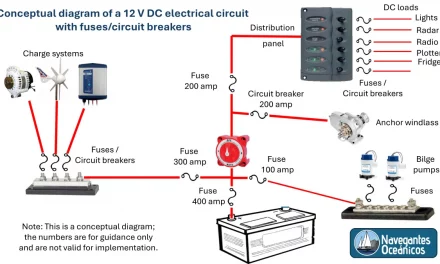
A short circuit or overheating of a cable (to the point of melting) are the most frequent causes of fires on board; and to protect ourselves, there are two key elements: cables and fuses (or circuit breakers).
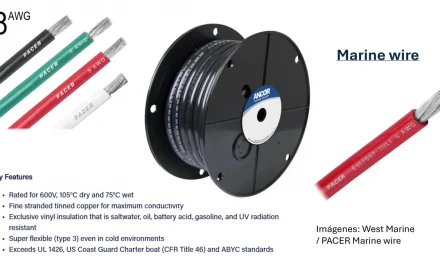
The marine environment, with its high humidity and salinity, is especially corrosive to the cables in our electrical circuit. Therefore, all cables must be of high quality, properly sized, and meet a series of specifications in accordance with current regulations. On a sailboat, it is not worth skimping on the wiring of our circuit.
There are two main reference standards regarding onboard wiring: in the USA, the ABYC (American Boat and Yacht Council) standards are used, and in Europe, the ISO 13297 standard (International Organization for Standardization) is used.
The skipper/owner of a sailboat must be familiar with the boat’s electrical system. To this end, the wiring must be accessible, well-organized, and labeled so that each section of the circuit can be identified and any component (e.g., a fuse) replaced if necessary.
In this chapter of the online book “ONBOARD ELECTRICITY,” we will cover the following aspects of a sailboat’s electrical wiring:
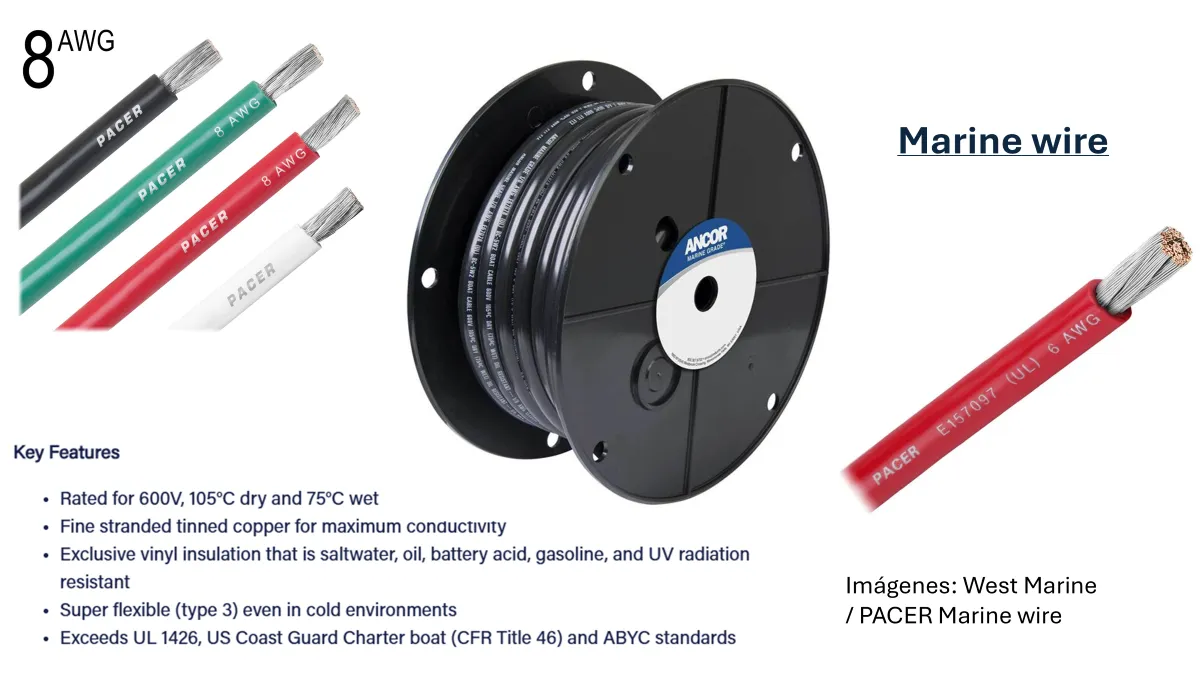
– Specific characteristics of the wires in a boat’s electrical system.
– Factors that affect the sizing of an electrical circuit wire.
– Using tables (and the calculator on the Boathowto website) to determine the required wire thickness.
Este contenido solo está disponible para subscriptores de navegantesoceanicos.com
Efecúe Log In para desbloquear.
Este contenido solo está disponible para subscriptores de navegantesoceanicos.com
Efecúe Log In para desbloquear.