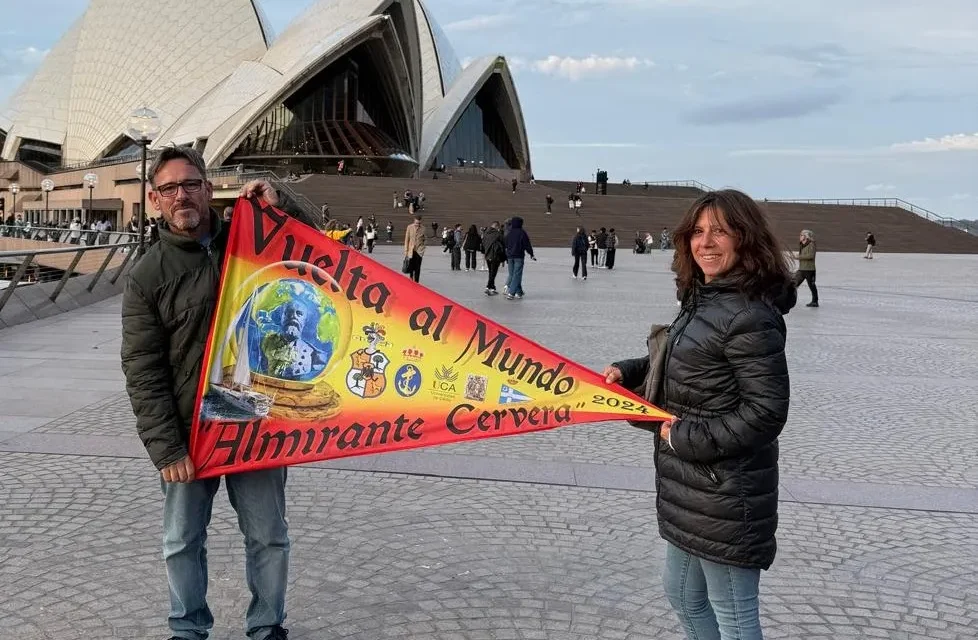
Esther Tejedor and Aurelio Muñoz are two expert sailors from Puerto Real (Cádiz) who are currently sailing around the world in stages aboard their sailboat, “Tuvalu.” Aurelio is also a doctor, a naval engineer, and a professor at the University of Cádiz.
The project has required meticulous planning and thorough preparation of their vessel—a production-model 45-foot Beneteau Oceanis—to ensure it is equipped for long-distance ocean crossings and a wide range of weather conditions.
Esther and Aurelio set sail from the Bay of Cádiz in August 2024 as part of an initiative dubbed the “Almirante Cervera Circumnavigation.” With their recent arrival in Australia, they have now completed nearly half of their journey around the globe—and the adventure continues!
We are grateful to Esther and Aurelio for sharing their experiences of sailing and life aboard, as well as the challenges that lie ahead, with us in this interview.
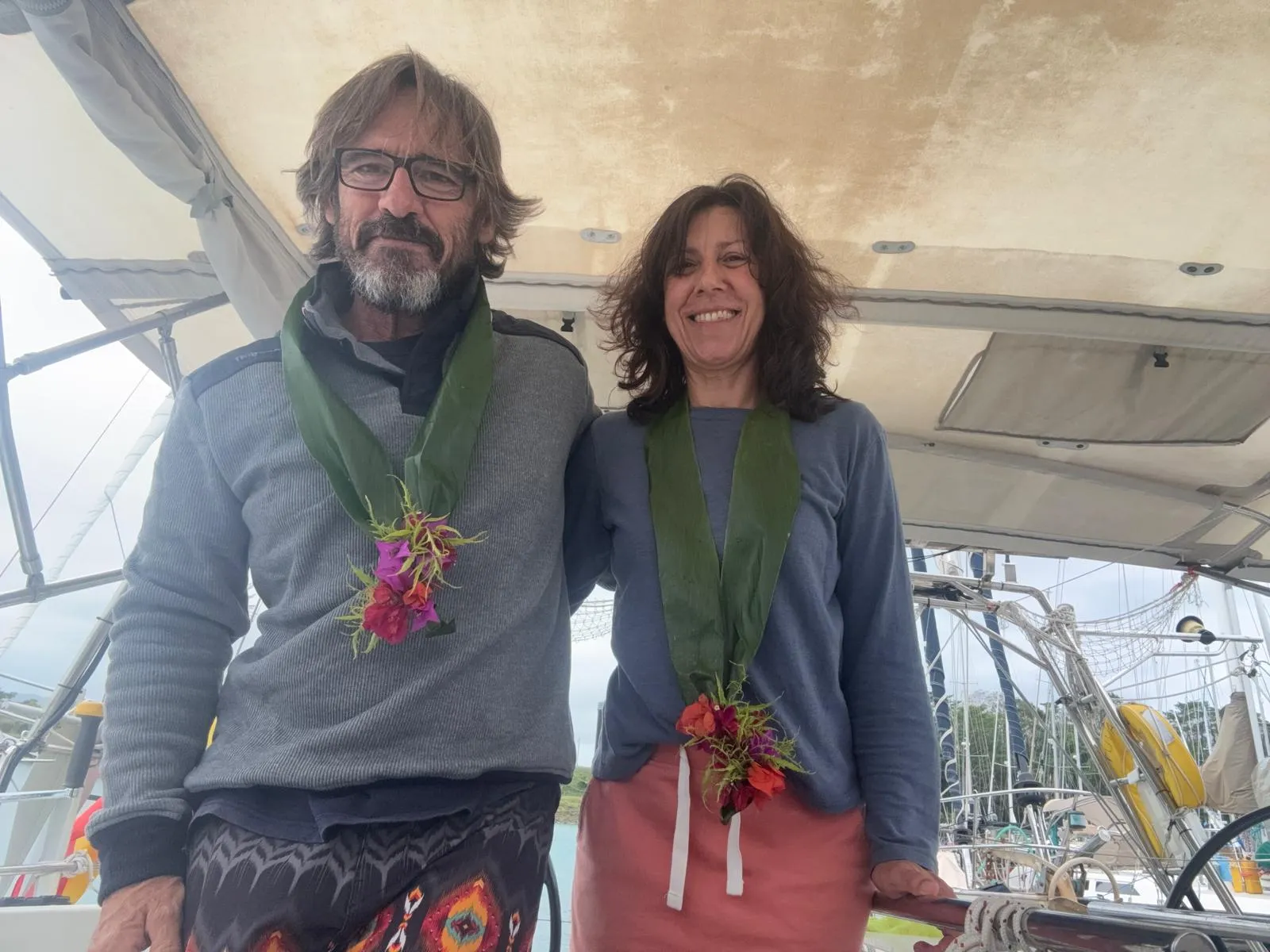
Interview with Esther & Aurelio (Part I)
Esther and Aurelio, how did your relationship with the sea begin, and when did you first go sailing?
Aurelio: Our history with the sea has two distinct origins that eventually converged into a shared passion. In my case, falling in love with sailing happened very early on and felt like a true calling; there was no maritime tradition in my family, nor anyone with ties to the sea. When I was about 11, while spending the summer in Puerto Real, I happened upon the El Trocadero Sailing School (part of the Puerto Real Yacht Club) and went in to ask how I could sign up. My parents knew nothing about it until I asked them for the money to pay the first monthly fee. That was 48 years ago, and I haven’t stepped off a boat since.
That childhood enthusiasm ended up shaping my professional life: I studied Naval Engineering at the Polytechnic University of Madrid and have dedicated my career to designing, building, and sailing boats. Today, I remain deeply involved in the maritime and nautical industry, and I also teach Naval Architecture at the University of Cádiz. I have been incredibly fortunate to be able to turn my greatest hobby into my profession and my way of life.
Esther: My connection to the sea came through my family, when my parents bought a small Coronado 25 for sailing. Later on, I met Aurelio, and as it turned out, he also had his own sailboat—a Puma 26. At first, my approach was more laid-back, but as our paths joined—and with an interest that grew beyond just the purely nautical—I truly became hooked on cruising.
Little by little, we raised the bar, moving from local outings to more demanding voyages through the Strait of Gibraltar, along the coast of Galicia, and to other destinations. And so, almost without realizing it—and after more than 25 years of sharing our lives and logging miles at the helm—we now find ourselves immersed in the greatest challenge of our lives: this circumnavigation of the globe aboard the *Tuvalu*.

What motivated you to embark on the adventure of ocean sailing?
What is the most difficult part of taking such a significant step?
Aurelio and Esther: Like most cruising sailors, for many years our sailing was essentially coastal. However, when you have accumulated over two decades of experience traversing the same areas and the same familiar routes, there comes a point where you feel the need to go a step further; otherwise, it risks becoming monotonous.
In the mind of almost every sailor, there is always that grand dream of crossing the Atlantic—though for a long time, we viewed it as something unattainable, reserved only for a select few. That was where our true motivation was born: from a visceral desire to reach this major milestone in cruising sailing. One day, over coffee—almost as a joke—we posed the question: “Why don’t we give it a try?” That was when the idea truly began to take shape.
As for the most difficult part, it is undoubtedly overcoming the initial sense of vertigo and figuring out where to begin. At first, the feeling is overwhelming; it is exactly like standing at the foot of Mount Everest without even having your boots on to start the climb. The most complex challenge isn’t the crossing itself, but rather having the discipline and vision to devise a concrete action plan that transitions you from coastal to oceanic sailing.
It is important to understand that taking this leap is not a decision made overnight; it requires a step-by-step approach and a tremendous amount of time dedicated to preparation. In our case, it was a process that involved nearly nine years of consistent effort before we felt ready to cast off with confidence.
A period dedicated to:
1) Proper training and certification: Expanding theoretical knowledge in areas such as safety, meteorology, and survival. I obtained the qualification of Merchant Marine Captain for vessels up to 3,000 GT.
2) Technical preparation of the vessel: Adapting and outfitting the sailboat to withstand long ocean crossings in complete autonomy.
3) Progressive experience: Sailing further and further from the coast and in increasingly demanding conditions to toughen ourselves up, both mentally and physically.
Ultimately, the initial motivation was simple: to fulfill the dream of crossing the Atlantic under sail and returning home. What we didn’t realize was that once you get a taste of that dream—during the preparation phase and as you venture out into the ocean—it gets into your blood like a true addiction. Crossing the Atlantic ceased to be the final goal and instead became the springboard that propelled us to take on even greater challenges, eventually leading us to embark on what is now our grand voyage around the world.

What is your sailboat like?
Have you had to improve any aspect of it to prepare it for ocean sailing?
Aurelio and Esther: Our *Tuvalu* is a 2018 Beneteau Oceanis 45. It is a vessel measuring 13.94 meters in length with a beam of 4.49 meters. Designed by Finot-Conq, it features a highly stable hull with a distinct chine, offering an excellent balance between speed and comfort. Notable features include a companionway with a gentle 45-degree incline, a signature mainsail arch over the cockpit, and a spacious interior filled with natural light.
Our specific model is configured with two cabins and a massive storage locker on the port side aft—a fantastic feature for long-distance cruising. We purchased the boat brand new at the Barcelona Boat Show; it arrived from the shipyard as a standard model—designed as an excellent coastal cruiser for the Mediterranean, but lacking the equipment and range required to meet the demands of extended ocean voyaging.
To prepare it for a circumnavigation, we had to undertake a significant technical and structural transformation:
First, we replaced all the running rigging with Dyneema.
1) Stern arch and transom reinforcement.
At the heart of the ocean-going equipment was the design of a custom-made stern arch. Given that the stern of the Oceanis 45 features a large drop-down platform, installing a fixed structure required maximum robustness. We conducted a naval architecture and engineering study to structurally reinforce the transom, ensuring an optimal distribution of loads.
This arch became the vessel’s “control tower”: it supports the wind generator, the Inmarsat antenna, and communication systems, while also serving as a heavy-duty davit for the convenient launching and retrieval of the tender (a 3-meter inflatable boat with a 9.9 hp outboard motor).
2) Energy management and transition to rigid panels.
Electrical autonomy is crucial when at sea. We have duplicated essential systems—such as the service battery chargers—to ensure redundancy in the event of a failure.
Regarding solar energy, our experience has been a continuous learning process:
– Flexible solar panels (initial Atlantic phase): These have the advantage of being very lightweight, integrating aesthetically onto the bimini or deck, and conforming to curved surfaces. However, during long passages, they suffer significantly from heat-related degradation (as they lack airflow underneath, their performance drops), and constant micro-movements eventually cause the silicon cells to crack.
– Rigid solar panels (final setup): For our circumnavigation, we decided to switch to a 740 W rigid solar installation mounted on the stern arch structure. These rigid panels—featuring aluminum frames and tempered glass—offer far superior thermal performance due to the ventilation beneath them. They provide greater efficiency per square meter and unmatched durability in a marine environment, serving as our primary source of clean energy on board today.
Batteries: Everything was powered by a 700 Ah AGM battery bank.
3) Redundant satellite communications.
Being isolated in the middle of the ocean no longer means being cut off from communication; however, for safety reasons, one should not rely on a single system. We carry these three:
– Starlink: This has been an absolute game-changer. It provides high-speed broadband, allowing us to download high-resolution weather reports, video-call our families, and work much as we would on land. Its only drawback is a higher power consumption.
– Inmarsat: This is the quintessential traditional maritime communications network. Its major advantage is exceptional reliability and continuous global coverage, with moderate power consumption—though data speeds are limited.
– Garmin inReach: A portable device that uses the Iridium network; it is extremely compact and consumes very little power. Its greatest advantage is that it runs on its own battery—independent of the boat’s electrical system—and functions as a real-time satellite tracking system, as well as an SOS beacon for serious emergencies.
4) Flag Requirements and Mandatory Safety Equipment
The *Tuvalu* sails under the Spanish flag, which means it is certified for “Zone 1” navigation (oceanic/unlimited distance from the coast).
Spanish Merchant Navy regulations are among the most stringent in the world regarding safety and lifesaving equipment. To comply with these standards and ensure the highest level of safety, the vessel is equipped with:
– An oceanic liferaft with a “Survival Pack A,” fully inspected and certified.
– A 406 MHz EPIRB (Emergency Position-Indicating Radio Beacon) with both automatic and manual activation.
– 275N self-inflating life jackets, each featuring an integrated harness, individual lights, and a personal AIS beacon (PLB) for every crew member.
– A complete set of oceanic pyrotechnic distress signals and an official Category 1 medical kit.
– Redundant bilge pumping systems (high-capacity automatic electric pumps and manual pumps), along with a thorough inspection of all seacocks and hull fittings.
– A radar transponder.
– Amateur radio (ham radio) and shortwave safety communication systems.
5) Amateur Radio Communications and Shortwave Safety.
In addition to the mandatory HF/SSB (Single Sideband, Class A) installation required under the Spanish flag for navigation in Zone 1, I also incorporate my hobby as a licensed amateur radio operator (call sign EA7FPG). On board, we carry two additional amateur radio transceivers configured for HF operation as a maritime mobile station.
This offers a twofold benefit: on one hand, it allows us to connect with the global amateur radio network, participate in maritime nets, and share our position; on the other, it provides a critical extra layer of safety. At sea, technological independence can be a lifesaver—should satellite-based digital systems go dark, suffer a major electrical failure, or lose coverage, analog radio frequency remains available to call for assistance or receive weather updates thousands of miles from the coast, without any reliance on external infrastructure.
6) Emergency Energy Redundancy: Portable Generator.
Although our 740 W solar panel array and wind generator more than cover our daily consumption, you cannot rely on just one energy source when out on the ocean. What happens if we go several days without sun or wind, and the main engine’s alternator also breaks down?
To avoid being left in such a vulnerable position, we carry a portable gasoline-powered electric generator. It is a compact, soundproofed unit that serves as a “last line of defense.” It allows us to power the service battery charger directly, ensuring that our navigation equipment, autopilot, and communication systems remain operational at all times—no matter what happens.
7) Sail Optimization: From Standard (Series) to Dyneema Triradial.
The sails supplied as standard by boat manufacturers are typically designed for casual coastal cruising: they feature a traditional cross-cut design and are made of conventional Dacron—lightweight, yet prone to rapid deformation when subjected to the force of trade winds or prolonged storms.
For our circumnavigation, we replaced the original rig with a set of tri-radial cut sails reinforced with Dyneema fibers.
– Why tri-radial? Unlike the classic horizontal cut, tri-radial panels distribute loads from the sail’s three corners—the head, tack, and clew—along the lines of tension within the fabric. This allows the sail to maintain its shape and optimal “draft” (curvature) over thousands of miles, preventing it from becoming overly baggy or distorting the vessel’s aerodynamic profile.
– Incorporation of Dyneema: The fabrics we selected feature Dyneema fibers interwoven across multiple layers. This material offers extraordinary tensile strength while remaining lightweight; it is exceptionally resistant to fatigue caused by flapping (luffing) and withstands the constant degradation inflicted by ultraviolet radiation from the tropical sun. These sails are engineered not only to withstand intense gusts without tearing but also to endure many years of ocean voyaging.
Thanks to this meticulous preparation, we transformed an excellent production boat into a truly autonomous, robust, ocean-going vessel—fully equipped to cross any ocean on the planet.
Before setting off on your circumnavigation, you had already made a round trip across the Atlantic to the Caribbean—how did that go? Any interesting stories?
Aurelio and Esther: Our baptism by fire on the ocean was the 2019 Atlantic Rally for Cruisers (ARC). For those unfamiliar with it, the ARC is one of the world’s most popular sailing events: a fleet crossing that brings together over two hundred sailboats to traverse the Atlantic from Las Palmas de Gran Canaria to the island of Saint Lucia in the Caribbean. For us, it served as the ultimate proving ground for our entire project.
The voyage could not have begun more dramatically. We had covered barely 30 miles after departing Las Palmas when, while executing an emergency maneuver to avoid a floating object in the middle of the sea, our boom snapped. It was a real blow to our maiden ocean crossing. We had to turn back to the Canary Islands, arrange for an urgent replacement of the boom, and set sail again—four days behind the rest of the fleet. Despite this significant initial setback, we managed to make up ground day by day, eventually finishing 13th out of the 21 boats competing in our category.
During the first few days, we remained on high alert. As this was our first ocean crossing, we felt an unavoidable sense of vulnerability; we were acutely aware that with every mile we gained to the west, we were venturing into absolute isolation, where any outside assistance would depend entirely on the goodwill of another ARC participant or a passing merchant vessel. Fortunately, the rally organizers maintained constant monitoring via satellite phone (at that time, Starlink did not yet exist in the maritime sector).
As the days passed, we realized that crossing the Atlantic at that time of year is a fairly predictable endeavor in terms of steady winds—interrupted only by the squalls that begin to occur in succession once you pass the halfway point of the journey. And that was where we experienced one of the most critical moments of the trip.
Blind, in underwear, at 40 knots
One night, while I was asleep and off-watch, I was jolted awake by shouts coming from the cockpit. Instantly, the boat began to heel violently, leaning over until it was practically lying flat on the water. We had been struck head-on by a squall with winds exceeding 40 knots, all while carrying nearly our full sail area.
I rushed out immediately, wearing only my underwear. Having had no time to even grab my glasses—and with a torrential, sideways-driving rain lashing down—I couldn’t see a thing; I couldn’t even read the instruments to check the wind direction or speed. I had to rely entirely on the crew member on watch, who shouted the data from the display to me while I steered blindly at the helm. We managed to maneuver the boat into the gust, bringing it back upright so that the wind pushed us along without damaging the rig. It was an extreme situation—we came perilously close to capsizing—but we emerged from it stronger, having learned a lesson that will stay with us forever.
A “photo finish” at the Santa Lucía finish line
I have a rule when sailing that I follow strictly: I never enter a port at night. I prefer to shorten sail, heave-to, or simply mark time at sea so that I can enter the harbor at first light. That is exactly what I did as we approached the island of Saint Lucia.
After a highly tactical crossing—during which we took a gamble by choosing a route much further north than the rest of the fleet, who had headed down toward the latitude of Cape Verde—we managed to gain a significant advantage, thanks to more consistent northerly winds. We arrived in the vicinity of Rodney Bay in the middle of the night, so I decided to slow the *Tuvalu* down and wait for dawn, drifting calmly.
Suddenly, a few hours into our wait, the AIS alarm went off: a sailboat we had previously overtaken was bearing down on us at full speed, aiming to beat us to the finish line! I shouted to wake the entire crew: “Everyone up—get the sails set, fast! They’re about to snatch our spot at the finish line!” We hauled in the sheets and pulled off a “photo finish” sprint, crossing the Saint Lucia finish line just ahead of our rival. It was the perfect conclusion to an unforgettable voyage. Later, at various celebrations in Rodney Bay, we would look back on that finish and share a good laugh with the crew of the other boat.

How did the “Almirante Cervera Around the World” project come about?
The origin of this project lies in a story of contrast: the tension between extreme exhaustion and that “call of the ocean” that every sailor knows so well.
In June 2020, we returned to Spain from the Caribbean, passing through the Azores. We were fortunate enough to spend the most difficult period of the COVID-19 pandemic in the archipelago of Saint Vincent and the Grenadines, where we stayed from December 2019 to May 2020. The impact of the pandemic there was virtually non-existent, which allowed us to move freely among the islands. By May 2020, however, the time had come to begin the voyage back to Spain.
Those who sail know the rigors of the return route via the North: to get back to Europe from the Caribbean, you cannot simply sail in a straight line against the easterly trade winds. The route requires heading north—gaining latitude toward Bermuda or the mid-latitudes (30°–40° N)—to escape the trade wind belt and catch the prevailing westerlies and the frontal systems that push you toward the Azores and the Iberian Peninsula. It is a demanding, cold, and technically challenging journey, exposed to the full force of North Atlantic weather fronts.
We arrived in Spain so exhausted from the crossing that, upon setting foot on land, we declared with absolute certainty: “We will never undertake such long voyages again.” But dry land can be deceptive. After about three months, we began to miss the open sea, the infinite horizon, and the rhythm of ocean sailing. We realized that offshore sailing had become, irreversibly, a part of who we are.
Around that time, the *Sociedad Puertorealeña de Amigos del País* (Puerto Real Society of Friends of the Country)—a non-profit association to which I belong—was established. The “Societies of Friends of the Country” (*Sociedades de Amigos del País*) are institutions with a long-standing Enlightenment tradition in Spain, established with the aim of promoting culture, science, local development, and social progress. This society sought to dedicate itself fully to fostering, promoting, and publicizing our maritime expedition. It was, in fact, within this association that the idea to formally name the project first emerged.

Why the name “Almirante Cervera”?
The choice of this name stems from a profound historical reason, as well as a very special personal and emotional bond:
– The historical figure: Admiral Pascual Cervera y Topete was one of the most illustrious figures in the Spanish Navy. During the Spanish-American War of 1898—fully aware of the overwhelming technical and numerical inferiority of the Spanish squadron—he courageously and dutifully obeyed orders to engage in combat during the Naval Battle of Santiago de Cuba, an act of heroism and military dignity that gained international recognition.
– Respect from the U.S. Navy: Cervera was a man of legendary chivalry. When the Americans attempted to block the channel at Santiago de Cuba by sinking the collier USS *Merrimac*, Cervera personally rescued Lieutenant Richmond Hobson and his crew. He sent an envoy to the opposing admiral to report that they were alive, publicly praising their bravery and guaranteeing them dignified treatment. This gesture of true naval gallantry earned him the highest esteem from the United States Navy. Months later, when the Spanish sailors were taken prisoner following the destruction of the fleet, the American command reciprocated by treating them with the utmost honor and respect.
– The personal and local connection: I was born and currently reside in Puerto Real (Cádiz), right next to what is known as the “Casa del Almirante Cervera” (Admiral Cervera’s House). For as long as I can remember, my family and the family of Admiral Cervera—his descendants—have shared a deep and lasting friendship.
Therefore, naming this voyage after him serves as our own personal tribute and acknowledgment of a true Spanish seafarer—an exemplar of honor, leadership, and maritime courage.
Thus, the “Admiral Cervera Around the World” expedition was born, with great pride.
Links:
Follow the adventure: www.bluewaterteam.es
YouTube, Velero Tuvalu
, and Instagram, Velero Tuvalu
At “Navegantes Oceánicos,” we thank Esther and Aurelio for sharing with our readers their exciting adventure—from preparing their sailboat and engaging in offshore sailing to living aboard—as part of the “Almirante Cervera Circumnavigation”.
Best of luck and fair winds!
To be continued in Part II.